Stainless Coil Pipe vs. Seamless Pipe: When to Choose Welded Coiled Tubing for High-Pressure Fluid Systems
When high-pressure fluid systems demand both resilience and responsiveness—whether in a petrochemical plant in the Middle East, a district heating network across Northern Europe, or an offshore platform off the coast of Southeast Asia—the tubing choice isn’t just technical. It’s tactical. Project managers don’t just select materials; they weigh trade-offs: lead time versus longevity, flexibility versus fatigue resistance, cost per meter versus total installed cost. In that calculus, stainless coil pipe is no longer the “alternative” to seamless—it’s the deliberate, often superior, choice for specific high-stakes scenarios.
Seamless pipe carries undeniable prestige. Its monolithic structure—forged, pierced, and drawn without welds—makes it the default reference point in many specs. But prestige doesn’t always translate to project advantage. Seamless production is inherently batch-oriented: each heat is limited by billet size, extrusion capacity, and draw bench length. That means fixed lengths (typically 5.8–6 meters), longer lead times, more inventory handling, and tighter tolerances that can trigger rework if field conditions shift. For global projects with compressed timelines and evolving site logistics, those constraints add up—not just in days, but in coordination overhead and contingency planning.
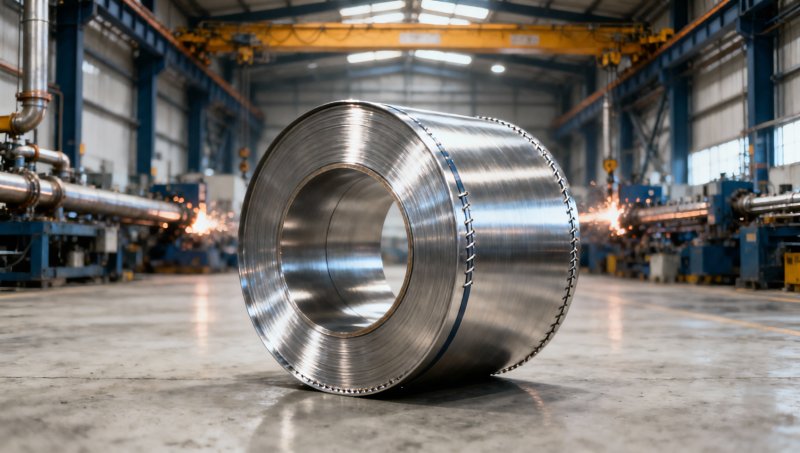
Welded coiled tubing, by contrast, operates on a different rhythm. Produced continuously—strip fed, formed, welded (often via high-frequency induction), and then coiled—it offers inherent scalability. A single coil can hold hundreds of meters of tubing, delivered in one compact package. No splices. No butt-welded joints in transit. Just consistent wall thickness, uniform surface finish, and traceable heat-to-coil mapping. That continuity matters—not only for pressure integrity but for installation efficiency. Think about threading long runs through congested mechanical rooms or routing along elevated pipe racks: fewer field welds mean less NDT, less labor, less weather dependency, and fewer potential leak points.
Of course, skepticism remains—and rightly so. The legacy concern centers on weld integrity under sustained high pressure and thermal cycling. But modern welding technology has closed that gap decisively. Precision-controlled HF welding, coupled with post-weld heat treatment (PWHT) and rigorous eddy current or ultrasonic testing, delivers weld zones with tensile strength matching or exceeding the base metal. When paired with stabilized grades like 321 Stainless Steel Pipe, the result is not just pressure-ready—but *temperature-resilient*. Titanium stabilization prevents chromium carbide precipitation during welding and service exposure, eliminating intergranular corrosion risk—a critical safeguard in cyclic heating applications like boiler feedwater lines or exhaust manifolds.
That’s where material selection becomes inseparable from process selection. Not all stainless coil pipe is equal. Grade, surface condition, dimensional control, and certification traceability define performance boundaries. For example, a 321 coil pipe with cold-drawn finish and ±0.05 mm wall tolerance behaves very differently—under vibration, thermal expansion, or pulsating flow—than a hot-rolled variant with looser tolerances. Surface finish also plays a role beyond aesthetics: a hairline brushed or sanded surface reduces turbulence-induced erosion in abrasive slurries, while a mirror finish improves cleanability in pharmaceutical or food-grade loops.
 What does this mean on the ground? Consider three real-world decision inflection points:
First—**scale and continuity**. If your project involves >5 km of tubing across multiple parallel systems (e.g., HVAC distribution in a mixed-use tower or cooling loops in a data center campus), coiled delivery eliminates dozens of field welds, reduces scaffolding time, and cuts QA documentation load. Seamless would require managing hundreds of individual sticks, joint tracking, and alignment verification at every connection.
Second—**thermal cycling environments**. In steam tracing lines, heat recovery circuits, or turbine bypass systems, repeated expansion/contraction stresses weld zones. Here, the titanium-stabilized microstructure of 321 stainless—combined with the uniform metallurgical consistency of coiled production—offers demonstrably better fatigue life than non-stabilized 304 or even some seamless 316 variants subjected to uncontrolled thermal histories.
Third—**supply chain agility**. Global infrastructure projects rarely wait. With seamless pipe, delays cascade: mill allocation → forging queue → drawing schedule → inspection backlog. Coiled stainless, especially from manufacturers with integrated strip rolling and tube welding lines, can move from order to dispatch in weeks—not months. And because coils are lighter and denser to ship than cut-length bundles, freight costs drop, carbon footprint shrinks, and port clearance accelerates.
None of this implies seamless pipe is obsolete. It remains essential where extreme burst pressure (>10,000 psi), ultra-high purity (e.g., semiconductor gas lines), or severe mechanical bending (tight-radius bends without ovality) are non-negotiable. But those are exceptions—not the norm—for most industrial fluid systems operating between 1,500–6,000 psi and −40°C to +650°C.
At Hongteng Fengda, we see this shift daily—not as a trend, but as an engineering evolution. Our stainless coil pipe production isn’t retrofitted; it’s purpose-built. We start with certified cold-rolled 321 strip—chemically controlled for optimal Ti/C ratio—then form and weld under real-time laser micrometry and dual-frequency eddy current monitoring. Every coil carries full EN 10216-5 and ASTM A269 compliance documentation, with optional third-party witness testing for critical projects. And because we serve clients from Houston to Hamburg to Hyderabad, our logistics planning accounts for customs readiness, container loading optimization, and regional certification bridging—so your procurement team spends less time chasing certs and more time sequencing work.
There’s also a quiet human factor here: confidence. When a project manager signs off on a tubing spec, they’re not just approving a line item—they’re signing off on years of operational safety, maintenance predictability, and reputational accountability. Choosing stainless coil pipe—especially a rigorously stabilized, fully tested grade like 321—means choosing a solution engineered for repetition, not just first-time fit.
So how do you decide? Ask three questions—not of the supplier, but of the system itself:
• Does the design require *continuous* runs over 100 meters?
• Will temperature fluctuations exceed 200°C cycles, repeatedly?
• Is your critical path constrained more by fabrication than by ultimate material strength?
If two out of three point toward coiled, it’s worth re-evaluating assumptions—not discarding seamless, but repositioning it where it truly adds value.
In the end, material selection isn’t about picking the “best” pipe. It’s about selecting the *right* pipe—one that aligns with physics, project rhythm, and people. Welded stainless coil pipe, when specified with precision and sourced with discipline, doesn’t compromise. It converges. Strength, speed, and stability—coiled into one continuous solution.
What does this mean on the ground? Consider three real-world decision inflection points:
First—**scale and continuity**. If your project involves >5 km of tubing across multiple parallel systems (e.g., HVAC distribution in a mixed-use tower or cooling loops in a data center campus), coiled delivery eliminates dozens of field welds, reduces scaffolding time, and cuts QA documentation load. Seamless would require managing hundreds of individual sticks, joint tracking, and alignment verification at every connection.
Second—**thermal cycling environments**. In steam tracing lines, heat recovery circuits, or turbine bypass systems, repeated expansion/contraction stresses weld zones. Here, the titanium-stabilized microstructure of 321 stainless—combined with the uniform metallurgical consistency of coiled production—offers demonstrably better fatigue life than non-stabilized 304 or even some seamless 316 variants subjected to uncontrolled thermal histories.
Third—**supply chain agility**. Global infrastructure projects rarely wait. With seamless pipe, delays cascade: mill allocation → forging queue → drawing schedule → inspection backlog. Coiled stainless, especially from manufacturers with integrated strip rolling and tube welding lines, can move from order to dispatch in weeks—not months. And because coils are lighter and denser to ship than cut-length bundles, freight costs drop, carbon footprint shrinks, and port clearance accelerates.
None of this implies seamless pipe is obsolete. It remains essential where extreme burst pressure (>10,000 psi), ultra-high purity (e.g., semiconductor gas lines), or severe mechanical bending (tight-radius bends without ovality) are non-negotiable. But those are exceptions—not the norm—for most industrial fluid systems operating between 1,500–6,000 psi and −40°C to +650°C.
At Hongteng Fengda, we see this shift daily—not as a trend, but as an engineering evolution. Our stainless coil pipe production isn’t retrofitted; it’s purpose-built. We start with certified cold-rolled 321 strip—chemically controlled for optimal Ti/C ratio—then form and weld under real-time laser micrometry and dual-frequency eddy current monitoring. Every coil carries full EN 10216-5 and ASTM A269 compliance documentation, with optional third-party witness testing for critical projects. And because we serve clients from Houston to Hamburg to Hyderabad, our logistics planning accounts for customs readiness, container loading optimization, and regional certification bridging—so your procurement team spends less time chasing certs and more time sequencing work.
There’s also a quiet human factor here: confidence. When a project manager signs off on a tubing spec, they’re not just approving a line item—they’re signing off on years of operational safety, maintenance predictability, and reputational accountability. Choosing stainless coil pipe—especially a rigorously stabilized, fully tested grade like 321—means choosing a solution engineered for repetition, not just first-time fit.
So how do you decide? Ask three questions—not of the supplier, but of the system itself:
• Does the design require *continuous* runs over 100 meters?
• Will temperature fluctuations exceed 200°C cycles, repeatedly?
• Is your critical path constrained more by fabrication than by ultimate material strength?
If two out of three point toward coiled, it’s worth re-evaluating assumptions—not discarding seamless, but repositioning it where it truly adds value.
In the end, material selection isn’t about picking the “best” pipe. It’s about selecting the *right* pipe—one that aligns with physics, project rhythm, and people. Welded stainless coil pipe, when specified with precision and sourced with discipline, doesn’t compromise. It converges. Strength, speed, and stability—coiled into one continuous solution.
Previous page: Already the first one
Next page: Already the last one
Please give us a message


Please enter what you want to find