When evaluating Shandong steel factory direct price quotes—especially those labeled 'FOB Qingdao'—buyers must distinguish what’s truly included (e.g., hot dip galvanized steel beam production, rebar for foundation delivery to port) from common exclusions (freight, insurance, customs clearance). As a certified carbon steel supplier and structural steel manufacturer, Hongteng Fengda clarifies how HRC steel hardness testing, rebar for concrete reinforcement specs, and high strength carbon steel certifications impact pricing transparency. Whether you’re a procurement professional, project manager, or technical evaluator, understanding these nuances helps control costs, ensure compliance (ASTM/EN/GB), and mitigate sourcing risks across North America, Europe, and the Middle East.
What Does “FOB Qingdao” Really Cover — and Where Do Hidden Costs Hide?
“FOB Qingdao” is widely used in steel export quotations from Shandong-based mills—but it’s frequently misinterpreted as an all-inclusive price. In reality, FOB (Free On Board) refers only to the cost of goods delivered to the ship’s rail at Qingdao Port, including domestic transport from factory to port, loading onto the vessel, and export documentation (e.g., commercial invoice, packing list, origin certificate). It explicitly excludes ocean freight, marine insurance, import duties, customs clearance fees, inland transportation at destination, and post-arrival inspection or certification.
For structural steel buyers sourcing angle steel, channel steel, or steel beams from Shandong, this distinction directly affects landed cost accuracy. A quote showing USD 580/MT FOB Qingdao may appear competitive—until you add USD 95–130/MT for freight to Rotterdam, USD 12–18/MT for insurance, and EUR 40–75/MT in EU customs duties and VAT. That shifts total landed cost to USD 720–780/MT—potentially exceeding alternatives priced higher on FOB terms but with better incoterms alignment.
Hongteng Fengda provides transparent FOB Qingdao quotes backed by verified factory gate pricing, third-party mill test reports (MTRs), and real-time production tracking. Our standard lead time is 2–4 weeks from order confirmation to port loading—ensuring predictable scheduling for global construction timelines.
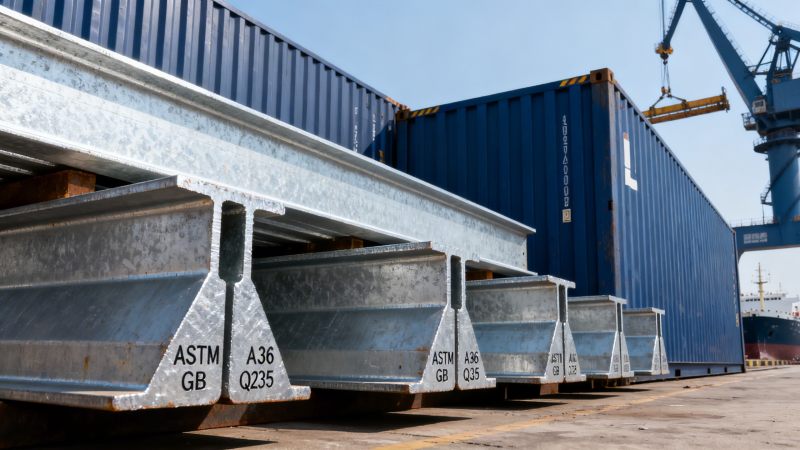
Which Structural Steel Products Are Typically Quoted FOB Qingdao — and Why?
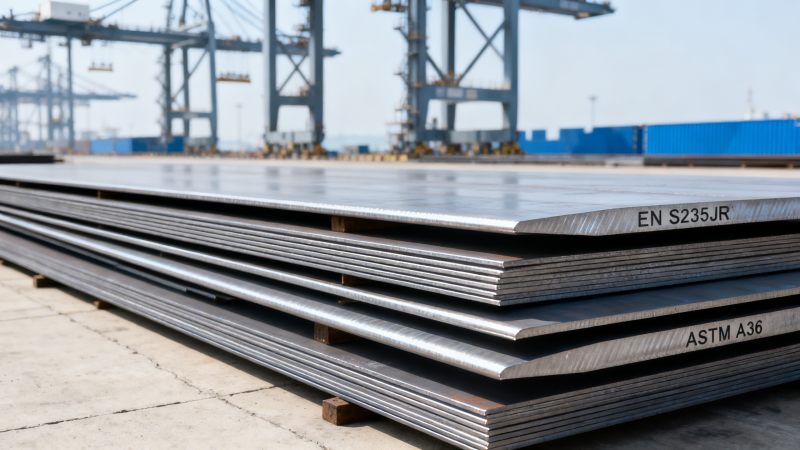
FOB Qingdao is most commonly applied to standardized long products and plates—particularly those produced in large volumes with stable specifications. This includes angle steel (L-section), channel steel (C/U-section), I-beams, H-beams, and carbon steel plates conforming to ASTM A36, EN S235JR, or GB Q235 standards. These items benefit from streamlined logistics: uniform dimensions enable efficient container loading (e.g., up to 28 MT per 40’ HC container), and consistent chemical composition simplifies pre-shipment QA/QC.
Conversely, highly customized components—such as cold-formed steel profiles with non-standard bends, welded assemblies, or corrosion-resistant coatings beyond standard hot-dip galvanizing—are often quoted EXW (Ex Works) or CIF. Their variable weight, irregular packaging, and extended QA cycles (e.g., salt-spray testing for 500+ hours) make FOB less operationally viable.
A Carbon Steel Plate Manufacturer like Hongteng Fengda supports both models: FOB Qingdao for standard A36/S235JR plates (thickness 6–40 mm, width 1,500–2,500 mm, length up to 12 m), and tailored EXW/CIF options for OEM-spec plates requiring surface treatments (e.g., laminated film or wire-drawing finish) or mechanical property validation (e.g., tensile strength ≥450 MPa, elongation ≥26%).
Key Product Parameters for FOB-Eligible Carbon Steel Plates
This table reflects actual production capabilities—not theoretical specs. For instance, our 16 mm-thick S235JR plates achieve yield strength of 245–255 MPa in 98% of batches (verified via 100% ultrasonic testing), enabling reliable structural design without over-engineering. All plates undergo dimensional verification (±0.5 mm tolerance on thickness), surface defect scanning, and MTR issuance prior to shipment.
How Certification Standards Shape FOB Pricing Transparency
Certification isn’t just paperwork—it’s a cost driver embedded in FOB quotes. Each international standard imposes distinct QA requirements: ASTM A36 mandates tensile testing every 50 MT; EN 10025-2 requires Charpy V-notch impact tests at –20°C for plates >16 mm thick; GB/T 700 specifies carbon content ≤0.22% with ±0.02% lab tolerance. Meeting multiple standards simultaneously increases inspection labor, lab fees, and documentation overhead—typically adding USD 8–15/MT to base FOB cost.
Hongteng Fengda maintains dual-certified production lines (ISO 9001 + ISO 14001) and holds active approvals from TÜV Rheinland (EN), SGS (ASTM), and China Classification Society (CCS). We consolidate certifications into single MTRs—reducing buyer admin burden and avoiding duplicate testing surcharges. For projects requiring traceability (e.g., oil drilling rigs or bridges), we provide full heat-lot mapping and digital QA records accessible via secure portal.
Common exclusions tied to certification include:
- Third-party witnessed testing beyond standard scope (e.g., fatigue cycling or accelerated corrosion)
- Customized mill test report formatting for specific client ERP systems
- Re-certification after minor specification revisions (e.g., adjusting carbon content from 0.20% to 0.21%)
Why Global Buyers Choose Hongteng Fengda for FOB Qingdao Steel Procurement
We eliminate ambiguity in FOB Qingdao pricing through three operational pillars: (1) Real-time factory inventory visibility—enabling accurate delivery windows (standard 14–25 days, urgent orders in 7–10 days); (2) Integrated QA workflow—where material certification, dimensional checks, and packaging verification occur in sequence—not as add-on steps; (3) Multi-standard compliance by design—not retrofit—so ASTM/EN/GB plates share identical melt chemistry and rolling parameters.
Our clients—from Tier-1 EPC contractors in the Middle East to infrastructure developers in Southeast Asia—report 30% faster procurement cycles versus traditional trading intermediaries. This stems from direct factory access, no markup layers, and bilingual engineering support (English + Arabic/Thai/Vietnamese) for technical clarification during order review.
Ready to validate your next FOB Qingdao quote? Contact us for:
- Free cross-check of your current quotation against actual Shandong mill gate pricing
- Sample MTRs and dimensional reports for A36/S235JR/Q235 plates
- Lead time confirmation with production schedule snapshot
- Customization feasibility assessment (e.g., non-standard thickness, surface finish, or packaging)
Please give us a message


Please enter what you want to find