When evaluating stainless steel piping for corrosive, high-pressure, or high-temperature environments, the choice between seamless stainless steel pipe and welded options can directly affect safety, service life, and project cost. For technical buyers, understanding performance differences, standards compliance, and application fit is essential to making a reliable sourcing decision in harsh-use conditions.
What is the core decision in harsh-service stainless piping selection?
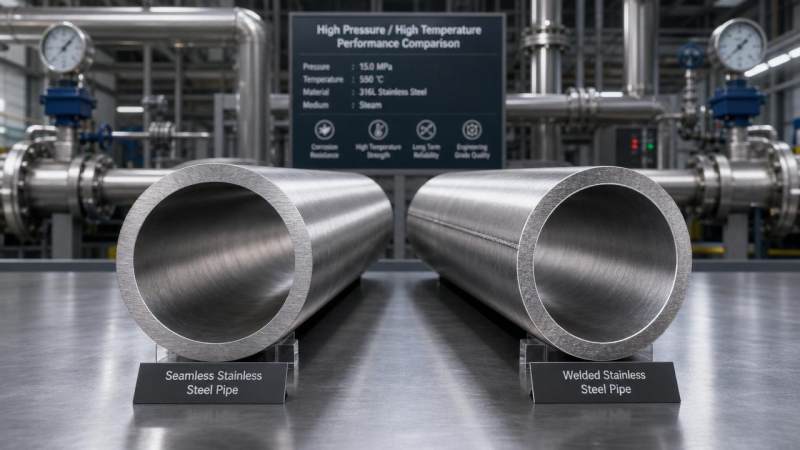
For technical evaluation teams, the real question is not whether seamless is always better. It is whether the service conditions justify the higher cost and lead time.
In harsh use, seamless stainless steel pipe is often preferred for very high pressure, cyclic loading, severe temperature fluctuation, or critical safety service where weld integrity becomes a major risk factor.
Welded stainless steel pipe, however, can perform reliably in many corrosive and industrial applications when material grade, weld quality, heat treatment, testing, and standards compliance are properly controlled.
The best sourcing decision depends on design pressure, corrosion mechanism, operating temperature, code requirements, inspection level, and the consequence of failure in actual plant conditions.
Why do technical buyers often choose seamless stainless steel pipe for severe environments?
The main advantage of seamless stainless steel pipe is structural continuity. Because there is no longitudinal weld seam, buyers reduce one potential location for weakness, corrosion attack, or inspection concern.
In systems exposed to high internal pressure, rapid pressure cycling, hydrogen service, chloride contamination, or elevated temperatures, seamless pipe often provides a higher confidence level during technical review.
Another reason is quality predictability in critical applications. Even though modern welded pipe can be excellent, seamless products are often viewed as lower risk where failure cost is unacceptable.
This is especially true in oil and gas process units, chemical plants, heat exchangers, offshore systems, boiler lines, and instrumentation tubing in aggressive media or unstable operating conditions.
Where can welded stainless pipe still be the right engineering choice?
Technical assessors should avoid a simplified assumption that welded pipe is unsuitable for all harsh environments. That conclusion can increase procurement cost without improving actual system performance.
High-quality welded pipe made to recognized standards can be an effective option for lower to moderate pressure service, large diameters, and applications where weld inspection and corrosion control are well managed.
In many water treatment, food processing, architectural, pulp and paper, and general industrial systems, welded pipe can meet operating demands while offering cost and availability advantages.
If the weld is fully penetrated, properly treated, tested, and manufactured under strict process control, welded pipe may deliver acceptable reliability for many non-extreme services.
What performance differences matter most in harsh use?
For technical buyers, the most meaningful comparison points are pressure resistance, wall uniformity, corrosion behavior at the weld area, fatigue performance, and traceable compliance with relevant product standards.
Seamless pipe usually offers stronger buyer confidence in pressure-bearing service because there is no weld seam that may become a stress concentrator or a localized metallurgical variation zone.
Welded pipe can have very good dimensional consistency, especially in larger diameters, but weld area quality depends heavily on forming method, welding process, heat input, and post-weld finishing.
In chloride-bearing environments, poor weld treatment can increase susceptibility to pitting, crevice corrosion, or intergranular attack. This is why weld quality and post-processing details must be closely reviewed.
For cyclic service, repeated thermal expansion and pressure fluctuation can magnify small discontinuities. In such cases, seamless products are commonly favored because fatigue concerns are easier to manage conservatively.
How should standards and inspection requirements guide the decision?
Technical evaluation should begin with the governing code, specification, and end-use standard rather than supplier marketing language. Compliance documents are often more important than product labels alone.
Buyers should check whether the pipe conforms to ASTM, ASME, EN, JIS, or project-specific requirements, including dimensions, chemistry, mechanical properties, hydrostatic testing, non-destructive examination, and marking traceability.
For seamless stainless steel pipe, common references may include ASTM A312, A213, A269, or A789 depending on service type, tubing or pipe form, and pressure or temperature range.
For welded products, technical teams should review whether welds are radiographed, solution annealed, pickled, passivated, and tested according to the specific standard and purchase specification.
Mill test certificates should be checked carefully. Material grade alone does not prove suitability. Heat number traceability, actual test results, wall tolerance, and inspection records are all part of a sound approval process.
Which material and process questions should technical assessors ask suppliers?
To reduce sourcing risk, buyers should ask direct questions about raw material origin, production route, dimensional tolerances, heat treatment, surface finishing, and third-party inspection availability.
They should also request information on corrosion allowance assumptions, PMI support, hydrotest or eddy current testing, weld seam treatment for welded products, and packaging for export protection.
For harsh-service projects, it is useful to confirm whether the supplier has prior experience with chemical processing, marine, refinery, or high-temperature industrial applications similar to the current project.
Technical assessors should compare not only nominal specifications but also manufacturing stability. A supplier with strong quality discipline often creates more value than a low initial quotation.
How do corrosion type and service environment influence pipe choice?
Corrosion mode should be central to the decision. Uniform corrosion, pitting, crevice corrosion, stress corrosion cracking, erosion-corrosion, and high-temperature oxidation each affect product suitability differently.
In chloride-rich environments, stainless steel grade selection is often as important as the seamless-versus-welded decision. For example, 316L may outperform 304 in many marine or chemical conditions.
If weld areas are not properly treated, localized corrosion risk can rise. That is why welded pipe evaluation must include weld metallurgy, heat tint removal, passivation quality, and surface cleanliness.
For clean high-purity systems, internal surface condition and contamination control may also matter. In these cases, consistent finishing and documented production control can outweigh generic assumptions.
What is the real cost difference beyond purchase price?
Seamless stainless steel pipe usually carries a higher purchase price, especially in larger sizes or special grades. But technical buyers should evaluate lifecycle cost instead of material price alone.
If a pipe failure can stop production, create safety exposure, contaminate product, or trigger replacement in remote locations, the higher initial cost of seamless may be economically justified.
On the other hand, if the service is stable, design margins are moderate, and inspection access is good, welded pipe may offer a better overall value without compromising performance.
The correct calculation includes maintenance frequency, downtime risk, inspection burden, replacement complexity, installation method, and the financial consequence of unexpected leaks or rupture.
What sourcing signals indicate a reliable steel manufacturing partner?
Technical evaluation is not only about the product form. It also depends on whether the manufacturer can provide consistent production, international standard compliance, and dependable export execution.
A qualified structural steel manufacturer and exporter should demonstrate modern production capability, stable quality systems, clear documentation, and the ability to support customized specification requirements.
For global buyers, dependable lead times and communication discipline matter because harsh-service projects often have strict approval workflows and limited tolerance for documentation errors or delays.
Hongteng Fengda supports international buyers with structural steel products, OEM solutions, and production control aligned with ASTM, EN, JIS, and GB requirements for demanding project environments.
What supporting steel products may also matter in project procurement planning?
Technical buyers often manage broader packages beyond pipe alone, especially in industrial construction, plant support systems, fencing, containment, and fabrication-related procurement scopes.
In such cases, complementary materials can improve sourcing efficiency. One example is Metal Coil Wire, supplied in Q195 and Q235 low carbon steel grades.
It is available in wire diameters from 0.25 mm to 5.0 mm, with tensile strength of 350 to 550 MPa and zinc coating thickness from 8 to 25 g/m2.
Typical uses include construction, wire mesh, packaging, decoration, breeding, barrier isolation, fences, wire ropes, hangers, filter baskets, and tie ropes across industrial and daily-use applications.
For buyers balancing cost and practicality, this product offers low cost, good corrosion resistance, bright appearance, strong coating adhesion, and excellent ductility in coil or bobbin packaging formats.
When should seamless clearly be specified instead of welded?
Technical teams should strongly consider specifying seamless when failure consequences are severe and process conditions involve high pressure, high temperature, corrosive media, or repeated thermal and pressure cycling.
It is also the more conservative choice when project standards, owner specifications, or regulatory codes explicitly prefer or require seamless construction for particular lines or service categories.
Examples include critical steam lines, aggressive chemical transfer, offshore instrumentation, refinery high-pressure systems, and applications where weld seam integrity would be difficult to inspect in service.
In these situations, seamless stainless steel pipe helps reduce approval uncertainty and supports a stronger technical justification during design review, procurement qualification, and long-term maintenance planning.
When is welded pipe a rational and defensible specification?
If the operating environment is corrosive but not extreme, and if the product is manufactured and tested to the correct standard, welded pipe may be fully defensible from an engineering and commercial perspective.
This is particularly true where larger diameters are needed, budgets are constrained, or project schedules require faster market availability than seamless supply can offer.
The key is not to accept welded pipe by default, but to confirm weld quality, inspection scope, heat treatment condition, and documented compliance with the exact project requirement.
For many industrial buyers, a properly qualified welded solution can deliver a sound balance between technical suitability, lead time control, and total installed cost.
Conclusion: how should technical buyers make the final call?
For harsh-use service, seamless stainless steel pipe is often the safer and more conservative choice, especially where pressure, temperature, corrosion severity, or failure consequence is high.
But welded stainless pipe should not be dismissed automatically. In many applications, it can perform well if supported by strong manufacturing control, correct grade selection, and verified standards compliance.
The smartest decision comes from matching product form to real service conditions, code requirements, inspection expectations, and lifecycle risk rather than relying on assumptions or lowest-price sourcing.
For technical assessment teams, the goal is clear: choose the pipe option that provides the best combination of safety, durability, compliance, and procurement reliability for the actual harsh environment.
Please give us a message


Please enter what you want to find