Choosing between seamless steel pipe and welded alternatives in high-pressure lines is not a purely technical exercise. It is a project decision that affects safety margins, inspection complexity, procurement lead time, budget exposure, and long-term operating reliability. For project managers and engineering leaders, the most practical answer is this: seamless steel pipe is often preferred where pressure, temperature, cyclic stress, or regulatory scrutiny are high, while welded pipe can be the better commercial choice when service conditions are less severe and cost efficiency matters more.
The core search intent behind this topic is usually decision support. Buyers and project teams are not just asking what seamless and welded pipes are. They want to know which option reduces risk, meets code, controls total installed cost, and avoids delays or failures in demanding line service.
That means the real concerns are straightforward. Will the pipe safely withstand design pressure? How do standards treat each option? What are the trade-offs in cost, availability, inspection, and fabrication? And how should a project team choose without over-specifying or underestimating field risk?
This article focuses on those questions. Rather than repeating generic definitions, it explains where seamless steel pipe creates measurable value, where welded options remain practical, and how project leaders can make a procurement decision that is technically sound and commercially realistic.
What project managers need to know first about seamless vs welded pipe
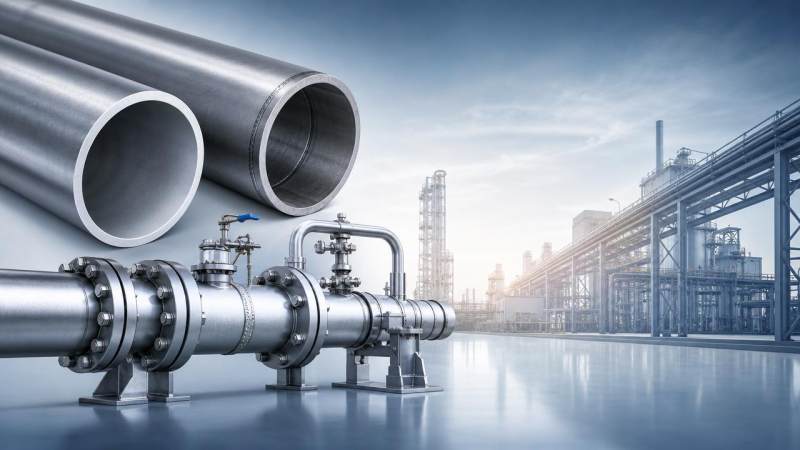
At a high level, seamless pipe is made without a longitudinal weld seam, while welded pipe is formed from steel plate or coil and then joined through a welding process. That single structural difference drives most of the comparison in high-pressure applications.
In severe service, many engineers favor seamless steel pipe because the absence of a weld seam removes one potential weak point. This can simplify risk perception in critical systems, especially where pressure surges, elevated temperatures, vibration, or repeated load cycles are expected.
However, that does not mean welded pipe is automatically inferior. Modern welded pipe, when produced by qualified mills under strict process control and tested to the relevant standard, can perform very well. In many industrial lines, it delivers acceptable performance at a lower cost.
For project decision-makers, the issue is not which product sounds stronger in theory. The issue is which option best matches design conditions, code requirements, inspection strategy, supply schedule, and budget tolerance. That is where the real value of comparison begins.
How pressure and stress conditions change the pipe selection logic
High-pressure lines place pipe under continuous hoop stress, and any pressure fluctuation increases fatigue demand over time. If the system also sees thermal expansion, pulsation from pumps or compressors, or transient events, the consequences of material inconsistency become more serious.
Seamless steel pipe is often selected in these conditions because its wall structure is continuous around the circumference. Without a weld seam, project teams may have greater confidence in uniform strength distribution, particularly in smaller diameters and heavier wall thicknesses used in critical services.
Welded pipe can still meet high-pressure requirements, but the design team must pay closer attention to weld quality, heat-affected zones, non-destructive testing, and manufacturing traceability. If the service is especially aggressive, these control steps become more important, not optional.
In practical terms, if failure consequences are high, the project logic usually shifts toward reducing uncertainty rather than only reducing upfront cost. That is one reason seamless products are common in power generation, petrochemical units, process piping, and other pressure-sensitive systems.
Strength, reliability, and failure risk: what actually matters on site
Many purchasing decisions are made using a simplified assumption that higher nominal strength solves the problem. In reality, project reliability depends on more than minimum yield or tensile values. It depends on consistency, manufacturing quality, dimensional accuracy, and the ability to pass inspection without disruption.
Seamless steel pipe can offer an advantage in perceived reliability because there is no seam to inspect as a separate metallurgical feature. For teams managing shutdown schedules or fast-track construction, this can reduce debate during vendor approval and quality review.
With welded pipe, the weld itself is not necessarily a defect, but it is a critical feature that must be controlled. Poor seam integrity, inadequate testing, or inconsistent forming can increase the likelihood of rejection, repair, or future maintenance concern. The higher the operating pressure, the less room there is for quality variation.
For project managers, this means pipe selection should always be connected to failure consequence. If a line leak would only create a manageable maintenance event, welded pipe may be acceptable. If a failure could stop production, trigger safety incidents, or damage project reputation, the risk calculation changes quickly.
Code compliance and inspection burden often influence cost more than the pipe price
One common procurement mistake is comparing seamless and welded products only by purchase price per ton. In regulated or high-specification environments, total project cost is strongly affected by documentation, inspection hold points, testing requirements, and approval cycles.
Seamless steel pipe may carry a higher unit price, but it can reduce friction in applications where clients, consultants, or certifying bodies prefer it for critical pressure service. Fewer technical objections can translate into smoother submittals, faster approval, and less schedule risk.
Welded pipe often requires closer review of mill process data, weld testing records, radiography or ultrasonic reports, and standard-specific acceptance criteria. None of this is impossible, but it adds administrative and technical workload. If the project team is already stretched, that burden has a real cost.
This is especially relevant in international projects. Products may need to comply with ASTM, EN, JIS, or GB standards, and procurement teams must ensure that mechanical properties, dimensions, chemistry, and test reports align with contract documents. Strong supplier quality systems matter as much as the pipe category itself.
When welded pipe is the smarter choice
Even in high-pressure discussions, it is important to avoid over-specification. Not every line requires seamless material. If operating pressure is moderate, temperatures are stable, fluid conditions are not unusually severe, and the supplier has proven manufacturing control, welded pipe can be a rational and cost-effective option.
Welded products are often advantageous in larger diameters, where availability, production efficiency, and pricing can be more favorable. In some projects, the ability to secure the required quantity faster is more important than the theoretical benefits of seamless construction.
For project leaders, the smarter question is not “Which is better?” but “What level of performance certainty does this line require?” If the answer is moderate rather than extreme, welded pipe may provide the best balance between compliance, timeline, and cost.
The key is to make that decision deliberately. It should be supported by design conditions, code review, supplier qualification, and inspection planning rather than by habit or lowest quoted price.
Supply chain reliability can decide the success of a pressure-line project
On paper, material selection looks like an engineering decision. In practice, it is also a supply chain decision. Even the best specification has limited value if the supplier cannot maintain quality consistency, document compliance properly, or ship on time.
For international buyers, this is where experienced steel manufacturers add value. A supplier with stable production, strong quality control, and familiarity with export documentation can help reduce sourcing risk across multiple product categories, not only pipes but also supporting structural materials used in the same project.
For example, projects that involve pressure systems frequently require broader steel procurement packages for supports, frames, equipment foundations, or fabrication inputs. In such cases, buyers may also source products like Wire Rod for downstream manufacturing or industrial applications.
That product is commonly available in carbon steel grades such as GB1499.2 HRB400, HRB500, ASTM A615 Grade 60, BS4449 460B, and AS/NZS 4671 500N, with compliance to ASTM, GB, EN, DIN, and JIS standards. Its formability and weldability make it useful across sectors including building materials, petrochemical plants, machinery, and transportation-related manufacturing.
For project managers, the broader lesson is simple. A capable steel supply partner reduces coordination cost across the package. That can be just as valuable as negotiating a lower unit price on one line item.
A practical decision framework for high-pressure line procurement
If you need to choose between seamless steel pipe and welded alternatives, start with service severity. Review design pressure, temperature, corrosion allowance, pressure fluctuation, fatigue exposure, and failure consequence. These factors should define the baseline selection logic.
Next, check the governing standard and client specification. Some codes or end users are more conservative for certain services, and their requirements may narrow your options before commercial comparison even begins. Early alignment avoids redesign, resubmittal, and procurement delay.
Then evaluate the supplier, not just the product category. Ask about manufacturing route, inspection scope, dimensional tolerance, certification history, traceability, and export experience. A qualified welded pipe from a disciplined mill is not the same as a low-control market offering.
After that, compare total delivered value. Include price, testing, documentation effort, approval risk, logistics, and schedule security. The lowest ex-works quote is rarely the true lowest project cost in high-pressure service.
Finally, reserve seamless selection for lines where uncertainty is expensive. If the system is safety-critical, high-pressure, cyclic, or heavily regulated, paying more for seamless pipe is often justified. If the service is stable and controls are robust, welded pipe may be the more efficient choice.
Final takeaway for engineering and project leaders
In high-pressure lines, the choice between seamless steel pipe and welded options should be made through a risk-and-value lens, not a simple material preference. Seamless pipe usually offers greater confidence in severe service because it eliminates the weld seam as a variable and may reduce inspection and approval friction.
Welded pipe, however, remains a valid solution when operating conditions are less demanding and supplier quality is strong. It can lower upfront cost and improve availability, especially where the project specification allows it and the inspection plan is well defined.
For project managers and engineering leaders, the best decision is the one that aligns technical requirements with commercial reality. Evaluate pressure severity, compliance obligations, failure consequences, and supplier capability together. That approach leads to safer systems, smoother execution, and more predictable lifecycle cost.
If your project involves global sourcing, treat steel procurement as a partnership decision as much as a product decision. Reliable manufacturers with consistent quality systems, international standard compliance, and dependable delivery performance can help reduce risk across the entire package, from pressure-line materials to structural steel support needs.
Please give us a message


Please enter what you want to find