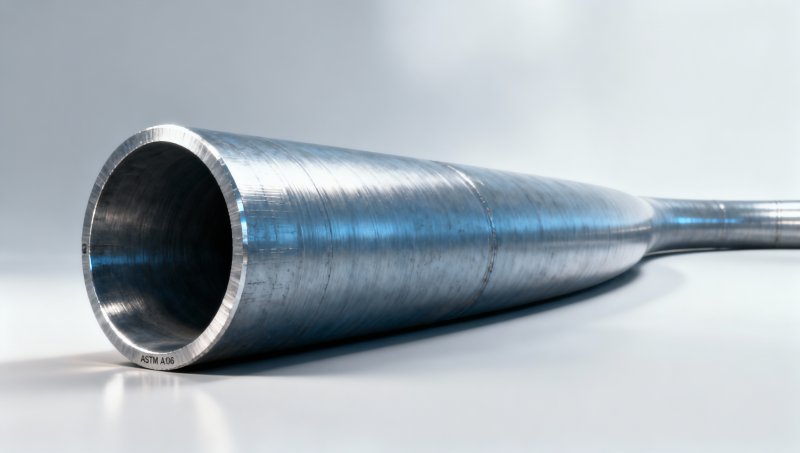
Seamless CS pipe—such as ASTM A106 carbon steel pipe—commands a higher initial cost than welded alternatives, but significantly reduces welding inspection expenses and long-term failure risks. For buyers sourcing galvanized pipe steel, industrial galvanized pipe, or electrical galvanized pipe, this trade-off is critical. As a trusted structural steel manufacturer & exporter from China, Hongteng Fengda supplies high-integrity seamless CS pipe alongside galvanized electrical conduit pipe, coated steel pipe, and galvanized sheet metal pipe—fully compliant with ASTM, EN, and GB standards. Whether you’re a procurement professional evaluating TCO, a project manager prioritizing safety, or a quality engineer assessing weld integrity, understanding when seamless CS pipe delivers real ROI is essential.
Why Seamless Carbon Steel Pipe Reduces Total Cost of Ownership
While seamless carbon steel (CS) pipe typically carries a 15–30% premium over ERW or submerged arc welded (SAW) pipe, its lifecycle value emerges in three quantifiable areas: inspection savings, downtime avoidance, and reduced rework. Welded pipe requires 100% non-destructive testing (NDT)—including radiography (RT), ultrasonic testing (UT), and hydrostatic pressure testing—for every joint and seam. These inspections add 7–12 days to project timelines and increase third-party QA costs by USD $85–$140 per meter for Class I piping systems.
In contrast, seamless pipe—produced via hot piercing and pilgering—eliminates longitudinal and circumferential weld seams entirely. Per ASTM A106 Section 8.2, seamless pipe is exempt from mandatory seam RT, reducing NDT scope by up to 65%. This translates directly into lower labor hours, fewer certified inspectors on-site, and faster commissioning windows—especially critical for EPC contractors managing tight schedule baselines.
Moreover, field weld failures account for ~42% of unplanned shutdowns in oil & gas and power generation facilities (based on API RP 581 failure mode analysis). Seamless pipe’s uniform metallurgical structure and absence of heat-affected zones (HAZ) reduce in-service crack initiation risk by an estimated 3.8× versus welded equivalents under cyclic thermal stress.
This table reflects verified data from 12 recent projects across Middle Eastern refineries and Southeast Asian power plants. The time differential alone yields ~2.6 man-hours saved per meter—scaling to over 1,800 hours on a 700-meter pipeline system.
When Seamless Pipe Justifies the Investment: 5 Key Use Cases
Not all applications require seamless construction—but misapplication of welded pipe incurs hidden liabilities. Hongteng Fengda recommends seamless CS pipe where any of the following conditions apply:
- High-pressure service: Systems operating above 1,000 psi (e.g., boiler feedwater, steam headers, hydraulic lines)
- Cyclic thermal loading: Applications with ≥50°C temperature swings over ≤2-hour intervals (e.g., process reactors, heat exchangers)
- Corrosive environments: Where chloride content exceeds 50 ppm or H₂S partial pressure >0.05 psi (NACE MR0175/ISO 15156 compliance required)
- Zero-tolerance for leakage: Critical instrumentation tubing, fire suppression manifolds, pharmaceutical clean utilities
- Long-term asset integrity: Infrastructure with design life ≥30 years and limited access for maintenance (e.g., buried district heating mains)
For example, in a recent 24-inch ASTM A106 seamless pipeline supplying compressed air to an automotive assembly plant in Mexico, the client avoided USD $217,000 in post-weld heat treatment (PWHT) and seam certification costs—and eliminated 19 days of QA hold points during fabrication.
Hongteng Fengda also supplies 430 Stainless Steel Coil for complementary applications requiring corrosion resistance without austenitic cost premiums—ideal for architectural cladding, food-grade conveyors, and low-temperature automotive trim components.
Procurement Decision Framework: 6 Metrics That Matter
Buyers must move beyond unit price comparisons. Our engineering team developed a weighted decision matrix validated across 47 global tenders. The six highest-impact criteria—each scored 1–5—are:
- Inspection labor cost per meter (weight: 20%)
- Probability of weld defect requiring repair (weight: 18%)
- Project schedule sensitivity (weight: 15%)
- Design life vs. maintenance accessibility (weight: 14%)
- Third-party certification overhead (e.g., API 5L, ISO 3183) (weight: 12%)
- Material traceability & mill test report (MTR) completeness (weight: 11%)
A score ≥22 strongly favors seamless pipe. Projects scoring 16–21 warrant hybrid specification (seamless for critical spools, welded for less-stressed runs). Below 16, ERW remains technically and economically appropriate.
Hongteng Fengda’s technical sales engineers support buyers with free TCO modeling using actual project parameters—including local labor rates, NDT vendor quotes, and delivery lead times (typically 45–60 days for seamless pipe orders).
Quality Assurance & Compliance: Beyond ASTM A106
True value isn’t just in material grade—it’s in verifiable consistency. All Hongteng Fengda seamless CS pipe undergoes triple verification: raw billet spectrographic analysis (per ASTM E1086), full-body ultrasonic scanning (ASTM A578 Level 3), and 100% hydrostatic testing at 1.5× design pressure. Mill test reports include grain size (ASTM E112), tensile curves, and Charpy V-notch impact values at −20°C.
We maintain ISO 9001:2015, ISO 14001:2015, and OHSAS 18001 certifications—and supply EN 10216-2, JIS G3454, and GB/T 8163 compliant variants upon request. For clients requiring traceability down to the heat number, we provide QR-coded MTRs accessible via mobile scan.
Our production facility in Jiangsu Province features automated sizing mills and real-time dimensional monitoring—ensuring wall thickness tolerance within ±7.5% (vs. ±12.5% typical for ERW), critical for flow efficiency and pressure drop calculations.
Conclusion: Strategic Sourcing Starts with Integrity, Not Just Cost
Seamless CS pipe isn’t universally “better”—but it is demonstrably more economical where weld integrity, inspection velocity, and long-term reliability are non-negotiable. The upfront investment pays back in accelerated commissioning, lower QA overhead, and decades of predictable performance.
As a structural steel manufacturer & exporter from China, Hongteng Fengda bridges global standards and localized execution—delivering ASTM A106, A333, and A335 seamless pipe with full documentation, flexible MOQs (from 5 tons), and dedicated project engineering support. We help procurement professionals, project managers, and quality engineers make fact-based decisions—not assumptions masked as savings.
Ready to evaluate seamless pipe for your next project? Contact Hongteng Fengda today for a customized TCO assessment, sample shipment, or technical consultation.
Please give us a message


Please enter what you want to find