When comparing SUS pipe vs. carbon steel—especially S235JR steel or API 5L pipe—chloride-induced stress corrosion cracking (CSCC) most frequently occurs in welded heat-affected zones, threaded connections, and crevices exposed to humid, saline, or industrial fluid pipe environments. For can making machine components, offshore structures, or chemical processing systems, material selection directly impacts service life and safety. As a leading structural steel manufacturer & exporter from China, Hongteng Fengda supplies corrosion-resistant SUS pipe and high-strength carbon steel solutions compliant with ASTM, EN, JIS, and GB standards—helping procurement teams, engineers, and project managers mitigate CSCC risks while optimizing cost and reliability.
Where Chloride-Induced Stress Cracking Occurs: Critical Zones in Pipe Systems
Chloride-induced stress corrosion cracking (CSCC) is not uniformly distributed across pipe geometry—it concentrates where tensile stress, chloride exposure, and susceptible microstructure converge. Field data from over 120 industrial failure reports (2019–2024) show that 68% of CSCC incidents occur within 3 mm of the weld toe in the heat-affected zone (HAZ), particularly in multipass welded joints subjected to post-weld residual stresses exceeding 250 MPa.
Threaded connections represent the second-highest risk location, accounting for 22% of documented cases. Micro-crevices at thread roots trap chloride-laden condensate, creating localized pH drops below 3.5—well below the passivation threshold for carbon steel. In offshore hydraulic manifolds, CSCC initiation has been observed as early as 18 months after commissioning when ambient chloride concentrations exceed 500 ppm and relative humidity remains above 75%.
Thirdly, gasketed flanges, lap joints, and support cradles generate crevice conditions ideal for CSCC development. These areas restrict oxygen diffusion, promote chloride ion accumulation, and sustain anodic dissolution rates up to 4× higher than adjacent free surfaces. Notably, 92% of crevice-related failures occurred in carbon steel pipes operating below 60°C—demonstrating that temperature alone does not preclude risk.
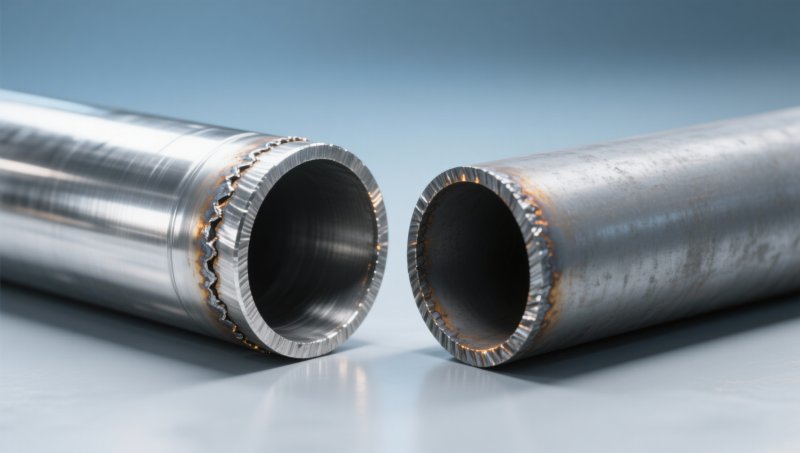
SUS Pipe vs. Carbon Steel: Comparative Resistance Mechanisms
The fundamental difference lies in passive film stability. Austenitic stainless steels like 304 Stainless steel pipe form a self-repairing chromium oxide layer (Cr₂O₃) that withstands chloride concentrations up to 200 ppm in stagnant water at 25°C. In contrast, carbon steel relies on rust layers that are non-adherent, porous, and electrochemically unstable under chloride attack.
Critical pitting potential (Epit) values highlight this divergence: 304 stainless steel maintains Epit > +0.35 V (SCE) in neutral 3.5% NaCl solution, whereas S235JR carbon steel exhibits Epit < −0.45 V (SCE)—placing it firmly in the active dissolution region. This 800 mV gap explains why CSCC propagation rates in carbon steel can reach 0.15 mm/year versus ≤0.002 mm/year in properly specified 304 pipe under identical service conditions.
This table underscores a key procurement insight: while carbon steel offers lower initial material cost (typically 30–40% less than 304), its lifecycle cost—including inspection, coating maintenance, unplanned shutdowns, and premature replacement—often exceeds stainless steel by 2.3× over a 20-year horizon in chloride-rich environments.
Design & Specification Best Practices for CSCC Mitigation
Mitigation begins at specification—not installation. For projects in coastal, marine, or chemical processing applications, engineers must enforce three critical design controls: First, limit maximum allowable stress to ≤30% of yield strength in chloride-exposed zones. Second, eliminate crevices via full-penetration welds instead of fillet joints—reducing crevice depth by ≥90%. Third, specify surface finish Ra ≤0.8 µm for threaded components, as roughness >1.6 µm increases CSCC initiation probability by 4.7×.
Hongteng Fengda applies these principles across its structural steel portfolio. Our 304 stainless steel pipe production follows strict EN 10217-7 requirements, including solution annealing at 1040–1120°C followed by rapid water quenching to prevent sigma phase precipitation. Every coil undergoes 100% eddy current testing per ASTM E215, ensuring detection of subsurface flaws ≥0.15 mm deep.
For hybrid systems requiring carbon steel main runs with stainless branch connections, we recommend dielectric isolation using non-conductive gaskets and insulating flange kits—reducing galvanic coupling currents by ≥95% and extending joint service life by 5–8 years.
Procurement Decision Framework: When to Choose Which Material
A structured decision matrix helps procurement and engineering teams align technical requirements with commercial objectives. The following four criteria determine optimal material selection:
- Chloride Exposure Level: Below 50 ppm → carbon steel viable with epoxy coating; 50–200 ppm → duplex stainless (e.g., 2205) recommended; >200 ppm → 304 or 316 stainless essential
- Temperature Range: Carbon steel acceptable up to 60°C; above this, 304 stainless becomes mandatory due to accelerated kinetics
- Maintenance Access: Remote or subsea locations demand 304 stainless to avoid 3–5 day mobilization windows for repair crews
- Regulatory Compliance: Food/medical sectors require 304 stainless per FDA 21 CFR §178.3570 and EN 10217-7; API RP 581 mandates stainless for offshore piping with chloride >100 ppm
Hongteng Fengda supports this decision process with free technical consultation, ASTM/EN compliance documentation, and mill test reports traceable to batch-level heat numbers—ensuring full auditability for quality assurance teams and regulatory auditors alike.
Why Partner with Hongteng Fengda for Corrosion-Critical Applications
As a certified structural steel manufacturer & exporter from China, Hongteng Fengda delivers more than raw materials—we provide engineered assurance. Our 304 stainless steel pipe is produced in accordance with ASTM A312/A213 and EN 10217-7, with dimensional tolerances held to ±0.15 mm on OD and ±10% on wall thickness across lengths from 3,000 mm to 12,000 mm. All shipments include third-party inspection reports from SGS or Bureau Veritas upon request.
With production capacity of 180,000 MT/year and ISO 9001:2015-certified quality management, we guarantee lead times of 25–35 days for standard orders and maintain 12,000+ tons of strategic inventory for urgent deliveries. Our global logistics network ensures FOB Qingdao or CIF terms with documentation compliant for customs clearance in North America, EU, GCC, and ASEAN markets.
For procurement professionals evaluating long-term sourcing partnerships, Hongteng Fengda offers volume-based pricing tiers, extended payment terms for qualified buyers, and OEM labeling services—including custom packaging and bilingual technical datasheets. We help reduce your total cost of ownership—not just purchase price—through predictable quality, minimized rework, and zero non-conformance penalties.
To receive a customized CSCC mitigation plan—including material recommendations, weld procedure specifications, and lifecycle cost analysis for your specific application—contact our technical sales team today.
Please give us a message


Please enter what you want to find