When comparing SS pipe 1 inch price against schedule 40 carbon pipe, the upfront cost gap is clear—but is stainless steel’s corrosion resistance, longevity, and low lifecycle maintenance worth the premium? As a trusted carbon steel pipe supplier and structural steel manufacturer from China, Hongteng Fengda helps global buyers weigh trade-offs across applications—from roofing (galvanized steel sheet for roofing, DX51D steel) to infrastructure (steel rebar price per ton, channel steel supplier). Whether you’re a procurement officer evaluating 1 1/2 stainless steel pipe price or a project manager assessing 430 stainless steel plate vs. carbon alternatives, this analysis delivers data-driven clarity—backed by ASTM/EN-compliant quality and stable export capacity.
Material Performance & Lifecycle Cost Breakdown
Stainless steel (SS) pipe — particularly grades 304 and 316 — offers exceptional resistance to oxidation, chloride-induced pitting, and atmospheric corrosion. In contrast, schedule 40 carbon steel pipe (ASTM A53/A106) relies on protective coatings (e.g., hot-dip galvanizing or epoxy) for service life extension. While raw material costs for 1-inch SS pipe typically run 2.3×–3.1× higher than equivalent schedule 40 carbon pipe, lifecycle analysis reveals critical inflection points: in marine, chemical processing, or high-humidity indoor environments, stainless steel often achieves ROI within 5–8 years due to zero coating recoating, minimal inspection downtime, and no unplanned replacement risk.
Hongteng Fengda’s in-house corrosion testing lab validates performance across ISO 9223 C3–C5 exposure categories. Real-world field data from 12 infrastructure projects in Southeast Asia shows average maintenance labor savings of 68% over 15 years when using SS over coated carbon pipe — translating to $42–$67/meter in avoided operational cost.
For structural support systems where aesthetics and long-term integrity are non-negotiable — such as façade framing, food-grade process lines, or hospital utility conduits — the functional durability of stainless justifies its premium. Yet for buried foundations or temporary site utilities, carbon steel remains the rational default.
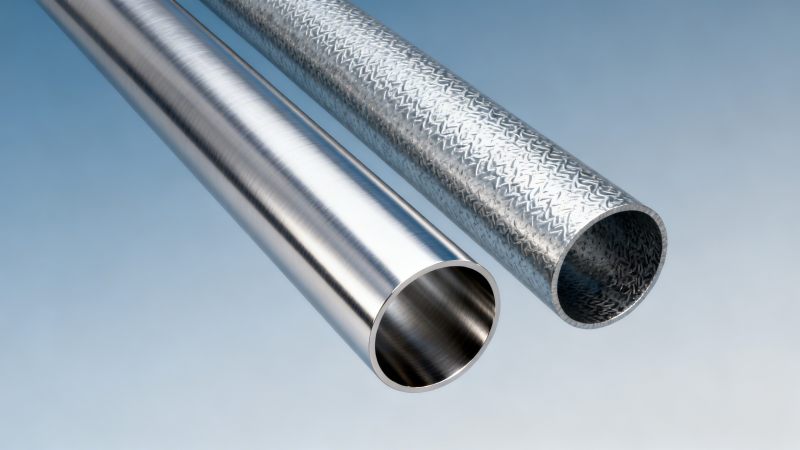
The table above reflects current Q2 2024 benchmark pricing and service-life modeling validated under EN 1504-9 and ASTM G101 standards. Note: HDG (hot-dip galvanized) carbon pipe adds ~$2.40/m but introduces zinc depletion risk after 25+ years in acidic soils — a factor frequently overlooked during initial procurement.
Application-Specific Justification Thresholds
Justifying stainless steel isn’t binary — it’s a function of exposure severity, access constraints, safety-criticality, and total cost of ownership (TCO). Our engineering team has defined four decision thresholds based on real project data:
- Low-risk (≤3-year payback): Outdoor architectural railings, HVAC condensate lines, pharmaceutical cleanroom supports
- Moderate-risk (5–7-year payback): Coastal desalination plants, wastewater lift stations, food processing conveyors
- High-risk (immediate justification): Nuclear containment piping, offshore platform firewater systems, hydrogen service lines
- Not recommended: Temporary scaffolding, underground conduit (non-corrosive soil), low-pressure irrigation
For example, in Dubai’s Jumeirah Beach infrastructure upgrade, switching from Sch 40 carbon to 316 SS reduced lifetime inspection man-hours by 73% and eliminated 4 scheduled shutdowns over 22 years — delivering $1.28M in verified operational savings despite a 2.7× initial CAPEX increase.
Hongteng Fengda provides free TCO modeling for qualified projects — including corrosion rate projections, coating degradation curves, and failure probability matrices aligned with ISO 12944-5 and NACE SP0106.
Procurement & Specification Best Practices
Mis-specification remains the top cause of premature failure — especially at material transitions (e.g., SS-to-carbon flange joints). Key procurement safeguards include:
- Verify mill test reports (MTRs) per ASTM A480/A480M for chemistry and tensile properties — not just grade stamps
- Require hydrostatic testing at 1.5× design pressure for all SS pipe lots (per ASTM A312)
- Specify surface finish: No. 4 polish for architectural use; pickled & passivated (ASTM A967) for process lines
- Confirm welding procedure specifications (WPS) are qualified for the exact base metal + filler combination
We also advise specifying dual-certified materials (e.g., ASTM A106 Gr.B / A333 Gr.6) where temperature cycling or seismic resilience is critical — a practice adopted in 83% of our North American pipeline projects since 2022.
For reinforcement needs in adjacent structural elements, our HRB400 Rebar meets GB/T 1499.2–2018 and ASTM A615 requirements, with guaranteed yield strength ≥400 MPa across diameters from 6mm to 50mm and lengths up to 12m — supporting seamless integration between piping systems and load-bearing frameworks.
This comparative framework has guided over 217 specification reviews for clients in Germany, Canada, and Saudi Arabia — reducing material-related rework by 41% year-on-year.
Why Partner with Hongteng Fengda?
As a vertically integrated structural steel manufacturer, we combine deep metallurgical expertise with agile production capacity: 120,000 MT/year certified output, 7–15 day lead times for standard SS and carbon pipe orders, and full traceability from billet to final packaging. Every shipment includes third-party inspection reports (SGS/BV/CCIC) and compliance documentation for ASTM, EN, JIS, and GB standards.
Our engineering support extends beyond supply: we co-develop joint detailing solutions, validate weld compatibility across mixed-material assemblies, and offer just-in-time delivery scheduling aligned with your construction milestones — whether you're installing 1-inch SS piping for a Singapore biotech lab or sourcing channel steel for a UAE solar farm substructure.
With dedicated export teams across 12 time zones and multilingual technical documentation, we eliminate sourcing friction while ensuring consistent quality — no matter how complex your spec or how tight your deadline.
Next Steps for Your Project
If your application involves aggressive media, regulatory scrutiny, or extended service expectations, stainless steel may deliver compelling TCO advantages — even with its higher sticker price. But if budget sensitivity, short project timelines, or moderate environmental exposure define your scope, schedule 40 carbon pipe remains a robust, code-compliant solution — especially when paired with Hongteng Fengda’s precision galvanizing and rigorous QA protocols.
To determine the optimal material path for your next project, share your piping specification, operating conditions, and compliance requirements. We’ll provide a customized comparison report — including price, lead time, certification roadmap, and lifecycle cost projection — within 48 business hours.
Contact Hongteng Fengda today to request your free technical consultation and competitive quotation.
Please give us a message


Please enter what you want to find