A workable stainless steel plate budget begins with the finished part rather than a headline material rate. The quoted ss steel plate price is only the starting point when plates must be cut, drilled, formed, welded, pickled, or delivered in a sequence that matches site fabrication. A lower price per tonne can become the higher-cost choice when the plate format creates excessive offcut, requires extra handling, or arrives without the documentation and surface condition needed for the next operation.
For fabrication work, the useful comparison is the cost of compliant, usable material at the point where it enters production. That figure combines plate value, yield from the nesting plan, processing allowances, inspection needs, packing, freight, and the consequences of schedule changes. Treating these items as separate commercial and technical decisions often produces a budget that looks controlled until cutting begins.
Price the required plate condition, not only the alloy name
Stainless steel grades with similar names can have very different cost and fabrication implications. The grade must be selected against the service environment, exposure to chlorides or process chemicals, operating temperature, cleaning regime, and the required mechanical properties. Specifying a higher-alloy plate without a service reason raises material cost and may add lead time. Specifying an inadequate grade can create a much larger cost later through replacement, staining, corrosion investigation, or rejected fabricated items.
Grade alone does not fully define the plate. Thickness tolerance, flatness, width, length, edge condition, surface finish, and heat or batch traceability all influence whether a plate is suitable for the drawing. A nominal thickness is especially easy to misread. If a fabricated component has a tight weight, stiffness, machining-depth, or weld-preparation requirement, the permitted thickness range needs to be stated before quotation. Buying on nominal thickness alone can leave no allowance for dimensional variation after surface preparation or machining.
Surface finish should be tied to its actual purpose. A finish needed for visual consistency, cleanability, or later polishing should be protected during transport and processing. Protective film can prevent scratches during handling, yet the film type and removal process need to suit laser cutting, bending, or welding. Film residue, heat damage around a cut edge, and mixed surface directions can create rework even when the base material is correct.
Plate dimensions decide how much of the purchase becomes a part
Plate size changes the effective price because a rectangular purchase format rarely matches the final shapes perfectly. Before asking for a firm quotation, prepare a nesting estimate using actual cutting clearances, kerf, edge trim, grain direction where relevant, and the space required between parts. A simple calculation based only on component area overlooks remnants that cannot be reused, particularly with irregular brackets, rings, long narrow strips, and parts that must maintain a specific rolling or finish direction.
The largest available plate is not automatically the most economical choice. Large sheets may improve nesting, but they can exceed crane capacity, require more difficult manual handling, or create distortion when thin sections are released during cutting. Conversely, purchasing many small plates can increase loading time, jointing, and remnant management. The practical optimum is the format that fits the cutting bed, material flow, lifting method, and planned part mix.
A good material schedule separates net part weight from purchased weight. It also identifies shared nests, anticipated reusable remnants, and parts that must be cut from a single plate due to finish, traceability, or appearance requirements. This avoids applying one waste allowance across every item when some geometries are efficient and others are not.
Processing scope needs a boundary that a quotation can hold
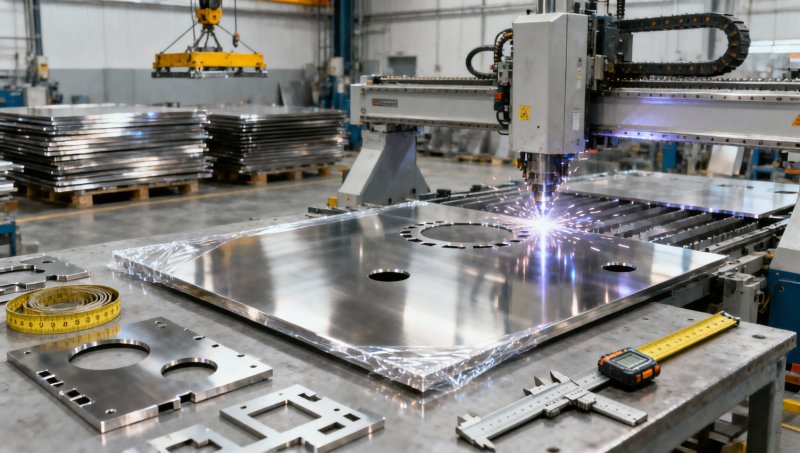
“Cut and fabricate” is too broad to produce comparable pricing. Thermal cutting, waterjet cutting, drilling, counterboring, edge milling, rolling, press braking, fit-up, welding, grinding, passivation, and packing each have different setup demands and tolerances. A quote that includes only basic cut profiles will not cover the same work as one that delivers parts ready for assembly.
Cutting method deserves early attention. Laser cutting can be efficient for suitable thickness ranges and detailed profiles, but edge quality and heat effects should be matched to subsequent bending, welding, or visible finish expectations. Plasma cutting may be appropriate for heavier sections and larger profiles, yet its cut edge commonly needs more allowance where precise machining or high-quality weld preparation follows. Waterjet cutting avoids a heat-affected zone but has its own cost and cycle-time profile. The process should follow the required edge condition, not a generic preference.
Hole features create another common mismatch. A drawing that shows a hole diameter does not state whether a thermal-cut hole is acceptable, whether drilling is required, whether threads are needed, or whether positional tolerance is referenced from a datum that survives cutting. These distinctions affect both the process route and inspection method. Slots, small holes relative to plate thickness, countersinks, and holes near a formed edge should receive separate review because they are more likely to distort or require secondary work.
Welding cost should be assessed through joint design and access, rather than by simply applying a rate to plate weight. Joint type, weld length, position, root access, backing requirements, filler compatibility, fixture needs, distortion control, and post-weld dressing all matter. Stainless fabrication also requires disciplined separation from carbon steel tools and work surfaces where contamination could compromise corrosion resistance or appearance. If weld discoloration must be removed, the requested treatment and acceptance condition should be included in the scope.
Small drawing omissions can change the commercial result
Fabrication estimates become unstable when the drawing package lacks a revision-controlled bill of materials, clear dimensions, tolerances, weld symbols, finish notes, and a defined measurement basis. Dimensions after bending must distinguish between inside radius, outside dimension, and developed blank length. Otherwise, a part can be cut accurately to an assumed flat pattern and still fail after forming.
Where formed plate interfaces with cold-formed framing, the connection details must account for real tolerances on both components. For example, a perforated or non-perforated Z-beam used as a purlin, wall member, bracket support, or lightweight roof element may call for a distinct hole pattern and coating-compatible fastener arrangement. Its profile tolerances, member length, and galvanised surface condition affect the plate connection design. Stainless plate fastened directly to coated structural members also needs review for moisture retention, dissimilar-metal contact, access for tightening, and the sequence in which protective finishes are repaired.
Do not leave “as per standard” as the only instruction for fabricated parts. The relevant requirement may address material, while the project need concerns dimensional inspection, surface appearance, marking, or packing. A concise fabrication note can state which dimensions are critical, where burrs are unacceptable, whether sharp edges need breaking, how parts are identified, and whether dry fit-up is required before dispatch.
Order volume changes more than the unit rate
Volume can reduce repeated setup and improve use of full plates, but it also introduces exposure when drawings are still moving. Releasing the entire quantity before connection details, hole patterns, or equipment interfaces are fixed can turn a favorable rate into unusable inventory. A staged release is often more defensible when first articles or trial assemblies will confirm fit before the remaining parts are cut.
Repeated parts should be grouped by material, thickness, finish, and processing route rather than only by assembly name. This makes it easier to see whether multiple drawings can share a nest and whether a common blank size will simplify handling. At the same time, parts from different assemblies should not be mixed without a reliable identification method. The cost of sorting unmarked stainless components after cutting can outweigh a small saving in nesting.
Freight and packaging require similar discipline. Stainless surfaces can be damaged by movement against unprotected steel, wet packing, abrasive straps, or stacking pressure at corners. Long plate items and fabricated frames need support points that prevent permanent distortion. If unloading equipment is limited at the destination, package weight and lifting locations belong in the procurement instruction; an otherwise sound delivery can be delayed when it cannot be unloaded safely or segregated by installation sequence.
Use a comparison basis that exposes exclusions
When quotations differ materially, compare them line by line against the same deliverable rather than selecting the lowest total. Confirm the grade, plate origin requirements where applicable, dimensions, tolerance basis, finish, cutting method, hole treatment, forming, weld scope, inspection, certificates, marking, packaging, freight terms, taxes or duties where relevant, and stated lead time. An omission is not necessarily an error, but it must be visible before the order is placed.
- A rate quoted by weight should identify whether it uses theoretical weight, actual weighbridge weight, or a cut-part calculation. These bases produce different totals when nesting losses are significant.
- Scrap ownership needs a clear treatment. Reusable remnants have value only when they are labelled, stored, and likely to be consumed by future work; otherwise they remain a disposal or handling burden.
- Clarify whether dimensional verification occurs before or after surface finishing. Grinding or polishing can alter edges and local dimensions that were acceptable immediately after cutting.
- For assemblies, distinguish shop fit-up from final site fit-up. Transport joints, field welds, and site-drilled holes may move costs away from the shop without eliminating them.
Lead time should be connected to the actual release path. Material availability is only one portion of the schedule. Approval of shop drawings, arrival inspection, nesting, cutting, forming, welding, finishing, inspection, packing, and transport all consume time. A supplier’s material dispatch date is not the same as a ready-to-install date. Where fabrication follows immediately after receipt, agree on how plate identification and certificates will be transferred into the production records.
Control changes before they reach the cutting table
Stainless plate is difficult to return to a standard stock condition after customized cutting or fabrication. Revision control therefore has direct cost value. Each released drawing should carry a revision, issue date, part number, material callout, and quantity. A written hold point before cutting is useful for items affected by unresolved equipment dimensions, mating-hole locations, access panels, or finish samples. Verbal changes are particularly risky once nesting has started because a small hole shift can invalidate an entire shared sheet.
On receipt, verify plate count, visible surface condition, heat or batch marking, dimensions, and documentation against the purchase order before pieces are separated. Marking should remain legible through the intended process route, while avoiding methods that damage an exposed finish. Where cut parts will undergo further fabrication, retaining a traceability map from each part to the original plate is more dependable than trying to reconstruct the link after welding and finishing.
A disciplined ss steel plate price plan therefore measures cost at the finished, acceptable component level. It connects material selection with nesting yield, defines every processing boundary, and preserves enough drawing and traceability control to prevent late changes from becoming scrap. That approach creates a quote comparison grounded in the work that must actually be completed, rather than in an attractive but incomplete plate rate.
Please give us a message


Please enter what you want to find