SS Pipe Schedule and Wall Thickness: What Should Be Checked First?
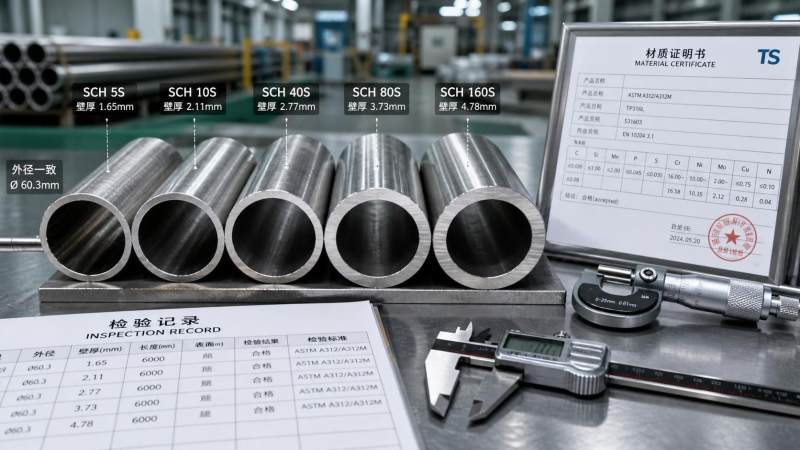
When reviewing ss pipe offers, outside diameter alone never tells the full story.
The schedule and actual wall thickness determine pressure capacity, forming behavior, weld preparation, and service life.
That matters in construction, fabrication, fluid transport, and industrial support systems where one wrong assumption can create cost overruns.
A common issue is ordering by nominal size, then discovering the delivered pipe is lighter or heavier than expected.
In practical sourcing, the better approach is to confirm schedule, wall tolerance, grade, standard, and test requirements together.
Suppliers with broad structural steel experience usually control this process better, especially when projects also involve beams, channels, or custom components.
For international orders, consistency across ASTM, EN, JIS, and GB references is also worth checking before production starts.
Is pipe schedule just a code, or does it change real performance?
It changes performance in a very direct way.
For ss pipe, schedule is a standardized way to indicate wall thickness within a given nominal pipe size.
A higher schedule usually means a thicker wall, more weight, and higher pressure resistance.
It also means higher material cost and sometimes slower processing.
The mistake is treating Schedule 10, 40, and 80 as interchangeable because the outer diameter looks identical.
They are not interchangeable in welding fit-up, bending response, threading feasibility, or corrosion allowance planning.
In lighter service, thinner-wall ss pipe may reduce cost and simplify installation.
In chemical lines, structural supports, or fabrication under repeated loads, thin walls can create avoidable risk.
The right question is not which schedule is cheaper.
The right question is which schedule matches design pressure, joining method, and expected service conditions without excess weight.
A quick comparison helps narrow the choice
How do you know the quoted wall thickness is really suitable?
Start with the service condition, not the catalog page.
An ss pipe used for handrails, support frames, or light fabrication needs a different review than one used for process fluid or corrosive media.
The wall should be checked against five practical points.
- Operating pressure and temperature range.
- Corrosion allowance over the expected service life.
- Joining method, including welding, threading, or grooving.
- Mechanical loads during transport, installation, and use.
- Tolerance requirements for fit-up with flanges, elbows, or fabricated assemblies.
More commonly, problems appear when drawings specify schedule, but the order only lists thickness in millimeters.
That can lead to mismatch if the referenced standard differs.
It is safer to request nominal size, schedule, actual wall thickness, tolerance, and applicable standard in one line item.
For mixed material packages, some projects combine ss pipe with coated carbon steel for lower-pressure service.
In that context, Hot diped-Galvanized Pipe may be considered for general low-pressure water, gas, oil, support frames, or corrosion-resistant outdoor use.
Its available standards, broad application range, and options such as 1-12m length or customized surface treatment can help balance lifecycle cost where stainless steel is not essential.
Which documents should be reviewed before placing an ss pipe order?
A low unit price means little if the paperwork is incomplete.
The most reliable ss pipe orders are supported by clear technical and inspection records before shipment.
This is especially relevant in cross-border sourcing, where material substitution and standard confusion create avoidable delays.
The core document set usually includes
- Material test certificate showing grade, heat number, and chemical composition.
- Dimensional inspection report with outer diameter and wall thickness results.
- Standard reference such as ASTM, EN, JIS, or GB.
- Surface condition record for pickled, annealed, polished, or industrial finish.
- NDT, hydro test, or pressure test records where required.
- Packing list and marking details for traceability on arrival.
Need-to-check details are often small.
For example, wall tolerance can affect welding alignment, and missing heat numbers can weaken later claim handling.
A supplier with disciplined quality control and stable export routines usually reduces those issues.
That is why many international projects favor mills or exporters already working with multiple structural steel categories and major standards.
Where do cost mistakes usually happen when buying ss pipe?
They usually happen after the quotation is accepted, not before.
A thinner ss pipe may look attractive on price, but rework, leakage risk, or installation changes can erase that saving quickly.
At the other extreme, overspecifying schedule can add unnecessary steel weight across the entire project.
A better cost review looks at total delivered value.
It also helps to compare shipping efficiency.
Heavier schedules increase freight and handling costs, especially in export packaging and container loading.
That is why wall thickness should be justified by function, not habit.
What practical checks reduce quality risk before shipment?
The most effective checks are simple, specific, and done early.
For ss pipe, quality risk usually comes from dimensional inconsistency, incorrect grade, poor surface finish, and incomplete traceability.
Before dispatch, these points deserve confirmation:
- Measure random wall thickness samples at several positions.
- Confirm heat number marking matches the certificates.
- Check straightness, end condition, and ovality.
- Review surface defects that may affect corrosion or appearance.
- Verify quantity by bundle, length, and packing method.
Where projects combine stainless and coated steel items, using one experienced export partner can simplify inspection planning and shipment coordination.
Companies with modern production lines, stable capacity, and familiarity with ASTM, EN, JIS, and GB requirements usually provide smoother documentation and delivery control.
That is particularly useful when schedules are tight and material interfaces must match on site.
So, what is the smartest next step before confirming the order?
Treat ss pipe selection as a technical decision with cost consequences, not as a simple commodity purchase.
Start by listing service conditions, required standard, grade, nominal size, schedule, actual wall thickness, and tolerance limits.
Then compare offers on processing scope, inspection records, lead time, and shipment reliability.
If the project includes multiple steel categories, align pipe specifications with the broader structural package early.
That reduces interface errors and helps keep fabrication on schedule.
In short, the best ss pipe order is not the cheapest line on paper.
It is the one with the right wall thickness, the right documents, and the fewest surprises after arrival.
A careful review at this stage usually saves more than any late-stage correction.
Please give us a message


Please enter what you want to find