When space is limited and routing accuracy matters, choosing between ss coil pipe and welded straight pipe can affect installation speed, waste control, and service reliability.
In steel-based industrial and construction projects, the right pipe format supports cleaner layouts, fewer joints, and better fit-up in confined areas.
For projects requiring dependable steel supply, Hongteng Fengda provides structural steel products and customized solutions aligned with ASTM, EN, JIS, and GB standards.
Tight installation spaces change how pipe selection should be judged
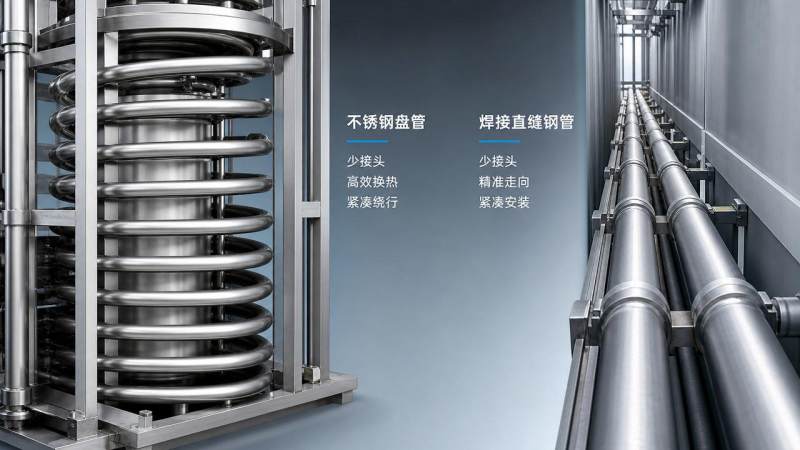
Not every piping layout needs the same material form. A compact skid, ceiling void, trench, or equipment enclosure creates different routing pressures.
In these conditions, ss coil pipe often reduces joint count and allows smoother directional changes. Welded straight pipe may offer easier section control on linear runs.
The key is not which option is universally better. The key is which option matches the physical limits, bending needs, and assembly method of the site.
What makes a layout “tight” in practice
A tight installation usually includes short turning radii, many obstacles, limited tool access, and strict dimensional tolerance.
- Pipe routes passing around structural members
- Mechanical rooms with dense equipment placement
- Prefabricated modules requiring repeatable alignment
- Retrofit work inside restricted steel frames
In such environments, the choice between ss coil pipe and straight welded sections becomes a layout decision, not only a material decision.
Scenario one: compact industrial skids and equipment frames
Industrial skids often combine pumps, valves, supports, cable trays, and guarding within a narrow steel platform.
Here, ss coil pipe is useful when routing must weave around components with fewer connection points.
Longer continuous lengths can reduce welding positions, leak paths, and rework caused by cumulative tolerance error.
When welded straight pipe still fits better
If the skid uses mostly straight corridors, repeated spool lengths, or rigid support spacing, welded straight pipe may simplify cutting and staged assembly.
Straight sections can also help when field crews prefer measurable piece-by-piece installation instead of controlled bending.
Scenario two: building service routes above ceilings or inside shafts
Overhead service zones in commercial or institutional buildings are usually crowded with ducts, cable trays, hangers, and fire systems.
In these routes, ss coil pipe helps where soft directional adjustment is needed between structural steel members.
Fewer fittings can support faster installation in congested spaces where torch access or welding clearance is limited.
By contrast, welded straight pipe suits long corridor runs where supports are evenly spaced and route geometry is already fixed by design drawings.
A related envelope consideration
Projects balancing pipe routing and exterior enclosure planning often also review lightweight steel building materials.
For roof applications, Colored Corrugated Roof Sheet offers corrosion resistance, heat resistance, and easy installation for factories, warehouses, sheds, and public buildings.
Available in PPGL with wavy, trapezoidal, and tile profiles, it supports thicknesses from 0.2mm to 1.2mm and service life beyond 25 years.
Scenario three: retrofit projects inside existing steel structures
Retrofit work is rarely clean or predictable. Existing beams, channels, braces, and old utilities often force nonstandard routing.
ss coil pipe becomes attractive when exact field measurements are difficult and route adjustments must happen on site.
Its flexibility can help avoid excessive fitting inventory. That lowers handling complexity when access is restricted.
Welded straight pipe remains useful if the retrofit design includes clear spool drawings and open welding access at connection points.
Scenario four: long linear process runs with limited deviations
Not all tight projects are highly curved. Some installations are narrow but mostly straight, such as sidewall process lines or utility galleries.
In these cases, welded straight pipe may be the more efficient answer because alignment, support spacing, and inspection points are easier to standardize.
Using ss coil pipe in a nearly straight route may add unnecessary forming steps without creating real installation value.
How scenario demands differ: key decision points
Cost should be read beyond material price
A lower unit price does not always mean lower project cost. Labor time, fitting quantity, weld count, and scrap rate often matter more.
This is why ss coil pipe can be cost-effective in difficult layouts even when straight sections look cheaper on paper.
Practical selection advice for steel project planning
Use the following checks before locking the pipe form into your procurement or fabrication plan.
- Map every direction change and count expected joints.
- Confirm whether field bending is acceptable for the application.
- Review access for welding, inspection, and future maintenance.
- Measure tolerance sensitivity across the whole route.
- Compare total installed cost, not only raw material cost.
If the route is compact, irregular, and obstruction-heavy, ss coil pipe often brings a clear installation advantage.
If the route is straight, repetitive, and well-defined, welded straight pipe may provide simpler execution and easier dimensional control.
Common mistakes when judging tight installations
One common mistake is evaluating only the plan view. Vertical clashes and tool movement space are often missed.
Another mistake is underestimating the impact of fittings. Every additional elbow or connection can increase time, inspection needs, and leak risk.
Some projects also assume all tight spaces require ss coil pipe. That is not always true for linear routes with predictable spool geometry.
Others default to welded straight pipe because it feels familiar, even when obstacle density makes joint reduction the higher-value strategy.
A reliable next step for better pipe decisions
Start with a route-based review instead of a product-first assumption. Separate straight sections, transition zones, and high-congestion points.
Then compare where ss coil pipe improves fit-up and where welded straight pipe improves standardization.
For steel projects needing stable supply, custom processing support, and international-standard quality, Hongteng Fengda can assist with dependable structural steel solutions.
A well-matched pipe choice reduces waste, avoids avoidable delays, and supports stronger long-term system performance in tight installations.
Please give us a message


Please enter what you want to find