Choosing the right ss coil manufacturer can directly affect your project cost, delivery schedule, and purchasing flexibility. For business evaluators comparing global suppliers, understanding differences in price, lead time, and MOQ is essential to reducing sourcing risk and improving procurement efficiency. This guide outlines the key factors to review when selecting a reliable steel manufacturing partner.
How Should Business Evaluators Compare an ss coil manufacturer?
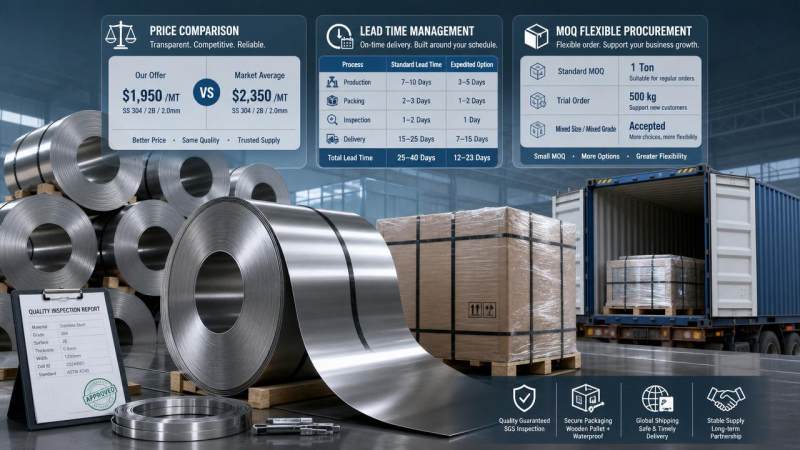
For procurement teams, comparing an ss coil manufacturer is not only about unit price. It is a commercial risk assessment process that includes production capability, raw material consistency, export coordination, and the supplier’s ability to support specification changes without delaying the project.
In the steel industry, the lowest quotation may hide issues such as unstable thickness tolerance, unclear surface finish, weak packing standards, or long replenishment cycles. Business evaluators therefore need a structured comparison model that goes beyond headline pricing.
- Price structure: base material cost, processing fees, export packing, inland transport, and port charges.
- Lead time reliability: actual production scheduling, rolling capacity, stock availability, and shipping readiness.
- MOQ flexibility: whether the supplier can support trial orders, mixed specifications, or project-based volume planning.
- Compliance support: ASTM, EN, JIS, or GB standard matching, plus MTC and inspection document readiness.
Hongteng Fengda supports international buyers with a practical sourcing model: stable structural steel production, customized solutions, and export coordination for projects that require clear specifications, controlled lead times, and dependable quality management.
Price Comparison: What Really Changes the Offer From One Supplier to Another?
When comparing one ss coil manufacturer with another, evaluators should separate the visible quotation from the total procurement cost. Stainless and structural steel sourcing often becomes expensive because of hidden conversion costs, rework, or specification mismatch after arrival.
Core price drivers in steel procurement
- Steel grade and chemistry requirements, especially when substitution is not acceptable.
- Thickness, width, and tolerance range, which directly affect rolling difficulty and yield.
- Surface treatment, edge condition, and additional processing such as slitting or cutting.
- Order volume, packing standard, and destination market documentation requirements.
The table below helps business evaluators compare common quotation components when screening an ss coil manufacturer for international procurement.
A strong offer is not always the cheapest one. The better option is the quote that remains commercially stable after adding logistics, document compliance, and quality assurance costs. This is where experienced exporters often outperform pure traders.
Lead Time Comparison: Why Quoted Delivery and Actual Delivery Often Differ
Lead time is one of the most underestimated variables in ss coil manufacturer comparison. Many suppliers quote an attractive production window, but actual delivery may be extended by material allocation delays, overloaded rolling schedules, re-inspection, or incomplete export preparation.
What business evaluators should verify
- Whether the supplier has regular manufacturing capacity or relies heavily on outsourced processing.
- Whether standard sizes are available from stock or need full new production.
- Whether technical confirmation, drawing approval, and packing requirements are included in the timeline.
- Whether the supplier has export experience for your destination and shipping method.
Hongteng Fengda serves global construction, industrial, and manufacturing buyers with stable production planning and strict quality control. For evaluators, this matters because dependable lead times reduce downstream disruptions in fabrication, site installation, and cash flow planning.
The following comparison table can be used when evaluating delivery reliability among suppliers.
A supplier that gives a realistic 25-day lead time can be safer than one promising 15 days without production visibility. In commercial evaluation, schedule credibility should be ranked as high as price competitiveness.
MOQ and Purchasing Flexibility: Which Supplier Fits Your Sourcing Strategy?
MOQ affects cash flow, inventory turnover, and project procurement flexibility. A business evaluator comparing an ss coil manufacturer should ask whether the supplier can support pilot orders, mixed grades, or partial container planning instead of forcing uniform high-volume purchasing.
This point becomes more important when buyers manage multiple steel categories in one project. For example, structural steel procurement may combine coils, profiles, beams, and fabricated components under one sourcing program.
In many projects, evaluating cross-category supply capacity helps reduce supplier fragmentation. A practical example is H-beam sourcing for steel structures, shipbuilding, bridging, and automobile chassis, where buyers may need Q235, Q345B, SS400, S275JR, S355JR, A572, A992, or stainless grades depending on design requirements.
For such applications, buyers often review flange thickness from 8-64mm, web thickness from 5-36.5mm, flange width from 50-400mm, web width from 100-900mm, and lengths from 1m-12m or as required. When a supplier can handle both standard and customized structural items, overall procurement becomes simpler and more controllable.
- Lower MOQ is useful for market testing, new project qualification, and engineering sample validation.
- Flexible mixed loading can reduce warehousing pressure when project demand is phased.
- Combined supply of coils and structural sections can improve coordination and reduce sourcing time.
Which Technical and Compliance Factors Should Not Be Ignored?
A qualified ss coil manufacturer should not be judged only by commercial terms. Technical matching and standard compliance are equally important, especially for buyers serving construction, machinery, fabrication, or public infrastructure sectors where project documents are strictly reviewed.
Key checkpoints before approval
- Confirm the applicable standard, such as ASTM, EN, JIS, or GB, and avoid relying on generic grade descriptions.
- Request material traceability documents and define whether third-party inspection is needed.
- Check whether tolerances, mechanical properties, and surface expectations are written into the PO.
- Review packing and marking details for destination-specific customs or site receiving requirements.
For structural sections, common references may include JIS G3101, EN10025, ASTM A36, ASTM A572, and ASTM A992. Hongteng Fengda aligns its supply model with major international standards and supports buyers who need standard-based specification matching rather than vague commercial descriptions.
A Practical Evaluation Matrix for Supplier Shortlisting
The table below is useful when your team needs to compare more than one ss coil manufacturer in a formal sourcing process. It converts technical and commercial observations into a decision framework.
This matrix is especially helpful for business evaluators who need to justify sourcing recommendations internally. It makes supplier comparison more defensible and reduces the chance of choosing based on incomplete commercial data.
FAQ: Common Questions When Reviewing an ss coil manufacturer
How can I tell if a low price is actually risky?
Ask for the quotation basis, grade definition, tolerance range, packing method, and documentation scope. If these are vague, the apparent savings may be offset by claims, reprocessing, late delivery, or unusable material after arrival.
What is a reasonable lead time for export steel orders?
It depends on grade, dimensions, and whether stock is available. Standard items may move faster, while customized or mixed orders need more time for scheduling, inspection, and packing. A reliable ss coil manufacturer should explain the timeline stage by stage.
Why does MOQ matter so much in business evaluation?
MOQ influences working capital, warehouse usage, and sourcing agility. If your project demand is uncertain or phased, a supplier with better MOQ flexibility can reduce financial pressure and lower the risk of excess inventory.
Should I prioritize a manufacturer over a trader?
Not always, but direct manufacturing capability often improves schedule visibility, technical control, and customization support. For buyers needing stable quality and predictable delivery, manufacturers with export experience usually offer stronger long-term procurement value.
Why Choose Us for Structural Steel and Related Export Supply?
Hongteng Fengda is a professional structural steel manufacturer and exporter from China, serving buyers across North America, Europe, the Middle East, and Southeast Asia. Our focus is not limited to supply alone. We help procurement teams reduce sourcing risk through stable production capacity, strict quality control, and dependable export coordination.
We specialize in angle steel, channel steel, steel beams, cold formed steel profiles, customized structural steel components, and related OEM solutions. This gives business evaluators a broader sourcing base when comparing an ss coil manufacturer alongside structural steel suppliers for project bundling or category consolidation.
- Consult us for parameter confirmation, including grade, dimensions, tolerances, and applicable standards.
- Discuss product selection if you need to balance cost, lead time, and performance across multiple steel categories.
- Request delivery schedule review for stock, production, packing, and export planning.
- Ask about customized solutions, certification alignment, sample support, and quotation communication for your target market.
If your team is comparing suppliers on price, lead time, and MOQ, a structured discussion with complete technical and commercial details will save time and prevent costly revisions later. Contact us with your specifications, target quantity, delivery destination, and standard requirements for a more accurate evaluation.
Please give us a message


Please enter what you want to find