SS 304 Pipe vs SS 316 Pipe: When “Standard” Stainless Isn’t Enough for Your Chemical Line
If you’re evaluating stainless steel pipe for a chemical processing line—especially one handling acids, solvents, or saline streams—you’re likely weighing SS 304 pipe against SS 316 pipe. Not as a theoretical materials exercise, but because a wrong choice risks pitting, stress corrosion cracking, unplanned shutdowns, or even safety incidents. The real question isn’t which grade is “better” in the abstract—it’s whether the extra cost and lead time of SS 316 are justified *for your specific fluid, temperature, concentration, and service life target*. And crucially: whether SS 304 pipe might still be viable—if applied with tighter controls.
Corrosion Resistance Is Not Linear—It’s Threshold-Driven
Both grades share the same austenitic crystal structure and high chromium content (18–20%), giving them strong resistance to oxidizing acids like nitric acid and general atmospheric exposure. But their divergence begins where chlorides enter the picture: seawater, brine, bleach, hydrochloric acid traces, or even cleaning agents containing sodium chloride.
SS 304 pipe contains ~8–10.5% nickel and no molybdenum. That makes it vulnerable to localized attack when chloride ion concentration exceeds ~50 ppm at ambient temperatures—and significantly lower if combined with elevated temperature, low pH, or stagnant flow. In practice, we’ve seen SS 304 pipe fail within months in caustic soda lines with trace chloride contamination from upstream water treatment, or in pharmaceutical rinse systems using deionized water with residual chloride from piping leaching.
SS 316 pipe adds 2–3% molybdenum—a critical alloying element that stabilizes the passive oxide layer in chloride-rich environments. It typically withstands chloride concentrations up to 200–500 ppm at room temperature, and maintains integrity under intermittent wet-dry cycling better than SS 304. But—and this is widely misunderstood—molybdenum doesn’t make SS 316 “immune.” At 80°C and >1,000 ppm chlorides (e.g., in some desalination pre-treatment or flue gas scrubber loops), even SS 316 can suffer crevice corrosion, especially under gaskets or weld heat-affected zones without proper pickling and passivation.
Temperature and Fluid Chemistry Change Everything
A common misstep is applying room-temperature lab data to operating conditions. Corrosion rates for both grades accelerate non-linearly above 60°C. For example:
- In 10% sulfuric acid at 25°C: SS 304 pipe shows acceptable corrosion rate (<0.1 mm/year); SS 316 offers marginal improvement.
- In the same solution at 80°C: SS 304 pipe corrosion jumps to >1.5 mm/year—unacceptable for pressure containment; SS 316 holds below 0.3 mm/year.
- In 5% sodium hypochlorite at 40°C: SS 304 pipe develops micro-pitting within weeks; SS 316 remains intact for >2 years with proper surface finish.
The presence of reducing agents (e.g., ferrous ions, sulfides) or oxidizers (e.g., ferric chloride, bromine) further shifts the electrochemical balance. A line carrying diluted hydrochloric acid with trace Fe³⁺ may corrode SS 316 faster than expected—not due to molybdenum failure, but because the oxidizer destabilizes the passive film. Always cross-check your actual process stream composition against ASTM G48 (ferric chloride pitting test) or ISO 11845 (electrochemical reactivity) data—not generic tables.
Weldability, Fabrication, and Real-World Consistency Matter More Than You Think
Both grades are readily weldable using standard TIG or SMAW methods—but SS 316’s higher molybdenum content increases susceptibility to sigma phase formation during prolonged heat input (>1 hour at 600–900°C). This embrittles the heat-affected zone, especially in thick-wall pipe or multi-pass welds. SS 304 pipe is more forgiving here, but its lower thermal conductivity means heat concentrates more locally—raising distortion risk in precision alignment applications.
More critically: material consistency affects performance far more than grade alone. We routinely test incoming coils and pipe lots for actual Mo content (SS 316 must be ≥2.0%; sub-1.8% lots behave closer to 304). Variability is higher in non-ASTM-compliant mill runs—particularly from suppliers without full traceability to primary ingot production. If your project specifies ASTM A312 TP316 but accepts EN 10217-7 1.4401 without verifying Mo min/max, you’re assuming risk.
This is where structural integration becomes relevant—not for the pipe itself, but for supporting infrastructure. Chemical plants require robust, corrosion-resistant framing for pipe racks, valve platforms, and instrument supports. While stainless piping handles the fluid, carbon steel components must resist splash, vapor, and environmental exposure. Here, C Beam Steel—with galvanized coating, tight ±1% dimensional tolerance, and ASTM/EN compliance—provides predictable load-bearing performance without introducing dissimilar-metal galvanic couples near sensitive process lines.
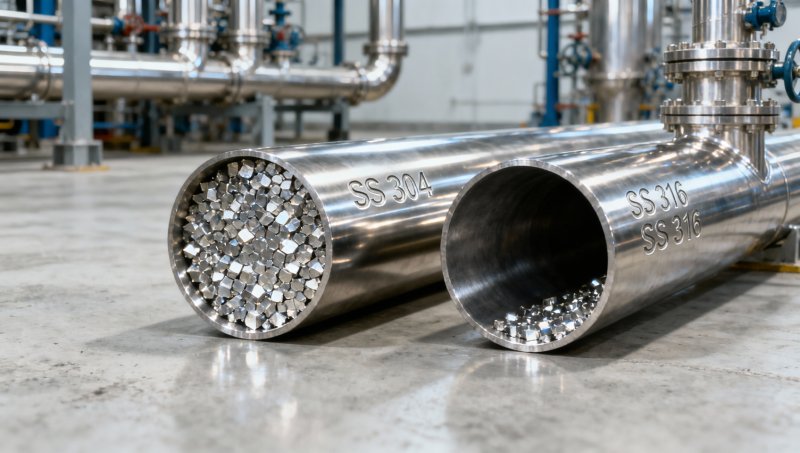
When SS 304 Pipe Can Still Be the Right Choice
SS 304 pipe remains appropriate—and often optimal—in several well-defined scenarios:
- High-purity oxidizing environments: Nitric acid lines (>20% concentration), hydrogen peroxide storage (≤35%), or clean steam tracing where chloride ingress is rigorously excluded.
- Short-service-life or disposable applications: Pilot-scale reactors, temporary bypass lines, or sampling manifolds designed for ≤12 months of operation.
- Cost-sensitive, low-risk segments: Instrument air headers, nitrogen purge lines, or vent stacks handling non-condensable gases with no liquid carryover.
But “low-risk” must be verified—not assumed. One client used SS 304 pipe for a solvent recovery condensate drain, reasoning “it’s just ethanol.” Unbeknownst to them, the upstream distillation column used stainless trays with trace molybdenum leaching into condensate. After 14 months, pitting initiated at a support clamp—causing a leak during startup. The fix wasn’t switching to SS 316 pipe; it was installing a dedicated SS 316 drip leg at the low point while keeping SS 304 elsewhere. Context dictates the solution—not the grade alone.
What to Verify Before Finalizing Your Spec
Before locking in either grade, confirm these four points with your supplier—not just the mill certificate, but actual test reports:
- Actual Mo content for SS 316 pipe: Minimum 2.0%, maximum 3.0%. Avoid “Mo-bearing 304” variants—they lack the full alloy balance.
- Surface finish: Ra ≤ 0.8 µm for chloride service. Mill finish (Ra ~3.2 µm) traps contaminants and initiates crevice corrosion.
- Heat treatment condition: Solution annealed and quenched—not stress-relieved. Residual stresses accelerate SCC.
- Trace element limits: Max 0.045% Cu (promotes pitting in HCl), max 0.002% Ca (reduces hot ductility during welding).
And remember: pipe is only one component. Flanges, gaskets, bolts, and supports must match the corrosion strategy. Using SS 316 pipe with carbon steel flanges invites galvanic corrosion at the joint. Using SS 304 pipe with PTFE-coated bolts? Fine—unless the coating chips during torque, exposing base metal.
There is no universal answer—but there is a defensible one. It starts with mapping your fluid’s worst-case chemistry, not its nominal spec; testing at operating temperature, not ambient; and treating material selection as a system-level decision—not a datasheet checkbox.
Please give us a message


Please enter what you want to find