Choosing between ss 304 pipe and 316 pipe can directly affect hygiene, corrosion resistance, lifecycle cost, and compliance in food, water, and general industrial systems. For technical evaluators, understanding the material differences is essential to selecting the right stainless steel pipe for performance, environment, and budget without overengineering or risking premature failure.
How different are ss 304 pipe and 316 pipe in real projects?
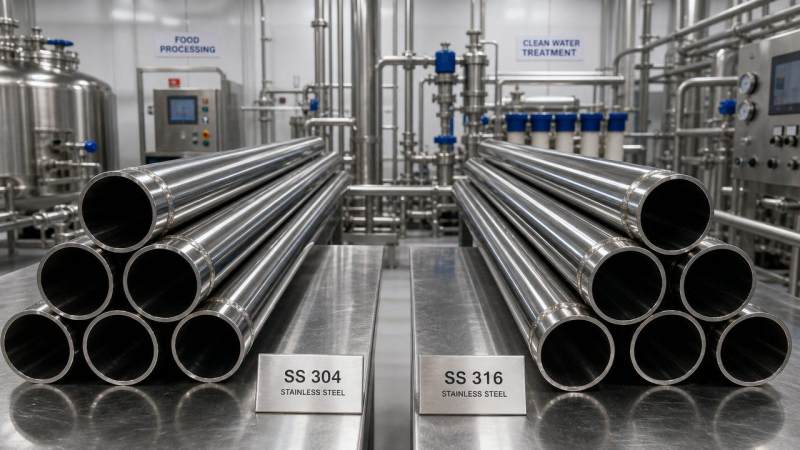
At first glance, ss 304 pipe and 316 pipe look similar. Both are austenitic stainless steels with good formability, weldability, and wide acceptance in industrial piping. Yet the small chemical difference, mainly the addition of molybdenum in 316, changes how each grade performs in chloride exposure, aggressive cleaning cycles, and corrosive process media.
For technical evaluation teams, the decision is rarely about selecting the “better” grade in isolation. It is about matching the pipe grade to water chemistry, cleaning method, installation location, service temperature, contamination risk, and total ownership cost. In many cases, ss 304 pipe is the practical choice. In other cases, 316 prevents failures that cost far more than the initial material premium.
This distinction matters in food processing, potable water distribution, and general industrial systems because the operating environment often changes over time. A line that seems mild during startup may later face harsher washdown chemicals, saline contamination, stagnant moisture, or higher hygiene demands.
- Use ss 304 pipe when corrosion conditions are moderate and cost control is a priority.
- Use 316 when chloride exposure, chemical cleaning, or long-term corrosion risk is more severe.
- Confirm the full system design, including fittings, weld quality, surface finish, and maintenance conditions, not just pipe grade.
Material comparison: what should technical evaluators focus on?
The table below compares the decision points most relevant when evaluating ss 304 pipe against 316 pipe for steel industry supply, fabrication, and end-use engineering review.
The key takeaway is simple. If the service environment stays clean, neutral, and low in chlorides, ss 304 pipe often delivers solid value. If the environment is uncertain, humid, saline, chemically cleaned, or exposed to crevice conditions, 316 usually offers a better safety margin.
Why composition matters in operation
Many procurement decisions fail because evaluation stops at tensile strength or basic corrosion claims. In stainless piping, localized corrosion is often the real issue. Surface deposits, dead zones, poor drainage, and heat-affected zones around welds can create conditions where 304 starts pitting earlier than expected.
That is why technical reviewers should assess not only grade designation but also finish quality, fabrication control, passivation practice, and system hygiene design. A well-made ss 304 pipe in a suitable environment can outperform a badly fabricated 316 system.
Which grade fits food processing, water systems, and general industrial use?
Application fit is the fastest way to narrow the decision. Instead of starting from price, start from fluid chemistry, cleaning regime, external atmosphere, and contamination sensitivity. This avoids both under-specification and unnecessary upgrade costs.
Food processing systems
In food lines, ss 304 pipe is widely used for dry product transfer, neutral food media, and equipment where washdown chemicals are mild. It remains common in dairy support systems, brewery utility lines, and non-saline product handling where hygiene is important but chloride attack is limited.
316 becomes more attractive for brine, sauces, seafood, pickled products, and production areas using aggressive chlorinated cleaners. It is also preferred when cleaning-in-place cycles are frequent and hot. The premium is easier to justify when contamination or shutdown carries a high cost.
Potable and process water systems
For indoor potable water with stable chemistry, low chloride levels, and good flow management, ss 304 pipe can be suitable. However, water quality varies by region. Coastal facilities, high-total-dissolved-solids water, intermittent service, and stagnant sections all increase corrosion risk.
In such conditions, 316 provides more confidence. Technical evaluation teams should request actual water analysis when possible. A pipe decision made without chloride data, pH range, and sanitization method is often incomplete.
General industrial use
General industrial lines cover compressed air, utility water, low-corrosive chemical transfer, machinery supports, and process interconnections. In many of these applications, ss 304 pipe is an economical engineering choice if exposure remains moderate and maintenance access is good.
Where there is splash exposure, outdoor marine air, chemical fumes, or risk of deposit formation, 316 gives a more conservative design basis. For industrial buyers balancing performance with budget, the best approach is to segment the system rather than specify one grade everywhere.
How to assess lifecycle cost instead of just purchase price
Technical evaluators are often pushed to reduce upfront cost, but the real cost of pipe selection includes inspection, maintenance, cleaning interruption, replacement labor, and process risk. The next table helps compare the cost logic behind ss 304 pipe and 316 pipe.
This is why many experienced buyers do not frame the question as 304 versus 316 only. They ask where each grade belongs in the same project. Main utility branches may use ss 304 pipe, while high-risk zones, CIP loops, or outdoor coastal sections move to 316.
What procurement checks should be completed before final approval?
A correct alloy choice can still fail if supply specifications are vague. For technical assessment teams in the steel sector, procurement discipline matters as much as grade selection. The checklist below helps reduce sourcing and installation risk.
- Confirm applicable standards such as ASTM, EN, JIS, or GB according to project destination and customer documentation requirements.
- Define pipe dimensions, schedule, tolerances, and surface finish instead of ordering by grade name alone.
- Review whether welded or seamless pipe is required based on pressure, hygiene, fabrication route, and inspection expectations.
- Ask for material traceability and routine quality records that support incoming inspection and project documentation.
- Evaluate lead time consistency, export packing, and supplier communication ability when project schedules are tight.
Hongteng Fengda supports global buyers with stable production coordination, strict quality control, and specification-based supply for structural and industrial steel needs. For evaluation teams, this matters because consistent execution reduces the gap between approved design and delivered product.
In some projects, stainless pipe is not the only line material under review. For low-pressure fluid transport, water, gas, oil-related auxiliary use, construction, machinery, mining support, or corrosion-managed utility lines, buyers may also compare coated carbon steel options. In such cases, Galvanized Pipe Manufacturers can be relevant for broader system planning, especially when the application falls outside food-grade stainless requirements.
That product range includes DX52D galvanized steel pipe options, hot-dip galvanized and electroplated variants, with reference dimensions such as length 1-12 m, width 0.6-3 m, thickness 0.1-300 mm, and common compliance references including AISI, ASTM, DIN, JIS, GB, SUS, and EN. For technical teams, the main value is not substitution in every case, but a clearer material map across the full plant or infrastructure package.
Which standards and compliance points are often overlooked?
In cross-border sourcing, many technical disputes come from incomplete specification alignment rather than poor material itself. A pipe may meet one standard family yet still create approval issues if test documents, dimensional basis, or finish expectations differ from project requirements.
- Check whether the order references material grade only or full product standard plus inspection requirements.
- Verify if the end market expects ASTM, EN, JIS, or GB alignment in documentation and marking.
- For food or water systems, define finish, cleanliness, and post-fabrication treatment requirements in advance.
- Include packaging and transport protection for exported pipe to avoid surface contamination before installation.
A capable Chinese exporter adds value here by coordinating manufacturing, quality records, and shipment details against project documents. Hongteng Fengda’s experience serving North America, Europe, the Middle East, and Southeast Asia is relevant because these regions often apply different standard combinations and delivery expectations.
Common mistakes when choosing ss 304 pipe
Several recurring mistakes lead to poor outcomes, even when buyers think they are saving cost. Recognizing these issues early helps technical evaluators build a stronger approval case.
Mistake 1: assuming indoor service is automatically low risk
Indoor systems can still face chlorinated washdown, trapped moisture, and concentrated deposits. An indoor food plant may be more corrosive than an outdoor dry installation.
Mistake 2: comparing only by material price per ton
If a corrosion event contaminates product, stops production, or forces rework, the savings from a cheaper grade disappear quickly. Lifecycle evaluation is essential.
Mistake 3: ignoring weld zones and surface condition
Poor welding, contamination during fabrication, and rough internal surfaces can reduce performance. Grade selection must be paired with fabrication control and proper finishing.
Mistake 4: using one grade everywhere without zoning
Mixed environments often justify mixed material strategy. The highest-risk nodes may need 316, while the rest of the system can remain ss 304 pipe for cost efficiency.
FAQ for technical evaluation teams
Is ss 304 pipe enough for potable water systems?
It can be, provided water chemistry is controlled, chloride levels are not excessive, and the system avoids stagnant sections and deposit buildup. For uncertain water quality or coastal exposure, 316 is often the more conservative option.
When is 316 clearly worth the extra cost?
It becomes easier to justify in seafood processing, brine service, chemical washdown areas, marine environments, and critical production lines where contamination or downtime has high economic impact.
Can ss 304 pipe be used in food applications?
Yes. It is common in many food and beverage systems, especially where products are not strongly saline or acidic and sanitation chemicals are moderate. The application details matter more than the industry label alone.
What should be included in a supplier inquiry?
Include grade, dimensions, wall thickness, standard, finish, welded or seamless requirement, quantity, destination market, document needs, and expected delivery schedule. This shortens quotation time and improves technical matching.
Why choose us for material evaluation and export supply support?
For buyers comparing ss 304 pipe, 316 pipe, and related steel products, the most useful supplier is one that can support technical clarification before production starts. Hongteng Fengda provides structural steel manufacturing and export support with attention to standard compliance, customized specifications, stable production planning, and dependable lead time coordination.
If your team is reviewing food, water, or general industrial piping decisions, you can consult on material selection, dimensional confirmation, applicable ASTM/EN/JIS/GB standards, corrosion environment assessment, OEM requirements, packaging needs, and shipment scheduling. This helps reduce sourcing risk while keeping the project aligned with budget and performance targets.
You can also request support for sample discussion, quotation comparison, mixed-product export planning, and specification review across stainless and other steel pipe categories. For technical evaluators, that practical coordination is often what turns a good material choice into a successful delivered project.
Please give us a message


Please enter what you want to find