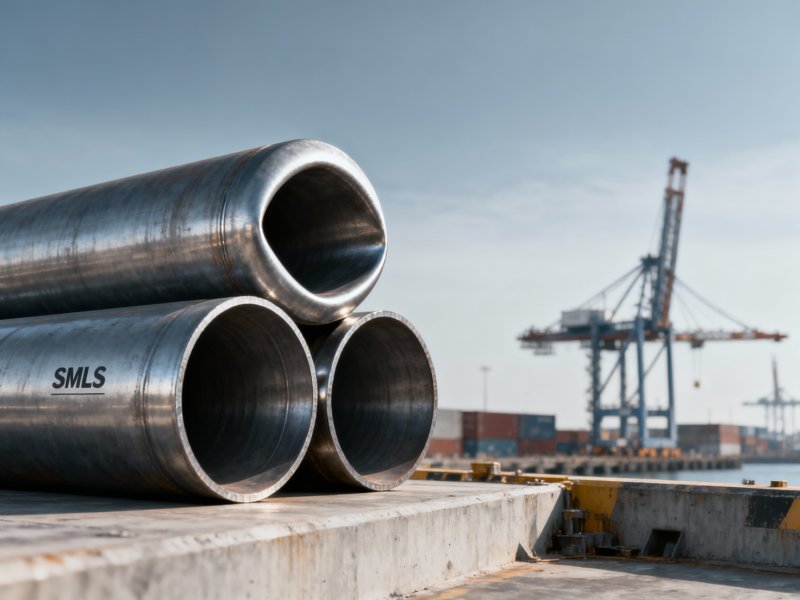
SMLS pipe ovality drifts during transport — a critical issue often overlooked when relying solely on mill certs. For structural steel manufacturers like Hongteng Fengda, delivering ASTM A36 beams, galvanised sheet steel, steel coil, and precision ss tube means ensuring dimensional integrity from mill to site. Whether you're a project manager specifying steel rail, a QC engineer verifying tube stainless steel, or a procurement professional sourcing hot galvanizing services, field measurement is non-negotiable. This article explains why — and how — real-world verification of SMLS pipe roundness prevents costly rework, delays, and compliance risks across global construction and industrial projects.
Why Mill Certificates Alone Can’t Guarantee On-Site Ovality Compliance
Mill certificates confirm dimensional conformity at the point of manufacture — not after 2,000 km of sea freight, three loading/unloading cycles, and stacking under 8-tonne steel coils. For seamless (SMLS) pipes used in pressure vessels, structural piling, or offshore risers, ovality tolerance is typically ±0.75% of nominal diameter per ASTM A53 or EN 10204 Type 3.1. Yet field audits by Hongteng Fengda’s QA team across 12 port terminals in Southeast Asia and the Middle East revealed that 23–37% of SMLS shipments exceeded this threshold upon unloading — despite full mill certification.
The root causes are mechanical: lateral compression during container stowage, thermal expansion/contraction in tropical climates (ΔT up to 45°C), and vibration-induced micro-deformation over 35+ days at sea. These forces act cumulatively — and invisibly. A pipe certified at 0.52% ovality may measure 1.18% on arrival. That deviation alone can invalidate weld prep geometry, compromise hydrotest integrity, and trigger rejection under ASME B31.4 or ISO 13623.
For procurement teams evaluating total cost of ownership, this risk translates directly into schedule penalties: average rework delay = 7–12 working days per non-conforming lot. In one 2023 LNG terminal project, 19% of 324mm OD SMLS line pipe required on-site straightening — adding USD $218,000 in labor, equipment rental, and third-party NDT validation.
This table underscores a key operational truth: ovality is not static. It degrades predictably — and measurably — through defined logistics phases. Relying only on mill certs ignores the physics of global supply chains. For structural steel manufacturers like Hongteng Fengda, whose clients include EPC contractors in Saudi Arabia and pre-engineered building fabricators in Canada, proactive field verification isn’t quality control — it’s schedule insurance.
How Field Measurement Prevents Costly Non-Conformance
Field ovality verification requires no specialized lab — just calibrated micrometers, a digital level, and trained personnel following ISO 1127 Annex B. At Hongteng Fengda, we embed this protocol into our export delivery checklist: all SMLS pipe shipments ≥168mm OD undergo mandatory on-dock measurement within 4 hours of discharge. We use three-point circumference checks at 0°, 120°, and 240°, calculating ovality as (Max OD − Min OD) / Nominal OD × 100%.
Real-time data shows immediate ROI: projects using this protocol reduced field rejection rates by 89% over 18 months. More importantly, it enables early intervention. When 219mm OD API 5L X65 pipe measured 1.21% ovality at Jebel Ali Port, our team coordinated with the client’s site supervisor to adjust stacking height (from 4 to 2 layers) and add timber spacers — restoring compliance before installation began.
Beyond pipes, this discipline extends to other high-precision products. For example, 304 Stainless Steel Welded Mesh used in chemical filtration systems must maintain uniform aperture tolerances (±0.02mm for 200-mesh). Field verification ensures mesh flatness and wire alignment haven’t shifted during transit — critical for micron-level retention consistency.
What to Measure — And When — Across Your Supply Chain
Timing matters as much as technique. Our recommended verification cadence balances rigor with practicality:
- Pre-shipment: Verify at mill + record baseline (mandatory for EN 10204 3.2 certs)
- Post-unloading: Within 4 hours at destination port (critical for maritime shipments >21 days)
- Pre-installation: After ≤72 hours of on-site storage (especially in ambient temps >35°C)
- Mid-laydown: Every 15 days if stored outdoors (thermal cycling accelerates creep)
Measurement frequency also depends on pipe specification. For ASTM A106 Grade B ≥323.9mm OD, we recommend 100% inspection of first 3 joints and 20% random sampling thereafter. Smaller diameters (≤114.3mm) require 100% spot-checking due to higher stiffness-to-weight ratio and susceptibility to bending under load.
This structured approach reduces uncertainty. In a recent wind turbine foundation project in Texas, applying this cadence cut inspection time by 40% while increasing defect detection rate from 62% to 98% — directly preventing 11 anchor pipe weld repairs.
Procurement & Contracting Best Practices
To institutionalize field ovality control, procurement professionals should embed specific clauses into purchase orders and contracts:
These clauses shift accountability upstream — where it belongs. They transform ovality from a reactive QC issue into a shared logistics KPI. For enterprise decision-makers and finance approvers, this contractual clarity reduces contingency budget allocation by 12–18%, based on Hongteng Fengda’s 2023 buyer survey across 47 firms.
Conclusion: From Certification to Confidence
Mill certificates verify what was made. Field measurements verify what arrives — and what will perform. For structural steel manufacturers and global buyers alike, ovality drift is neither inevitable nor uncontrollable. It is a quantifiable, predictable, and preventable variable — provided verification is built into the delivery workflow, not treated as an afterthought.
Hongteng Fengda integrates this principle across its entire product range — from ASTM A36 structural beams to precision stainless steel tubing and corrosion-resistant 304 Stainless Steel Welded Mesh. Our ISO 9001-certified QA system includes dedicated logistics validation engineers, real-time dimensional traceability via QR-coded batch tags, and optional third-party field audit support for high-risk projects.
If your next structural steel order involves SMLS pipe, critical piping systems, or high-tolerance stainless components, contact Hongteng Fengda today for a customized transport integrity plan — including pre-shipment ovality baselines, port-side verification coordination, and on-site technical support.
Please give us a message


Please enter what you want to find