S355JR can be the better choice for a building frame when member strength controls the design and a smaller section reduces the total project cost. S275JR is often sufficient when the available sections already meet strength requirements, or when deflection, vibration or connection detailing determines their size. The higher-strength grade is not automatically the lighter or more economical frame.
The distinction matters to buyers searching for acero s355jr as well as to engineers comparing European structural steel grades. Both S355JR and S275JR are non-alloy structural steels commonly specified to EN 10025-2 for hot-rolled products. Choosing between them requires more than comparing nominal yield strengths: the section thickness, governing load case, fabrication route and delivered material specification all affect the decision.
What changes between S275JR and S355JR?
The most visible difference is minimum yield strength: the stress level used to characterize when steel begins to deform permanently. For relatively thin products, the grade names indicate minimum yield strengths of 275 MPa and 355 MPa respectively. These are nominal grade indicators, not values that can be applied to every thickness without checking the relevant product standard.
Minimum yield strength and tensile strength depend on product thickness and the applicable standard. For a frame containing heavy column flanges, thick connection plates and lighter beams, the engineer should use the specified properties for each product rather than one nominal value for the entire structure.
The letters also carry useful information. “S” identifies structural steel, while “JR” identifies a specified Charpy impact performance of 27 J at 20 °C. JR is not a blanket assurance of suitability for cold-service conditions. Low temperatures, thick sections, restraint and the consequences of brittle fracture may call for a different toughness grade under the project’s design rules.
Will S355JR actually reduce frame weight?
It can, but only where strength limits the member size. A column controlled by cross-section resistance may be redesigned with a lighter section in S355JR, provided the new member also passes buckling, connection and other relevant checks. The comparison must be made between complete, compliant designs, not between the yield strengths alone.
In a beam governed by vertical deflection, changing the grade while keeping the same section usually produces almost no meaningful reduction in elastic deflection. The two grades have similar elastic stiffness. A deeper section, a different beam arrangement or an additional support may address deflection more effectively than a grade change.
Serviceability can also govern long-span roof members and floor beams. Floor vibration, cladding movement limits and the behavior of finishes may require a section larger than the one needed for strength. In such cases, S275JR may deliver the same practical frame geometry at a lower material cost, although the actual purchasing comparison depends on local offers.
Stability needs separate attention. A higher yield strength does not eliminate the need to check column buckling, lateral-torsional buckling of beams or local buckling of slender elements. A smaller S355JR section can have less stiffness or a less favorable buckling resistance than the section it replaces. Bracing positions, unrestrained lengths and connection assumptions must remain part of the redesign.
Where each grade tends to make sense
S275JR is a practical candidate for lightly to moderately loaded framing when standard sections meet resistance and serviceability requirements without relying on higher steel strength. Secondary beams, bracing and columns in relatively modest structures may fall into this category. It can also be sensible where a project benefits from using a readily available common grade across many different members.
S355JR becomes more attractive when member resistance drives the design. More heavily loaded columns, transfer members and some long-span elements may benefit if higher strength permits a smaller section without creating a stiffness or stability problem. Reduced member weight can also affect transport, lifting and foundation reactions, but these benefits depend on the resulting design and should be evaluated rather than assumed.
A mixed-grade frame is another option. An engineer may specify S355JR for selected highly loaded members and S275JR elsewhere. This can improve material efficiency, but it introduces identification and fabrication controls: similar-looking beams must not be mixed during storage, cutting or erection. The savings should justify the added procurement and traceability effort.
Compare the installed frame, not just the steel price
A price per tonne is only one input. When comparing compliant alternatives, ask the fabricator or supplier to price the actual section schedule, including quantities, lengths and delivery conditions. A grade with a higher unit price can still produce a competitive frame if it reduces tonnage or simplifies erection. Equally, a theoretical weight saving may disappear if the required sections are difficult to obtain or must be sourced in small quantities.
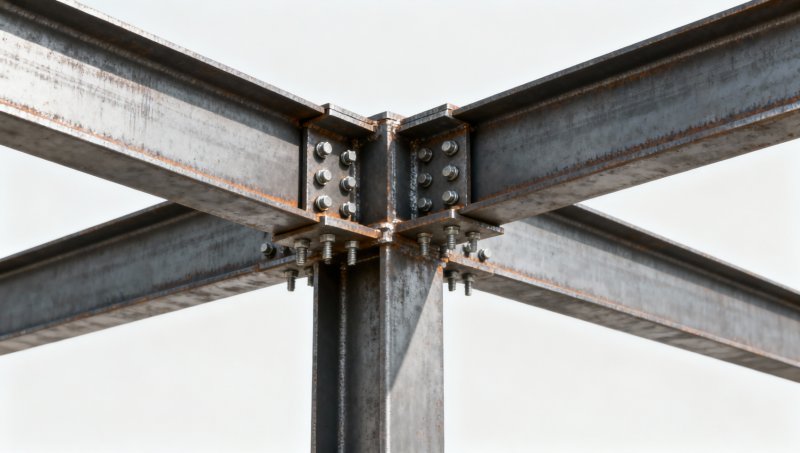
Connections can change the result. A smaller beam may need different end plates, welds or stiffeners, and an S355JR member does not automatically allow a lighter connection. Bolt resistance, weld resistance, plate thickness and load transfer must be checked as a system. If changing the grade forces extensive connection redesign, fabrication costs may outweigh the material saving.
Lead time and substitution risk deserve a place in the comparison. A standard S275JR section available in the required lengths may be more useful to the project than an optimized S355JR section with an incompatible delivery schedule. Before accepting a proposed replacement, check both the grade and the section properties; an apparently equivalent beam can differ in dimensions, mass, tolerances or connection fit.
Welding and fabrication: grade alone is not the procedure
Both grades are commonly fabricated by welding, but “weldable” does not mean that every joint can be welded under the same conditions. Section thickness, joint restraint, heat input, consumables and the material’s carbon equivalent influence the welding procedure and the risk of cracking. The fabricator should establish whether preheat or other controls are needed for the actual joint and material.
When S355JR is substituted for S275JR, review the welding procedure and consumable selection against the required joint performance. A stronger parent metal does not compensate for an inadequate weld, and matching nominal strengths is not the only design consideration. For heavily restrained joints or thick material, fabrication planning should begin before the section schedule is finalized.
Cutting, drilling, coatings and distortion control also belong in the comparison. If the same section is retained and only the grade changes, a frame may gain resistance without gaining the weight benefit that justified the upgrade. If the section changes, check whether existing details, bolt spacing and fabrication equipment remain suitable.
Check the product form before treating grades as interchangeable
S275JR and S355JR are commonly discussed in connection with hot-rolled beams, channels, angles and plates. A hollow section or pipe may be supplied to a different product standard, with different manufacturing, testing and dimensional requirements. Similar strength labels do not establish that two products are interchangeable in a building frame.
For example, Hongteng Fengda lists High Carbon Steel Pipe in a range of named grades and standards for industrial applications. Those listings are not, by themselves, a specification for an S275JR or S355JR structural hollow section. Where tubular members are proposed, the design and purchase documents should identify the required structural product standard, grade, dimensions and inspection documentation. The product title alone is not a basis for assigning carbon content or structural suitability.
The same caution applies to cross-standard substitutions. A steel grade described under ASTM, JIS or GB may have overlapping strength characteristics, but differences in chemistry, toughness, product form and delivery condition can matter. Treat an alternative as a proposed change for engineering review, not as an automatic equivalent.
What to put in the purchasing specification
A useful inquiry starts with the approved design, then makes the intended material identifiable throughout procurement and fabrication. Include:
- Product and grade: the applicable product standard, S275JR or S355JR, section designation and any project-specific toughness requirements.
- Dimensions and quantities: member sizes, lengths, thicknesses and tolerances needed for fabrication and transport.
- Delivery condition: any specified requirements for the product’s manufacturing or supply condition, surface preparation and coating.
- Inspection documents: the required certificate type, traceability arrangements and any agreed testing or inspection requirements.
- Substitution process: whether alternative sections, grades or standards may be proposed and who must approve them before supply.
Review the material certificate against the ordered product, including the grade, dimensions, reported test results and traceability to the supplied pieces. For a mixed-grade order, agree how individual members will be marked and segregated through fabrication. A certificate is valuable only when it can be associated with the material installed in the frame.
The most defensible selection is therefore a comparison of two engineered and purchasable options. Start with the governing checks, develop an S275JR and an S355JR section schedule where both are feasible, and compare the complete supplied and fabricated cost. Retain the grade that meets the required resistance, serviceability, toughness and delivery conditions with the clearest overall benefit.
Please give us a message


Please enter what you want to find