Choosing between S355JR Steel Plate and S235JR can directly affect project strength, budget, and procurement efficiency. For buyers in construction and manufacturing, understanding the differences in mechanical performance, application suitability, and total cost is essential. This guide compares both steel grades to help you make a practical sourcing decision with better value and lower risk.
What Buyers Are Really Comparing: Higher Strength vs Lower Initial Cost
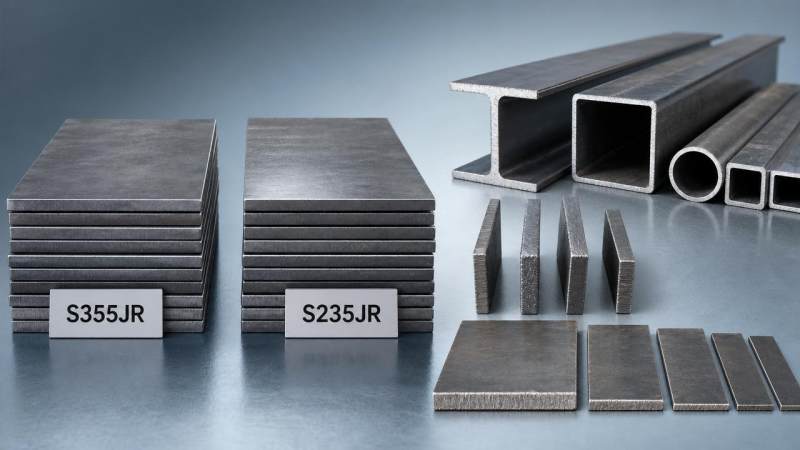
For procurement teams, the real question is not simply which steel grade is better. It is which grade delivers the required structural performance at the lowest practical project cost.
In most cases, S355JR Steel Plate offers higher strength and better load-bearing capacity, while S235JR usually provides a lower purchase price for general fabrication and lighter-duty structures.
If your design is load-sensitive, weight-sensitive, or intended for longer spans, S355JR often creates better value. If your application is simple and lightly loaded, S235JR may be sufficient.
The best choice depends on how strength, plate thickness, fabrication cost, transport weight, and compliance requirements interact in your actual project rather than on material price alone.
Core Search Intent: What Procurement Professionals Need to Know First
When buyers search for S355JR Steel Plate versus S235JR, they usually want a fast and reliable answer to three practical questions before requesting quotations or approving orders.
First, they want to know the mechanical difference and whether the higher grade is truly necessary. Second, they want to understand the price gap. Third, they want to reduce sourcing risk.
That means the article should focus on specification decisions, suitability by application, and total purchasing value. General textbook descriptions matter less than clear guidance for real buying decisions.
Mechanical Difference Between S355JR and S235JR
The biggest difference is yield strength. S235JR has a minimum yield strength of 235 MPa, while S355JR Steel Plate has a minimum yield strength of 355 MPa.
That difference is significant for structural design because yield strength strongly influences the amount of load a component can carry before permanent deformation begins.
Tensile strength also differs. S235JR generally falls around 360 to 510 MPa, while S355JR generally ranges around 470 to 630 MPa depending on thickness and supply condition.
In practical terms, S355JR can support heavier loads or allow engineers to reduce section size in many applications. This can improve efficiency in buildings, machinery frames, and industrial support systems.
Both grades are common non-alloy structural steels under EN standards, and both are widely available in plates, sections, and fabricated components for international projects.
How Strength Affects Actual Project Cost
Many buyers focus first on the per-ton price difference, but that can lead to incomplete cost analysis. Stronger steel may cost more per ton while lowering total steel consumption.
When S355JR is used, engineers may be able to specify thinner plates or lighter structural members without sacrificing required strength. This can reduce material weight across the project.
Lower weight can create savings in freight, handling, installation, and sometimes foundation design. In export business, shipping cost reductions can become especially meaningful for large-volume orders.
However, these savings do not automatically apply to every project. If the design is not strength-controlled, the upgrade from S235JR to S355JR may increase cost without bringing real benefit.
This is why procurement should compare not only material quotations, but also tonnage impact, fabrication methods, and the final installed cost of the structure or component.
When S235JR Is the Smarter Buying Option
S235JR remains a practical and economical option for many general applications. It is commonly selected where loading is moderate, structural complexity is limited, and compliance requirements are straightforward.
Typical examples include basic platforms, light supports, general welded frames, non-critical brackets, and parts where larger section size does not create major cost pressure.
If your project has generous design margins and there is no need to optimize weight, S235JR can offer solid value and easier budget control.
For buyers working on cost-sensitive standard fabrication, S235JR may be fully adequate as long as the design engineer confirms the grade meets all mechanical and safety requirements.
When S355JR Steel Plate Creates Better Value
S355JR Steel Plate becomes more attractive when the project must carry higher loads, span longer distances, or maintain strength with reduced weight and section thickness.
It is often used in structural frames, industrial buildings, equipment bases, transport-related structures, and engineered steel components that face greater stress or stricter performance demands.
For export buyers, choosing a higher-strength grade can also support specification alignment with international project requirements, especially when the end customer prioritizes durability and structural reliability.
In many cases, S355JR is not just a premium material. It is a risk-control choice that helps avoid under-specification, redesign, and costly delays during project execution.
Cost Comparison: Material Price, Processing, and Supply Considerations
From a raw material perspective, S355JR typically costs more than S235JR. The exact difference changes with market conditions, mill origin, thickness, order quantity, and international freight rates.
Procurement teams should also check whether the grade change affects fabrication. In most standard operations, both grades can be cut, welded, and processed effectively, but shop practice still matters.
If the project involves a high volume of formed or customized parts, discuss processing capability with the supplier early. Stable quality matters more than saving a small amount on quoted ton price.
Lead time is another factor. In some regions or order combinations, S235JR may be easier to source quickly. In other cases, exporters with regular production schedules can supply both grades efficiently.
A useful sourcing method is to request parallel quotations with full details including thickness, dimensions, tolerances, testing, delivery term, and certification instead of comparing headline prices only.
Why Procurement Should Review the Entire Structural Package
Buyers often source steel plate together with structural profiles, support members, or fabricated components. In that situation, grade selection should be coordinated across the full package.
For example, in light steel structures, purlins and wall beams may use formed sections rather than heavy plate. Matching the correct material grade to each component can improve overall cost efficiency.
A practical example is C Beam Steel, which is widely used in purlins, wall beams, lightweight roof trusses, brackets, and light manufacturing structures.
It can be supplied in materials such as Q195, Q235, Q345, A36, SS400, and s235jr, with galvanized, powder-coated, or black varnish surfaces depending on project requirements.
For procurement teams buying a combination of plate and formed sections, integrated sourcing can simplify quality control, dimensional consistency, processing service, and delivery schedule management.
That is especially helpful when the supplier can provide cutting, punching, welding, and custom lengths under recognized standards such as ASTM, DIN, GB, JIS, and related certifications.
What Questions Buyers Should Ask Suppliers Before Ordering
To reduce risk, procurement should go beyond grade names and verify the exact supply details. The same grade can still vary in consistency, inspection level, and documentation quality.
Start by confirming the applicable standard, plate thickness range, chemical composition requirements, and mechanical property guarantees. Ask whether mill test certificates will be provided with shipment.
Next, check tolerance control, surface condition, cutting options, and whether third-party inspection is available. These details matter when the steel will enter fabrication immediately after arrival.
It is also wise to ask about export packaging, loading methods, corrosion protection, and lead time reliability. These factors directly affect receiving condition and downstream schedule performance.
For international orders, make sure the quotation clearly states trade terms, payment terms, destination port, and claim procedure in case of quality or quantity discrepancy.
Common Buying Mistakes in S355JR and S235JR Selection
One common mistake is selecting S355JR purely because it sounds stronger and safer, without confirming whether the project design actually benefits from the higher grade.
Another mistake is choosing S235JR only because the offer price is lower, then discovering that the design needs thicker material, more weight, or even engineering revision.
Buyers also sometimes compare quotations from different suppliers without aligning specification details. Differences in testing, tolerance, plate origin, and delivery condition can distort the price comparison.
Finally, some teams separate purchasing from engineering too early. The best sourcing result usually comes when procurement, technical staff, and the supplier review the application together.
A Simple Decision Framework for Procurement Teams
If the application is lightly loaded, standardized, and budget-sensitive, start with S235JR and confirm compliance with the project engineer. This is often the most economical path.
If the project involves heavier loads, weight reduction goals, longer spans, or stronger performance expectations, evaluate S355JR Steel Plate as a value-driven option rather than a cost increase alone.
Then compare both grades based on total tons required, fabrication implications, freight cost, and lead time. This gives a more accurate picture than comparing price per ton only.
Finally, choose a supplier that can provide stable quality, international standard compliance, clear documentation, and dependable delivery support. That is often where the real procurement value is created.
Conclusion
S355JR Steel Plate and S235JR both have clear roles in structural and industrial purchasing. The right choice depends on your project’s load requirements, design efficiency goals, and total cost priorities.
S235JR is often the better option for basic and cost-sensitive applications. S355JR is often the stronger commercial choice when performance, weight optimization, or structural reliability matters more.
For procurement professionals, the smartest decision comes from balancing mechanical performance, processing needs, and sourcing risk instead of focusing on price alone.
When that evaluation is done correctly, you can improve budget control, reduce project delays, and secure steel products that match both engineering needs and business objectives.
Please give us a message


Please enter what you want to find