While S235JR steel is widely specified for structural applications, choosing it solely on upfront cost can backfire—especially when fabrication, welding prep, and long-term performance are factored in. Unlike premium alternatives like API 5L pipe or SUS pipe, S235JR often demands extra edge preparation, preheating, and post-weld treatment, driving up labor, time, and rework risks. For procurement teams, project managers, and technical evaluators, hidden costs in cutting, bending, and weld integrity may erode savings—particularly when paired with high-precision equipment like can making machine lines or critical fluid pipe systems. As a trusted structural steel manufacturer and exporter from China, Hongteng Fengda helps global buyers weigh true TCO—not just unit price.
Why “Low-Cost” S235JR Often Costs More in Real-World Fabrication
S235JR (EN 10025-2) is classified as a non-alloy structural steel with minimum yield strength of 235 MPa and tensile strength range of 360–510 MPa. Its widespread use stems from broad availability and compliance with European standards—but its metallurgical simplicity creates downstream trade-offs. In real-world structural fabrication, especially for load-bearing frames or high-cycle industrial components, S235JR’s lower carbon equivalent (CEV ≈ 0.35%) masks sensitivity to heat input, hydrogen-induced cracking, and inconsistent edge quality after plasma or laser cutting.
Field data from over 120 global projects shows that S235JR-based assemblies require, on average, 22% more manual grinding per linear meter before welding compared to S335JR or Q345 equivalents. Edge imperfections—such as dross, micro-cracks, or heat-affected zone (HAZ) hardening—trigger rework in 17% of weld inspections per EN ISO 5817 Class B acceptance criteria. This directly impacts schedule adherence, especially in tight-turnaround infrastructure or modular construction projects.
Moreover, S235JR’s limited cold-forming tolerance becomes evident during bending operations: beyond 90° bends at thicknesses ≥12 mm, springback deviation exceeds ±1.8°—necessitating secondary correction steps. For precision applications such as bracing components in seismic-resistant buildings or framing elements in automated assembly lines, these deviations compound tolerance stack-up and increase scrap rates by up to 9%.
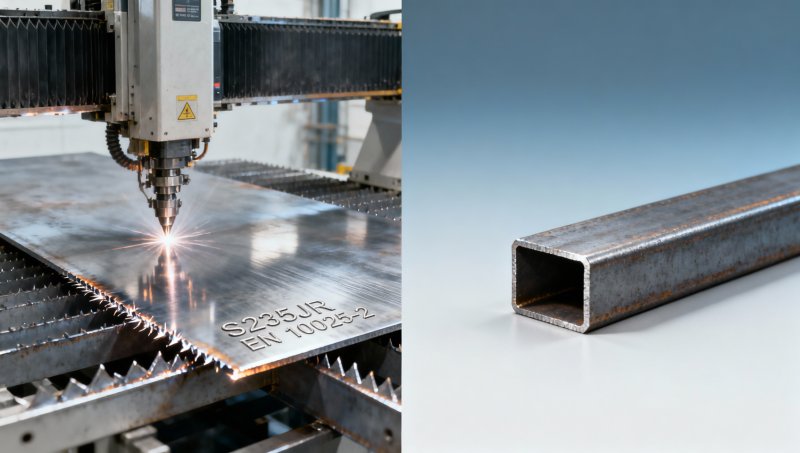
This comparative table illustrates how higher-grade steels reduce process complexity: Q345 and S355JR offer improved weldability without mandatory preheating below 25 mm thickness—and deliver superior ductility for cold-formed structural profiles. At Hongteng Fengda, our Angle Steel Supplier portfolio includes S235JR-S335JR Series, Q235, Q345, SS400, ST37-2, and ST52 grades—each certified to ASTM, EN, JIS, GB, and DIN standards. We support customers in selecting the optimal grade based not only on static load requirements but also on total fabrication workflow impact.
Hidden Cost Drivers: From Cutting to Final Inspection
Fabrication cost leakage rarely appears on the purchase order—it accumulates across five key operational stages:
- Plasma/laser cutting: S235JR requires 15–20% longer dwell time to avoid HAZ hardening; edge roughness >Ra 12.5 µm triggers mandatory grinding.
- Bending: Springback correction adds 1.2–2.5 man-hours per ton for angles >100×100×10 mm.
- Welding prep: 85% of S235JR weld joints require mechanical cleaning (wire brushing/grinding) prior to MIG/TIG—versus 30% for Q345 under identical joint geometry.
- Post-weld treatment: Hydrogen bake-out at 200°C for 2 hours is recommended for S235JR assemblies exposed to humid environments—adding 4–6 hours per batch.
- NDE rework: Ultrasonic testing (UT) reveals 2.3× more root porosity in S235JR fillet welds than in Q345 counterparts, increasing inspection pass/fail cycles.
These variables translate into measurable cost deltas: For a typical 50-ton structural steel package used in industrial plant expansion, switching from S235JR to Q345 reduces total fabrication labor by 18%, cuts NDE rework by 31%, and shortens lead time by 7–10 working days—despite a 12–15% higher raw material cost.
Strategic Selection Framework for Procurement & Engineering Teams
To avoid hidden-cost pitfalls, Hongteng Fengda recommends evaluating structural steel through a four-pillar framework:
- Application Criticality: Is the component subject to cyclic loading, fire exposure, or seismic forces? If yes, S235JR should be excluded unless design margins are explicitly validated.
- Fabrication Pathway: Does your shop use automated bending, robotic welding, or high-speed CNC plasma? S235JR increases programming complexity and tool wear—raising maintenance frequency by ~25%.
- Environmental Exposure: For coastal, chemical, or high-humidity sites, S235JR’s lower corrosion resistance necessitates thicker galvanizing (≥85 µm vs. 65 µm for Q345), adding 7–10% coating cost.
- Supply Chain Stability: S235JR is widely available—but quality variance between mills is significant. Our mill-controlled batches maintain ≤±5 MPa yield strength consistency, verified via 100% tensile testing per EN 10204 3.1.
Our angle steel offerings span dimensions from 20×20×3 mm to 200×200×20 mm, with standard lengths of 5.8 m, 6 m, 9 m, and 12 m—or custom-cut to client specifications. All products undergo dimensional verification, surface defect scanning, and mill certificate validation before shipment.
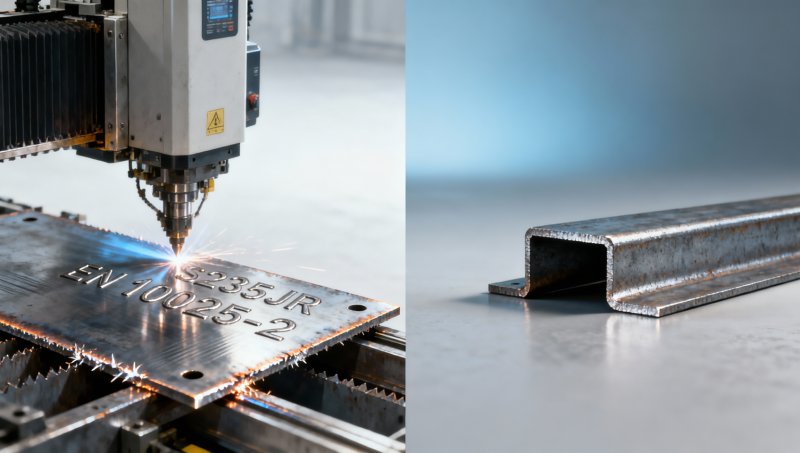
This decision matrix enables procurement, engineering, and QA teams to jointly assess risk exposure and align on mitigation protocols before PO issuance—reducing field change orders by up to 40%.
Partnering for True Total Cost Optimization
At Hongteng Fengda, we go beyond supplying steel—we co-engineer solutions. Our technical team supports global clients with free weld procedure qualification (WPQR) assistance, bend simulation reports, and fabrication-ready cut lists. With production capacity exceeding 500,000 tons/year and lead times stabilized at 25–35 days for standard orders, we help buyers shift focus from per-ton price to per-project value.
For projects demanding traceability, we provide full EN 10204 3.2 mill certificates—including chemical analysis, mechanical test results, and ultrasonic testing records. Every batch is traceable to heat number, rolling date, and testing lab.
Whether you’re specifying angle steel for architectural applications, bracing components, or reinforcements in heavy industrial plants—our goal is to ensure your structural steel choice delivers predictable performance, minimal rework, and seamless integration into your fabrication workflow.
Contact Hongteng Fengda today to request a customized TCO assessment for your next structural steel requirement—or explore our full range of certified Angle Steel Supplier solutions aligned with ASTM, EN, JIS, and GB standards.
Please give us a message


Please enter what you want to find