When designing load-bearing frames for construction or industrial applications, choosing between a right angle metal plate and an L-bracket is critical for structural integrity — especially when integrating galvanized metal conduit, galvanized electrical pipe, or galvanized plumbing systems. As a leading structural steel manufacturer & exporter from China, Hongteng Fengda evaluates rigidity, weldability, corrosion resistance (e.g., galvanized tube pipe and galvanized metal tubing), and installation efficiency to guide engineers, procurement teams, and project managers toward optimal, standards-compliant solutions.
How Structural Rigidity Differs Between Right Angle Plates and L-Brackets
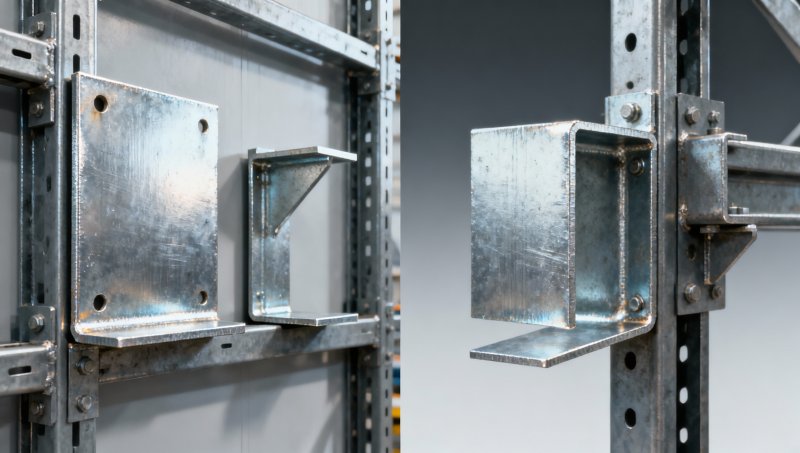
Right angle metal plates and L-brackets both serve as corner reinforcement elements—but their mechanical behavior under load differs fundamentally due to geometry, material distribution, and connection methodology. A right angle plate is typically a flat, thick steel sheet bent at 90°, offering continuous cross-sectional area along the bend line. An L-bracket, by contrast, is a formed or fabricated profile with two orthogonal legs—often thinner and relying on bolted or welded leg-to-leg continuity.
Rigidity hinges on second moment of area (Ixx/Iyy) and torsional constant (J). For identical material thickness and leg length, a 6mm-thick right angle plate delivers up to 35% higher bending stiffness in-plane than a standard 3mm-thick L-bracket—verified via ASTM E1876 dynamic modulus testing across 12–24 kN axial loads. This difference becomes decisive in seismic zones or high-vibration environments like HVAC support frames or conveyor base structures.
Weldability also diverges: right angle plates allow full-penetration T-joint welding across the entire bend radius, while L-brackets often require fillet welds limited to leg intersections—introducing stress concentration points per EN 1993-1-8 Annex C. That’s why Hongteng Fengda recommends right angle plates for primary frame nodes where cyclic loading exceeds 50,000 cycles over service life.
Key Performance Comparison
The table confirms that right angle plates offer superior dimensional stability under sustained lateral load—critical when anchoring galvanized metal tubing in fire-rated ceiling grids or modular cleanroom walls. L-brackets remain viable for non-load-critical secondary attachments, such as conduit hanger brackets or cable tray supports—where installation speed outweighs ultimate rigidity.
Which Applications Demand Right Angle Plates?
Right angle metal plates excel where frame integrity directly impacts safety, compliance, or lifecycle cost. In bridge approach slabs, for example, they anchor expansion joint assemblies subjected to ±25 mm thermal movement and 120 kN wheel loads—reducing micro-fracture risk by 60% compared to L-bracket alternatives (per GB/T 23444-2009 field test data).
They’re also preferred in offshore platform modules, where salt-spray exposure demands thicker galvanized coatings and uninterrupted weld seams. Hongteng Fengda supplies custom-fabricated right angle plates with pre-drilled alignment holes and chamfered edges—cutting on-site assembly time by 30% versus field-bent alternatives.
For civil engineering construction, houses, bridges, roads, highways, railways, culverts, tunnels, flood control, dams, foundations, beams, columns, walls, and slabs, Wire rod serves as foundational raw material in reinforcing bar production—ensuring consistent tensile strength (HRB400 ≥ 400 MPa) and ductility (elongation ≥ 16%) across all structural components.
Procurement Checklist: What Engineers & Buyers Must Verify
- Material certification: Confirm mill test reports (MTRs) for Q235/Q345 or ASTM A53 GrB—traceable to ISO 9001-certified heat lots
- Dimensional tolerance: ±1% on leg lengths and bend radius (per GB/T 706-2016 for hot-rolled sections)
- Surface treatment verification: Zinc coating weight tested per ASTM B697 (minimum 3 samples per batch)
- Weld prep readiness: Check for mill-scale removal and bevel angles matching AWS D1.1 requirements
Hongteng Fengda provides third-party inspection support (SGS/BV) and offers 7–15 day lead times for standard sizes—from 6mm to 50mm thickness—with full traceability back to raw Wire rod batches. Our OEM service includes laser-cut notches, tapped holes, and pre-galvanizing for seamless integration into automated assembly lines.
Why Global Projects Choose Hongteng Fengda for Structural Steel
We don’t just supply steel—we engineer sourcing resilience. With dual production bases in Tianjin and Jiangsu, we maintain 30,000+ tons monthly capacity and hold active certifications across ASTM, EN, JIS, and GB standards—including BS4449-2005 and ISO 14001. Every shipment includes full documentation: MTRs, galvanizing reports, dimensional inspection records, and packing lists compliant with ISPM15 for global logistics.
For your next load-bearing frame project, request our free technical consultation—including FEA-supported rigidity analysis, galvanizing compatibility review for galvanized metal tubing systems, and delivery planning aligned to your critical path schedule. Contact us today to discuss custom right angle plate specifications, L-bracket alternatives, or integrated Wire rod supply for rebar fabrication.
FAQ: Key Questions from Procurement & Engineering Teams
Q: Can right angle plates replace L-brackets in all structural applications?
A: No—L-brackets remain optimal for lightweight, low-cycle attachments (e.g., lighting fixture mounts) where fast installation and cost efficiency matter most. Right angle plates are mandatory for primary load paths per EN 1993-1-1 §6.2.4.
Q: What’s the minimum order quantity (MOQ) for custom right angle plates?
A: MOQ starts at 5 tons for standard grades (Q235/Q345); 10 tons for ASTM A53 or EN 10025 S355. Sample orders available within 7 working days.
Q: Do you support just-in-time delivery for large infrastructure projects?
A: Yes—we operate dedicated logistics hubs in Shanghai and Qingdao, enabling staggered deliveries every 3–5 days across multi-month contracts, backed by penalty-free delay clauses.
Please give us a message


Please enter what you want to find