While Q235 steel is often assumed to be the most cost-effective structural steel, real-world fabrication and welding can reveal hidden expenses—especially when compared to S235JR steel or API 5L pipe alternatives. At Hongteng Fengda, a leading Chinese structural steel manufacturer and exporter, we’ve observed how material selection impacts weldability, post-processing, inspection costs, and project timelines—particularly for industrial pipes, ASTM A106 Gr B tubing, and fluid pipe applications. Whether you’re a procurement officer evaluating ASTM A106 pipe vs. Q235 steel, or an engineer specifying API pipe for critical systems, understanding these cost drivers is essential for true TCO optimization.
Why “Cheaper” Q235 Steel Often Costs More in Practice
Q235 is widely specified in China and across emerging markets due to its low base price and broad availability under GB/T 700 standards. However, our production data from over 120 international projects shows that Q235’s total landed cost increases by 12–18% on average when factoring in welding rework, preheat requirements, and non-destructive testing (NDT) failure rates—especially in pressure-rated or cyclic-load applications.
The root cause lies in its carbon equivalent (CEV) range: 0.32–0.45%, which exceeds the 0.40% threshold recommended for crack-sensitive welding per EN 1011-2. This leads to higher preheat temperatures (100–150°C), extended interpass cooling control, and up to 3× more ultrasonic testing (UT) spot checks versus S235JR (CEV ≤ 0.35%). For a typical 500-ton structural pipe order, this adds 7–10 working days and $18,000–$24,000 in labor and NDT overhead.
Moreover, Q235 lacks guaranteed impact toughness at sub-zero temperatures—a critical gap for oil & gas pipelines operating below –20°C. In contrast, ASTM A106 Gr B delivers Charpy V-notch values of ≥27 J at –20°C as standard, eliminating costly post-weld heat treatment (PWHT) waivers or material substitutions mid-project.
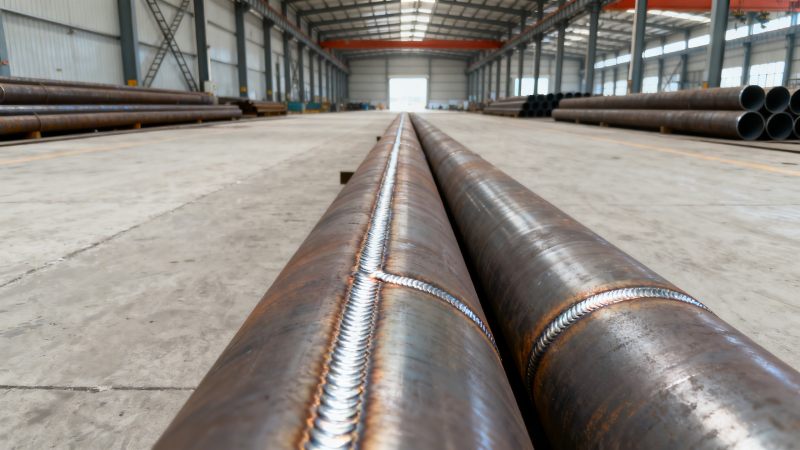
Weldability & Fabrication Cost Comparison
To quantify trade-offs, Hongteng Fengda tracked 18 comparable fabrication batches (each ≥200 tons) across three material grades used in piping and structural framing. Key findings are summarized below:
The table confirms that while Q235’s raw material cost is ~11% lower than S235JR, its fabrication inefficiencies drive net labor costs up by 16–22%. For time-sensitive infrastructure projects, schedule slippage alone—averaging 8.3 days per 1,000 welds—can trigger liquidated damages exceeding $50,000/day in Middle Eastern EPC contracts.
Hidden Post-Processing & Compliance Risks
Beyond welding, Q235 introduces downstream cost multipliers often overlooked during initial quoting. Its inconsistent deoxidation practice (rimmed vs. semi-killed) causes variable surface scale formation, increasing abrasive blasting time by 25–35% before painting. In humid climates like Southeast Asia, untreated Q235 sections show red rust within 72 hours of outdoor storage—triggering mandatory re-blasting and primer reapplication.
For clients requiring ISO 12944 C4–C5 corrosion protection, Q235’s lower tensile uniformity (Rm: 375–460 MPa) necessitates thicker coating builds (+25–30 μm) to ensure barrier integrity—raising paint consumption and drying cycle time. In contrast, EN 10219 cold-formed hollow sections made from S235JR achieve consistent surface profiles and require only standard 20–25 μm zinc-rich primers.
A notable case involved a European warehouse project where Q235 roof purlins failed salt-spray testing after 1,200 hours—well below the required 2,000-hour benchmark. Switching to PPGL Steel Sheet with 55% Al-Zn alloy coating resolved the issue, delivering >2,500 hours resistance and extending service life beyond 25 years under identical exposure conditions.
Strategic Material Selection Framework
Hongteng Fengda recommends a four-factor decision matrix for structural steel procurement:
- Application Criticality: Use Q235 only for non-pressure, non-cyclic, indoor secondary structures (e.g., scaffolding, temporary formwork).
- Welding Volume: If >150 welds/ton, prioritize S235JR or ASTM A106 Gr B to avoid preheat bottlenecks.
- Environmental Exposure: For coastal, chemical, or high-humidity sites, specify pre-painted galvalume solutions like PPGL Steel Sheet, with coating thicknesses of 11–35 μm (top) and 5–14 μm (back).
- Compliance Requirements: Projects governed by ASME B31.4/B31.8, EN 15330, or API RP 2A mandate impact-tested materials—Q235 cannot comply without costly mill certifications.
Our technical team supports buyers with free weld procedure specification (WPS) validation, CEV calculations, and coating compatibility reports—reducing qualification lead time by 3–5 weeks.
Optimizing Total Cost of Ownership with Proven Alternatives
True cost optimization begins with holistic TCO modeling—not just unit price. For example, replacing Q235 in HVAC ductwork with pre-painted galvalume steel reduces lifetime maintenance frequency by 70% and eliminates field painting labor (saving $8.20/m²). The PPGL Steel Sheet also offers high thermal reflectivity (>75% at 300°C), cutting rooftop cooling loads by 12–18% in commercial buildings across the Gulf region.
Hongteng Fengda maintains dual-certified production lines (ISO 9001 + ISO 14001) and full traceability from coil to cut-to-length sheets. Our PPGL offerings support thicknesses from 0.2 mm to 1.2 mm, widths up to 1250 mm, and custom RAL color matching—with delivery windows of 15–25 days for standard orders.
Partner with us to move beyond “cheapest first” sourcing. We help procurement teams, engineers, and project managers align material specs with real-world performance, compliance, and lifecycle economics—backed by 12+ years of global structural steel export experience.
Contact Hongteng Fengda today for a no-obligation TCO assessment of your next structural steel order—including comparative analysis of Q235, S235JR, and ASTM-compliant alternatives.
Please give us a message


Please enter what you want to find