How to Evaluate a Profile Steel Distributor—When Stock, Cutting, and JIT Delivery Actually Matter
If you’re sourcing structural steel for a live construction or industrial project—and your schedule is tight, your tolerances narrow, and your budget non-negotiable—you’re not evaluating distributors on “reputation” or “years in business.” You’re testing whether they can reliably deliver the right profile, cut to spec, at the exact moment it’s needed on-site. That’s the real filter. And most procurement teams discover too late that “stock availability” doesn’t mean what they assumed, “cutting service” isn’t standardized across vendors, and “just-in-time” often means “just-in-trouble.”
Stock Range: It’s Not About Quantity—It’s About Relevance and Readiness
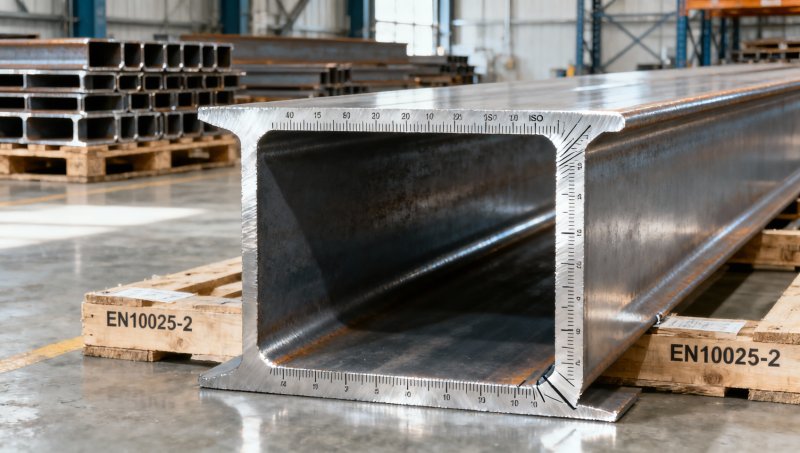
A distributor claiming “10,000 tons of angle and channel in stock” tells you almost nothing—unless you know which sizes, grades, and lengths are physically staged, certified, and ready to ship within 48 hours. For example, if your bridge substructure calls for S355JR channels in 6.0 m lengths with mill-certified EN10025-2 test reports, but the distributor’s “in-stock” listing only shows SS400 in 12 m bundles (requiring secondary cutting and re-testing), that inventory isn’t functional for your timeline.
True readiness means: • Standard profiles (angles, channels, T-sections, H Shape Beam) held in key regional hubs—not just at the factory gate; • Minimum 3–5 common cross-sections per grade (e.g., Q345B, A572 Gr 50, S275JR) available in ≤6 m increments, not just full-length bars; • Traceable material certs pre-attached to stock lots—not generated on request.
Without this, every order becomes a mini-sourcing exercise: checking lot numbers, waiting for certs, confirming dimensional compliance. That’s where delays compound—not from customs or shipping, but from internal verification bottlenecks.
Cutting Services: Precision Isn’t Optional—It’s a Cost Multiplier If Done Wrong
Off-site cutting isn’t a convenience—it’s a quality and cost control point. But not all cutting is equal. Plasma-cut edges on structural sections introduce heat-affected zones that compromise weld integrity in high-stress applications like crane rails or seismic bracing. Saw-cutting avoids that—but only if the saw has sufficient rigidity, blade geometry, and feed control to hold ±0.5 mm tolerance across a 300 mm flange width.
What procurement teams should verify—not assume: • Whether cutting is performed in-house (with calibrated equipment and documented procedures) or outsourced to third-party shops without traceability; • Whether edge preparation (beveling, grinding, chamfering) is included—and if it meets AWS D1.1 or EN ISO 9692-1 requirements for subsequent welding; • Whether cut pieces are marked with heat number, grade, and orientation (e.g., “web up”) to prevent field assembly errors.
One North American fabrication shop recently delayed a $4.2M wind tower project by 11 days because its distributor supplied laser-cut H-beams with inconsistent bevel angles—forcing rework on 87 components. The cost wasn’t just labor: it triggered penalty clauses for missed milestones. That risk lives entirely in how cutting is specified, executed, and verified—not in the steel grade itself.
Just-in-Time Delivery: It Fails When Logistics Aren’t Integrated With Production
JIT works only when the distributor’s logistics engine talks directly to their production planning—not just their ERP system. Consider a mechanical manufacturing plant in Poland ordering cold-formed C-sections for an automated assembly line. They need 220 pieces delivered in three batches over eight days, each batch timed to match line shutdown windows. A distributor with standalone freight forwarding can’t guarantee that. But one with synchronized warehouse scheduling, real-time production floor visibility, and regional cross-docking can—because their “delivery window” is defined by machine downtime, not carrier ETAs.
This requires infrastructure few profile steel distributors actually possess: • Regional consolidation hubs near major industrial clusters (e.g., Ruhr Valley, Greater Toronto, GCC industrial zones); • Dynamic slot booking—not just “next available truck”—so buyers reserve delivery time, not just date; • Real-time shipment tracking tied to mill release status, not just container departure.
For buyers in Southeast Asia or the Middle East, this integration is even more critical. Port congestion, inland transport variability, and customs clearance unpredictability mean JIT isn’t about speed—it’s about predictability. A 72-hour delivery window with 98% on-time performance beats a “48-hour express” promise with 65% reliability every time.
Where the Framework Breaks Down—And What to Watch For
Three red flags rarely appear in brochures but consistently derail procurement: • “Stocked to order” claims: Some distributors list “A992 beams in stock” while holding only one or two heats—and no backup supply agreement. If your project needs 120 tons across six heat numbers (for weld matching), that “stock” evaporates fast. • Uncertified cutting: A distributor may offer “free cutting,” but omit that their saw isn’t calibrated to ISO 9001 Annex A.2 for dimensional accuracy—or that they don’t retain cut-off samples for QA review. • JIT without buffer logic: True JIT includes contingency—e.g., holding 5% of critical sections as safety stock at destination hubs. If a distributor promises JIT but has zero local buffer, one port delay cascades into a full stop.
These aren’t theoretical risks. They’re recurring failure points we’ve observed across projects from Dubai data centers to Ohio automotive plants—where procurement teams treated distributor evaluation as a paperwork exercise, not a supply chain stress test.
So—What Should You Do Next?
Start with your next active RFQ—not a hypothetical one. Pull the top three candidate distributors and ask them, in writing: • “Which specific cross-sections and grades in your ‘in-stock’ list are currently staged in [your region], with mill certs on file?” • “Can you share your cutting procedure certification—and confirm whether bevel angles are measured and recorded per piece?” • “What’s your on-time delivery rate for multi-batch JIT orders over the past 90 days—and how do you define ‘on time’ (dock-in, unloading complete, or assembly-ready placement)?”
Don’t settle for averages. Ask for the last three shipments matching your spec. Then compare—not against marketing decks, but against your actual site constraints: crane access windows, welder shift patterns, and inspection sign-off cycles. That’s where distributor capability stops being abstract—and starts determining whether your project stays on track, or starts burning contingency.
Please give us a message


Please enter what you want to find