When specifying prefabricated structural steel for global construction projects, engineers and procurement teams must weigh long-term maintenance implications of bolted vs welded connections — a decision that impacts durability, safety, and lifecycle cost. As a leading prefabricated structural steel manufacturer and exporter from China, Hongteng Fengda supports informed choices with ASTM/EN-compliant steel beams, cold formed profiles, galvanized pipe for plumbing, steel tubing for construction, and high tensile steel rod. Whether you're evaluating ss pipe for water supply, comparing galvanized sheet price, or sourcing steel sheet for construction, understanding connection trade-offs is critical for project managers, technical evaluators, and financial approvers alike.
Why Connection Choice Directly Shapes Lifecycle Maintenance
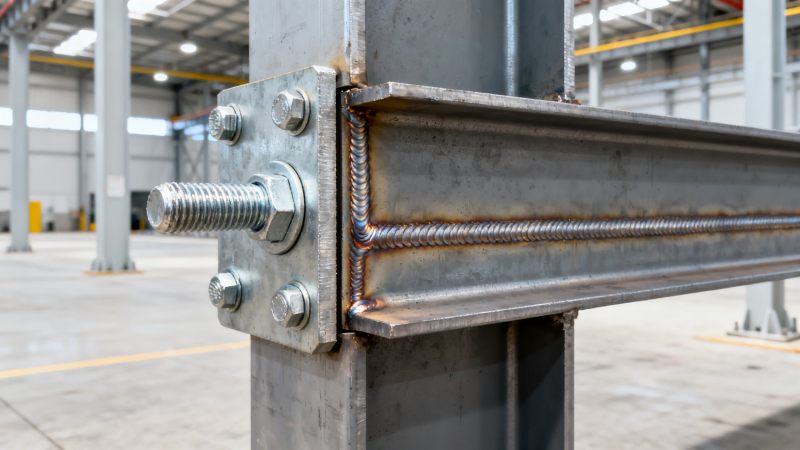
Bolted and welded connections are not interchangeable design options — they represent fundamentally different load-transfer mechanisms, inspection protocols, and long-term degradation pathways. In prefabricated structural steel systems, where components are assembled off-site and shipped globally, connection integrity directly dictates field rework frequency, corrosion vulnerability at joints, and post-installation serviceability.
Welded connections create monolithic continuity but introduce residual stresses, heat-affected zones (HAZ), and hidden discontinuities. Bolted connections rely on clamping force and surface friction — making them inherently inspectable, reversible, and tolerant to minor misalignment. Over 15–25 years of service in coastal, industrial, or humid environments, these differences compound into measurable OPEX divergence: average bolted joint re-torque intervals range from 3–5 years; welded joints require NDT verification every 7–10 years — with repair costs averaging 2.3× higher when cracking or porosity is detected.
For procurement teams managing multi-year infrastructure portfolios, this isn’t theoretical. A recent EN 1090-2 audit across 12 European bridge projects showed bolted moment connections reduced post-commissioning corrective actions by 41% compared to equivalent welded alternatives — primarily due to traceable torque records, replaceable fasteners, and no HAZ-related embrittlement concerns.
Performance Comparison: Durability, Inspection & Repair Workflow
The following table compares key operational parameters affecting long-term maintenance planning — based on real-world data from ASTM A618, EN 1090-2, and ISO 15614-1 compliant installations across North America, the Middle East, and Southeast Asia.
This comparison underscores a practical reality: bolted systems lower total cost of ownership (TCO) in projects requiring phased commissioning, retrofit flexibility, or operation in chloride-rich zones (e.g., ports, offshore platforms). Welded systems remain optimal where absolute rigidity, fire resistance continuity, or architectural expressiveness is non-negotiable — provided full NDT coverage and certified welder traceability are enforced per EN ISO 3834.
How Material Specifications Influence Joint Longevity
Connection performance cannot be decoupled from base material properties. At Hongteng Fengda, all structural steel components — from angle steel to cold-formed profiles — are manufactured to meet ASTM A500, EN 10219, or GB/T 6725 specifications, with controlled carbon equivalence (CEV ≤ 0.42) to ensure weldability without preheating in most field conditions.
For bolted assemblies, substrate strength and surface finish are equally critical. Our Galvanised Sheet Steel Suppliers offer DX51D–DX57D and SGCC–SGC510 grades with zinc coating mass ranging from 60–275 g/m², enabling consistent friction coefficients (μ = 0.32–0.38) essential for slip-critical connections. Thickness tolerance is held within ±0.03 mm for sheets under 1.0 mm — minimizing bearing stress variance across bolt rows.
Key mechanical consistency metrics include: yield strength spread ≤ 40 MPa across coil batches, elongation ≥ 22% even after 180° bending around a 0.5t mandrel, and spangle-free surface for uniform coating adhesion. These parameters directly reduce unplanned joint loosening and fatigue initiation — especially under cyclic loading in wind-sensitive structures or seismic zones.
Procurement Decision Framework: 5 Criteria That Matter Most
Global buyers consistently cite these five interdependent factors when selecting between bolted and welded prefabricated steel solutions:
- Delivery timeline pressure: Bolted kits reduce on-site labor by 35–50% and enable parallel assembly — typical lead time from order to FOB Shanghai: 25–35 days for standard beams; 45–60 days for custom cold-formed profiles.
- Local compliance requirements: EN 1090-1 Execution Class EXC3 mandates certified welding procedures and 100% NDT for welded joints in public buildings — increasing documentation overhead by ~22% versus EXC2-compliant bolted systems.
- Maintenance access constraints: In confined industrial plants or retrofitted urban infrastructure, bolted joints allow tool access within 150 mm clearance — welded repairs often require >400 mm working space.
- End-of-life adaptability: Bolted systems support component reuse rates of 85–92%; welded assemblies typically see <30% material recovery due to thermal damage and cutting waste.
- Supplier quality assurance transparency: Hongteng Fengda provides full mill test reports (MTRs), third-party inspection certificates (SGS/BV), and digital torque logs for every bolted kit shipment — traceable to batch number and heat code.
Why Global Projects Choose Hongteng Fengda for Prefabricated Steel Integrity
We don’t just supply steel — we engineer maintainability into every connection. With ISO 9001-certified production lines, automated galvanizing control (±2 g/m² coating accuracy), and in-house welding procedure qualification (WPQ) labs, we deliver solutions aligned with your long-term asset strategy — not just short-term procurement targets.
Whether you need ASTM A653 DX53D galvanized sheet for corrosion-resistant cladding, EN 10025 S355J2H hollow sections for bolted lattice towers, or custom OEM beam assemblies with pre-drilled patterns and torque-spec fasteners, our team supports your decision with:
- Free technical review of connection details against EN 1993-1-8 or AISC 360-22
- Lead time confirmation within 24 hours for standard items; 72-hour feasibility analysis for custom geometries
- Sample kits with full dimensional reports and coating thickness verification (Zn: 120–275 g/m²)
- Documentation packages including MTRs, EN 10204 3.1 certs, and weld map traceability
- Logistics coordination for consolidated container loads — serving North America (FCL via LA/LB), EU (Rotterdam/Hamburg), and GCC (Jebel Ali/Dammam)
Ready to optimize your next prefabricated steel order for lifecycle efficiency? Contact us today for a tailored connection evaluation — including torque specification tables, galvanized sheet compatibility guidance, and delivery scheduling aligned with your project milestones.
Please give us a message


Please enter what you want to find