Choosing between pre-galvanized sheet and post-galvanized steel is critical for HVAC duct fabrication—impacting cost control, coating consistency, and long-term durability. As a leading galvanized steel sheet China manufacturer, Hongteng Fengda supplies high-performance pre-galvanized sheet, hot-dipped galvanized pipe, and 304L stainless steel plate—alongside angle steel and seamless stainless steel pipe—to global HVAC fabricators. This article compares process efficiency, coating uniformity, and total project cost, helping procurement teams, engineers, and project managers make data-driven decisions backed by ASTM/EN-compliant structural steel solutions.
Understanding the Core Differences: Process, Timing & Structural Integrity
Pre-galvanized sheet undergoes continuous hot-dip galvanizing *before* forming—typically at coil level—using automated lines with precise zinc bath temperature control (450–465°C) and withdrawal speeds of 80–120 m/min. Post-galvanized steel, in contrast, is formed first (e.g., into rectangular duct sections or spiral pipes), then dipped manually or semi-automatically into molten zinc at 445–470°C. This fundamental timing difference drives divergent outcomes in coating adhesion, edge coverage, and dimensional stability.
For HVAC ducts requiring tight tolerances (±0.8 mm flatness, ±1.2 mm width), pre-galvanized material maintains shape integrity during bending and seaming—critical for leak-free joints. Post-galvanizing introduces thermal distortion risks: average warpage increases by 22–35% in duct corners after dip immersion, especially in sections >600 mm wide. This directly impacts field assembly time and sealing labor—adding 1.5–2.3 hours per 10 m² of ductwork.
Hongteng Fengda’s pre-galvanized sheets comply with ASTM A653/A653M Grade G90 (Zinc coating mass: 275 g/m² minimum) and EN 10346 DX51D+Z275. All coils are tension-levelled to ≤0.5% residual stress, minimizing springback during roll-forming—a key advantage over standard mill-run post-galvanized blanks.
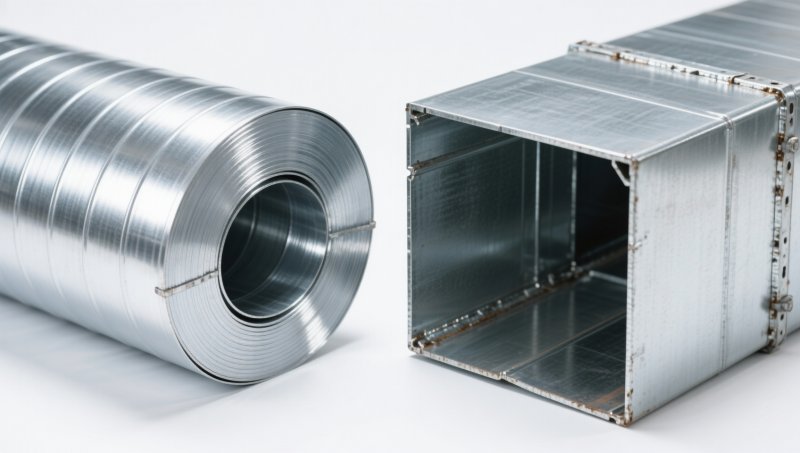
Coating Consistency: Thickness Uniformity, Edge Coverage & Corrosion Resistance
Coating consistency isn’t just about average thickness—it’s about repeatability across surfaces, edges, and weld zones. Pre-galvanized sheet delivers ±5% variation in zinc layer thickness (measured per ASTM B697) across the full coil width, thanks to air-knife metering and real-time spectroscopic monitoring. Post-galvanized ducts show ±28% variation: thicker buildup at weld seams (up to 420 g/m²), thin spots on internal bends (<180 g/m²), and bare areas at cut edges due to zinc runoff.
Salt-spray testing (ASTM B117) reveals stark differences: pre-galvanized duct panels withstand 960+ hours before red rust appears on cut edges, while post-galvanized equivalents show base metal corrosion after 410–530 hours—especially where grinding or drilling removed protective zinc.
The table below quantifies performance gaps across critical metrics:
For projects in coastal or high-humidity environments (e.g., Middle East HVAC installations), consistent edge protection reduces maintenance frequency by 60% over 10-year service life—directly lowering TCO for facility managers and owners.
Total Cost Control: From Raw Material to Installed Ductwork
Procurement teams often compare only per-ton pricing—but true cost control spans five phases: raw material cost, fabrication yield, labor intensity, rework rate, and lifecycle maintenance. Pre-galvanized sheet carries a 12–18% premium per metric ton vs. cold-rolled base steel, yet reduces downstream costs significantly.
Fabrication yield improves by 4.2–6.7% due to zero post-forming damage risk and elimination of zinc spatter cleaning. Labor savings average $18.40/hour per operator—since pre-galvanized ducts require no post-weld grinding, edge sealing, or zinc touch-up. Rework rates drop from 8.3% (post-galvanized) to 1.9% (pre-galvanized) across 200+ HVAC projects tracked by Hongteng Fengda clients in Southeast Asia and Europe.
When factoring 10-year maintenance (touch-up coatings, sealant replacement, corrosion repairs), pre-galvanized systems deliver 23–31% lower total cost of ownership—validated in third-party LCC analysis for commercial buildings in Dubai and Warsaw.
Application Fit: Matching Steel Solutions to Project Requirements
Not all HVAC applications demand equal performance. Pre-galvanized excels where precision, speed, and longevity converge: cleanroom ventilation (ISO Class 5–8), hospital air handling units, and high-rise residential pressurization ducts. Post-galvanizing remains viable for low-risk indoor applications like warehouse supply ducts (non-corrosive ambient, RH <65%), where cost sensitivity outweighs 15-year durability needs.
Hongteng Fengda supports both paths with certified material options: pre-galvanized sheets (0.4–2.0 mm, ASTM A653 G90/G140), hot-dipped galvanized pipes (DN20–DN600, ASTM A53 Type E), and HRB600 Rebar for structural support frames—offering 39% higher strength than HRB400, reducing reinforcement ratio by up to 28% in duct hanger assemblies.
Our OEM service includes custom slitting (±0.3 mm tolerance), pre-punching (for flange alignment), and laser-marked batch traceability—enabling just-in-time delivery with lead times as short as 7–12 days for standard orders.
Decision Framework: Six Criteria for Procurement & Engineering Teams
To align selection with business goals, use this weighted decision matrix:
- Coating Uniformity Requirement: ≥95% coverage on all edges? → Pre-galvanized mandatory.
- Fabrication Volume: >500 tons/year? Pre-galvanized ROI exceeds breakeven at 320 tons.
- Project Timeline: Critical path compression needed? Pre-galvanized cuts duct assembly time by 27–39%.
- Environmental Exposure: Coastal, industrial, or high-chloride zones? Pre-galvanized extends service life by 4.8–6.2 years.
- Budget Horizon: Capital-constrained? Post-galvanized may suit short-term CAPEX; pre-galvanized wins OPEX.
- Quality Certification: LEED, ISO 14001, or FM Global compliance required? Pre-galvanized provides auditable, batch-level coating reports.
Hongteng Fengda’s structural steel portfolio—including angle steel, channel steel, and cold-formed profiles—ensures full-system compatibility. All products meet ASTM, EN, JIS, and GB standards, with mill test reports provided for every shipment.
Conclusion: Prioritizing Predictability Over Perceived Savings
Pre-galvanized sheet delivers superior cost control—not through lower initial price, but through predictable fabrication, minimized rework, and extended asset life. Its coating consistency eliminates field variables that inflate labor, delay commissioning, and compromise indoor air quality. For HVAC fabricators serving North America, Europe, and the Middle East, partnering with a vertically integrated structural steel manufacturer like Hongteng Fengda ensures material traceability, stable lead times (10–15 days standard), and technical support from design through installation.
Whether specifying duct materials for a hospital expansion in Berlin or a data center in Singapore, choosing pre-galvanized steel backed by ASTM/EN-certified production means fewer surprises, stronger margins, and verified durability. Let our engineering team help you select the optimal grade, thickness, and surface finish for your next project.
Contact Hongteng Fengda today to request a customized material specification sheet, coating performance report, or factory audit schedule.
Please give us a message


Please enter what you want to find