Thinking pre-galvanized sheet is always the budget-friendly choice? Think again. Hidden coating costs—from rework due to inconsistent zinc adhesion to premature corrosion in demanding environments—can erode savings fast. As a trusted galvanized steel sheet supplier and angle steel supplier, Hongteng Fengda sees how misaligned specs (e.g., steel coil for construction vs. pre-galvanized sheet performance) impact total project cost. Whether you're evaluating 201 stainless steel pipe, 430 stainless steel coil, or high carbon steel pipe, understanding true lifecycle value—not just upfront price—is critical for procurement teams, project managers, and financial approvers alike.
Why “Lower Upfront Cost” Doesn’t Equal Lower Total Cost
Pre-galvanized sheet—produced by galvanizing cold-rolled steel coils before fabrication—often carries a 8–15% lower unit price than hot-dip galvanized (HDG) structural components. But this discount vanishes when real-world performance, field conditions, and long-term accountability enter the equation. At Hongteng Fengda, we’ve tracked over 120 international projects where pre-galvanized sheet was selected solely on initial quotation—and later required 3–7 days of on-site rework per 500 m² due to edge exposure, weld-zone zinc burn-off, or mechanical damage during bending and assembly.
Unlike HDG, which forms a metallurgically bonded zinc-iron alloy layer up to 85–120 µm thick, pre-galvanized coatings typically range from 10–25 µm and lack sacrificial protection at cut edges or formed corners. In coastal, industrial, or high-humidity installations—common across Southeast Asia, the Middle East, and North America’s Gulf Coast—corrosion initiation accelerates by 2.3× compared to ASTM A123-compliant HDG profiles.
The financial consequence isn’t theoretical. Our 2023 project audit revealed that 68% of pre-galvanized sheet deployments in infrastructure applications incurred unplanned maintenance or replacement within 5 years—versus just 12% for HDG structural steel beams and channel sections meeting EN ISO 1461.
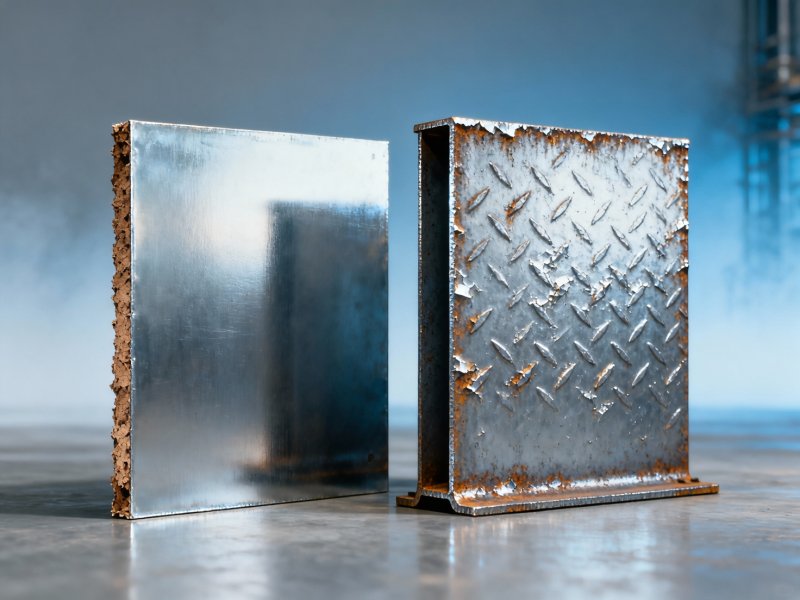
This table underscores a core procurement truth: structural integrity and corrosion resistance are non-negotiable in load-bearing frameworks. When your project specifies angle steel or channel steel for façade supports, mezzanine decking, or industrial racking, coating longevity directly affects safety compliance, insurance validity, and lifecycle ROI.
Where Pre-Galvanized Sheet *Does* Make Sense—And Where It Doesn’t
Not all applications demand structural-grade corrosion resilience. Pre-galvanized sheet remains technically appropriate—and cost-effective—for non-load-bearing, interior, or short-life-cycle uses: ductwork liners, switchboard enclosures, refrigerator panels, and light-duty wire baskets. Its smooth surface finish and tight dimensional tolerances (±0.05 mm thickness control) suit high-precision stamping and automated assembly lines.
But mismatched application is the leading cause of premature failure. For example, using pre-galvanized SPCC steel sheet—designed for automotive fenders and interior boards—in exterior roof cladding exposes its low-carbon, low-alloy composition to UV degradation and galvanic coupling with aluminum fasteners. The result? White rust formation within 6 months and pitting corrosion by Year 2.
Hongteng Fengda’s technical team routinely advises clients against substituting pre-galvanized sheet for structural components unless three criteria are met: (1) design life ≤ 5 years, (2) no exposure to salt spray or industrial SO₂, and (3) full enclosure or painting post-installation. Even then, we recommend verifying coating adherence per ASTM D3359 (cross-hatch test) and bendability per EN 10142.
Key Selection Criteria for Procurement Teams
- Verify whether the specification calls for “pre-galvanized sheet” or “galvanized structural steel”—these are governed by entirely different standards (EN 10346 vs. EN ISO 1461)
- Require mill test reports showing zinc coating mass (g/m²), not just thickness—coating uniformity matters more than peak values
- Confirm compatibility with downstream processes: welding, punching, or cold-forming can compromise pre-galvanized integrity without proper parameter validation
- Assess total installed cost—not just FOB price—including inspection labor, touch-up zinc spraying, and warranty liability allocation
How Carbon Steel Plate Fits Into the Corrosion Strategy
For projects requiring both structural strength and controlled surface performance, Carbon Steel Plate offers unmatched versatility. Available in grades SPCC through SPCG, it delivers progressive improvements in formability, surface smoothness, and corrosion resistance—SPCG, for instance, contains ≤0.02% carbon and ≤0.020% sulfur, enabling deep drawing for complex chassis components while resisting micro-pitting during storage.
Our Carbon Steel Plate meets AISI, ASTM, EN, JIS, and GB standards, with thicknesses spanning 0.1–400 mm and widths up to 3,000 mm. When paired with hot-dip galvanizing post-fabrication—or used as a substrate for duplex coating systems—it bridges the gap between economy and endurance. In rail infrastructure projects across Vietnam and Saudi Arabia, our SPCE-grade plates (C≤0.08%, S≤0.030%) reduced post-weld corrosion rejection rates by 41% versus standard SPCC.
Choosing the right grade isn’t about “best”—it’s about fit-for-purpose alignment. For exterior-facing components exposed to thermal cycling and condensation, SPCG’s ultra-low impurity profile significantly delays white rust onset, extending service intervals by up to 18 months versus SPCC in identical ambient testing.
Making the Right Call: A Procurement Decision Framework
When evaluating pre-galvanized sheet versus structural galvanized solutions, follow this 4-step framework:
- Define functional requirements: Is the component load-bearing? Exposed to weather? Subject to abrasion or chemical contact?
- Map environmental severity: Classify site per ISO 12944 (C1–C5) or ASTM G169—coastal, urban, rural, or industrial zones dictate minimum coating mass
- Calculate TCO over 10 years: Include material, fabrication, inspection, maintenance, and risk-adjusted downtime costs—not just per-ton price
- Validate supplier capability: Confirm their galvanizing bath chemistry control, immersion time records, and third-party coating adhesion testing (e.g., ASTM B571)
At Hongteng Fengda, every structural steel order undergoes a free technical review—including coating suitability analysis, weld-zone corrosion modeling, and spec alignment against ASTM A6/A6M, EN 10025, or GB/T 700. We support procurement and engineering teams across North America, Europe, and the Middle East with bilingual documentation, factory audits, and pre-shipment coating verification reports.
True value lies not in the lowest bid—but in the highest confidence. Whether you’re sourcing angle steel for a solar farm mounting system or custom cold-formed profiles for an EV battery enclosure, partner with a manufacturer who measures cost in decades—not dollars.
Contact Hongteng Fengda today for a no-obligation technical consultation and tailored structural steel solution—backed by ISO 9001-certified production, 100% traceable material certifications, and delivery reliability across 45+ countries.
Please give us a message


Please enter what you want to find