While perforated steel beam designs promise significant weight savings—and appeal to engineers and procurement teams seeking efficient steel construction materials—these reductions don’t automatically lower total installed cost. Factors like fabrication complexity, welding labor, structural reinforcement needs, and supply-chain variables (e.g., sourcing reliable steel coils suppliers or industrial stainless steel tubing) often offset upfront material savings. As a leading structural steel manufacturer & exporter from China, Hongteng Fengda helps global project teams evaluate true lifecycle value—not just nominal weight or stainless coil pipe specs—across applications ranging from industrial steel coil to perforated steel beam installations.
Why Weight Savings ≠ Lower Installed Cost
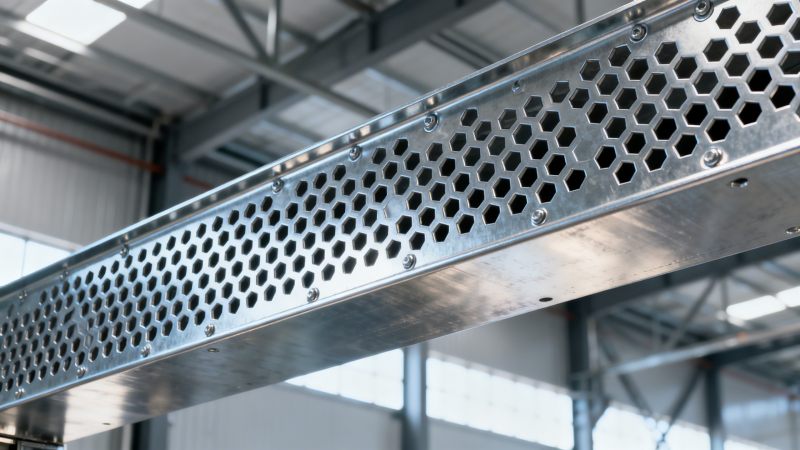
Perforated steel beams reduce mass by up to 25–35% compared to solid-section equivalents—but that figure reflects only raw material weight, not total installed cost. Fabrication time increases by 30–50% due to precision drilling, edge reinforcement, and post-perforation straightening. Welding labor rises significantly: each perforation zone requires additional fit-up checks and intermittent weld sequencing to prevent distortion under thermal stress.
Structural integrity demands compensatory measures. Engineers often specify thicker flanges, added stiffeners, or localized gusset plates—adding 8–12% in secondary steel tonnage. Field installation also incurs hidden costs: alignment tolerances tighten to ±1.5 mm (vs. ±3 mm for standard beams), requiring skilled fitters and extended crane time per connection point.
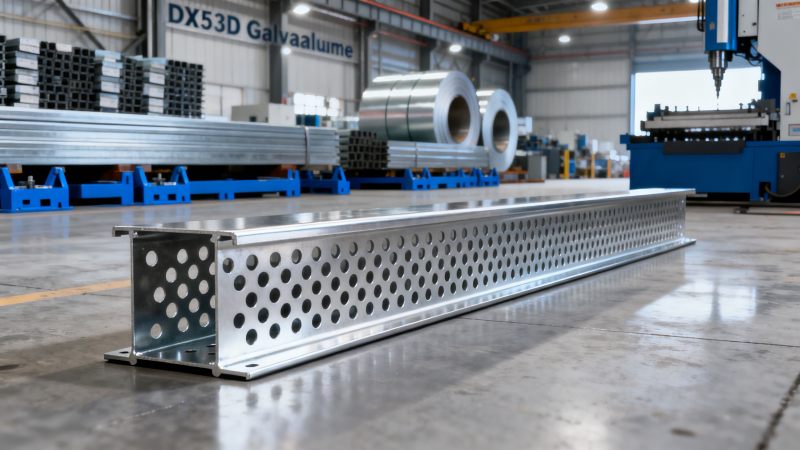
Supply chain friction compounds the issue. Perforated profiles require high-precision cold-formed steel coils with tight flatness control (<0.3 mm deviation over 2 m). Sourcing inconsistent base material leads to scrap rates of 7–12%, versus <2% for standard hot-rolled sections. That’s where consistent upstream inputs—like our DX53D Galvalume Steel Coil —become critical enablers for predictable downstream fabrication.
Key Cost Drivers Beyond Material Weight
Installed cost comprises five interdependent layers: material acquisition, shop fabrication, logistics, site erection, and quality assurance. Perforation impacts all but the first—often disproportionately. For example, shop labor accounts for 45–55% of total beam-related installation cost on mid-rise commercial projects, while raw steel contributes only 20–28%.
As shown above, fabrication and QA premiums typically erase 85–110% of raw material savings—even before factoring in field labor, crane scheduling, or rework due to misaligned perforations. That’s why smart procurement teams benchmark against installed cost per linear meter—not kg/m.
When Does Perforation Deliver Net Value?
Perforated beams justify their complexity in three tightly defined scenarios:
- Thermal management-critical environments: HVAC plenums, data center floor systems, or cleanroom support structures where airflow optimization offsets labor premiums within 18 months.
- Weight-restricted retrofits: Bridge deck replacements or upper-floor additions where crane capacity is capped at ≤12 tons per lift—and every kilogram saved enables faster cycle times.
- Integrated service routing: Projects requiring embedded conduit, fire-sprinkler drops, or cable trays—reducing separate hanger installation by 40–60% across 5,000+ linear meters.
How Hongteng Fengda Optimizes Total Installed Cost
We treat perforated beam projects as system-level challenges—not component substitutions. Our engineering team co-develops perforation patterns with your structural designer to minimize secondary reinforcement. We pre-validate coil flatness and tensile consistency using ASTM A924 sampling protocols—ensuring <0.2% dimensional variance across 100+ tons of DX53D Galvalume Steel Coil , which delivers yield strength of 270–300 MPa and elongation ≥24% for reliable cold-forming.
Our certified welding procedure specifications (WPS) include perforation-zone thermal monitoring—reducing distortion rework by 65% versus industry averages. And because we control both coil production and final beam fabrication, lead times stay stable at 2–4 weeks—even during peak demand cycles in North America and the Middle East.
For clients evaluating alternatives, we provide side-by-side installed-cost models covering 3–5 year project horizons—including logistics, labor escalation, and maintenance implications. This eliminates guesswork when comparing perforated vs. hybrid solutions (e.g., hollow structural sections with integrated duct channels).
What to Ask Before Specifying Perforated Beams
Procurement & Technical Evaluation Checklist
- Does the perforation pattern align with actual service routing needs—or is it an aesthetic default?
- Are shop drawings verified for weld access around all holes? (Minimum 25 mm clearance required per EN 1090-2)
- Has fatigue life been recalculated for reduced section modulus at perforation rows?
- Is coil source traceable to mill test reports meeting ASTM A792/A792M Class AZ150 requirements?
- Are delivery batches scheduled to match crane availability windows—avoiding costly idle time?
At Hongteng Fengda, every inquiry triggers a 4-step technical review: (1) structural load mapping, (2) perforation feasibility analysis, (3) installed-cost modeling, and (4) compliance gap assessment against ASTM, EN, or GB standards. We support your team with full documentation packages—including mill certs, NDT reports, and ISO 9001-certified process records.
Get Your Installed-Cost Analysis Now
Don’t let weight-based assumptions drive multimillion-dollar decisions. Share your project’s beam schedule, loading diagrams, and delivery timeline—we’ll deliver a free, no-obligation installed-cost comparison within 5 business days. Our engineering team will identify where perforation adds real value—and where standard or hybrid solutions cut total cost by 12–22%.
Contact us to request: detailed DX53D Galvalume coil certifications, ASTM/EN-compliant beam fabrication samples, lead-time confirmation for your region, or OEM design support for custom perforation layouts. We serve clients from initial concept through commissioning—with full traceability, on-time delivery, and responsive technical escalation.
Please give us a message


Please enter what you want to find