Why Mild Steel Plate for shipbuilding Should Be Verified by Application First
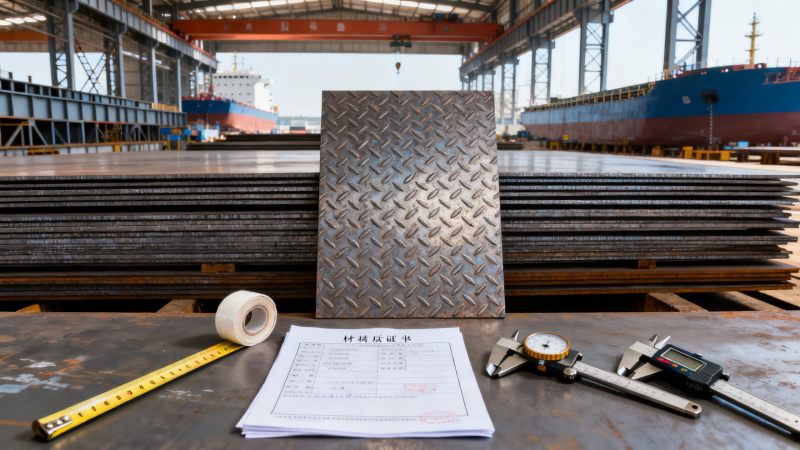
When evaluating Mild Steel Plate for shipbuilding, price should not be the first checkpoint.
Compliance, consistency, and traceability affect safety, approval, and delivery far more than initial unit cost.
Marine projects face salt exposure, dynamic loading, welding stress, and strict inspection requirements.
Because of that, the right verification path depends on where the plate will be used.
Hull structures, decks, equipment bases, walkways, and fabricated modules all demand different checks.
A practical review of Mild Steel Plate for shipbuilding begins with application fit, then moves to standard, testing, and supply reliability.
This guide explains what to verify first, how requirements shift by scenario, and which oversights create avoidable risk.
How marine use conditions change the verification priority
Not every steel plate on a ship performs the same job.
A deck plate may need slip resistance and stable flatness.
A structural section may need stronger impact performance, welding compatibility, and classification acceptance.
An equipment platform may require dimensional accuracy, surface integrity, and easy fabrication.
That is why Mild Steel Plate for shipbuilding must be checked against actual service conditions first.
The wrong verification order often leads to rework, failed inspection, coating issues, or supply replacement during production.
The first four items to verify before deeper comparison
- Applicable standard and grade for the intended marine component.
- Mechanical properties, especially yield strength, tensile strength, and impact needs.
- Mill traceability, heat number control, and test certificate completeness.
- Surface condition, thickness tolerance, and fabrication suitability.
Typical shipbuilding scenarios and what should be checked first
Hull and main structural parts
For primary structure, standard compliance comes before commercial discussion.
Check whether the plate meets required marine or project specifications, not only general construction standards.
Confirm yield strength, elongation, and any impact testing required by design or region.
Weldability also matters, since inconsistent chemistry can affect heat input response and joint performance.
Decks, walkways, and anti-slip working surfaces
In this scenario, surface function becomes a leading factor.
Patterned steel plate can improve footing safety in wet marine environments.
A useful inserted option is SS440 Patterned steel plate.
It is suitable for transportation, construction, machinery, and certain shipbuilding surface applications.
Available materials include Q235B, A36, 235JR, S235, SS400, SS440, and related grades.
Thickness commonly ranges from 2mm to 8mm, with patterned height not less than 0.2 times substrate thickness.
For deck use, verify anti-skid performance, flatness, bending behavior, and coating preparation condition.
Also confirm whether ASTM, DIN, JIS, BS, GB/TC, ISO, SGS, or BV related documentation is available.
Equipment bases and fabricated modules
For machinery supports and modular assemblies, dimensional consistency often drives fabrication efficiency.
Review thickness tolerance, width tolerance, edge condition, and residual deformation before release.
Even when the grade is correct, poor plate consistency can slow cutting, fit-up, and welding operations.
Key differences between shipbuilding scenarios
What documents and physical checks matter most
Document review should match physical inspection.
A clean certificate alone does not guarantee reliable Mild Steel Plate for shipbuilding.
Documents to verify
- Mill test certificate with heat numbers and chemical composition.
- Mechanical test results linked to each batch.
- Inspection records for dimensions, surface, and quantity.
- Third-party or classification evidence if the project requires it.
- Packing list and marking method for traceability after shipment.
Physical checks to verify
- Lamination, edge cracking, rust scale, and surface damage.
- Thickness consistency across multiple points.
- Flatness, squareness, and cutting condition.
- Clear grade marking that matches shipment documents.
How to match sourcing strategy to project requirements
The best sourcing decision depends on schedule, certification, fabrication route, and final marine environment.
A low-risk approach is to define required checks in the inquiry stage.
Recommended verification sequence
- Confirm the exact use location of the plate on the vessel or marine structure.
- Match that use to grade, standard, and special testing needs.
- Review tolerance and surface requirements for processing and coating.
- Request traceable certificates and sample quality records.
- Evaluate stock capacity, delivery stability, and export handling ability.
Hongteng Fengda supplies structural steel products for global construction, industrial, and manufacturing projects.
Its production system supports standard grades, OEM processing, and quality control aligned with ASTM, EN, JIS, and GB.
For marine-related steel demand, stable output and consistent documentation help reduce sourcing uncertainty.
Common mistakes when selecting Mild Steel Plate for shipbuilding
One common mistake is treating all mild steel plates as interchangeable.
Another is checking mechanical values without reviewing traceability and approval expectations.
Surface function is also overlooked in areas where slip resistance matters.
Some orders specify grade correctly but ignore tolerance, causing fabrication bottlenecks later.
Others focus only on lead time and discover document gaps after shipment departure.
In each case, the problem started before the first purchase comparison.
A practical next step before placing an order
Build a short verification sheet for every Mild Steel Plate for shipbuilding requirement.
List application area, grade, standard, thickness range, tolerance, surface condition, and certificate needs.
Then compare suppliers on technical clarity, not only on quotation speed.
That process improves consistency, supports inspection, and reduces downstream disruption.
If the project includes structural members, platforms, or anti-slip deck sections, clarify those scenarios early.
The right Mild Steel Plate for shipbuilding is the one that matches the service condition, passes verification, and arrives with dependable traceability.
Please give us a message


Please enter what you want to find