When selecting between L shape steel and square tube for light-duty framing, stiffness-to-weight ratio is a critical performance benchmark—especially for applications demanding structural integrity without excess mass. As a trusted structural steel manufacturer & exporter from China, Hongteng Fengda supplies high-quality l shaped metal bars, A36 angle, galvanized angle (also known as galv angle, angle galvanized, or steel ka angle), and l shaped metal sheet—each engineered for optimal bracing angle in steel structure performance. Whether you're a project manager evaluating load paths, a procurement specialist comparing cost-efficiency, or a safety manager verifying code compliance, understanding how material geometry impacts rigidity helps optimize design, reduce weight, and ensure long-term reliability.
Why Stiffness-to-Weight Ratio Matters in Light-Duty Framing
In light-duty framing—such as mezzanine supports, equipment platforms, modular enclosures, or temporary staging—the goal isn’t maximum strength, but optimal balance: sufficient rigidity to resist deflection under service loads while minimizing dead weight, transportation cost, and installation labor. A higher stiffness-to-weight ratio means less material delivers the same resistance to bending or torsion—directly influencing structural efficiency, logistics feasibility, and lifecycle cost.
This metric is especially decisive when comparing open-section profiles like Carbon Steel Angle against closed-section profiles like square tubes. Geometry—not just grade or thickness—dictates second moment of area (I), polar moment (J), and torsional constant (Ct), all of which scale nonlinearly with cross-sectional dimensions. For instance, doubling leg length in an equal-angle section increases its bending stiffness about 8×, but only if the thickness remains proportionally adequate to avoid local buckling.
Real-world constraints amplify this: typical delivery lead times for custom-cut angles range from 7–15 days, while square tubes often require longer scheduling due to extrusion or welding steps. Meanwhile, fabrication time for bolted angle connections averages 30–40% less than full-welded tube joints—critical for fast-track projects across North America and Southeast Asia.
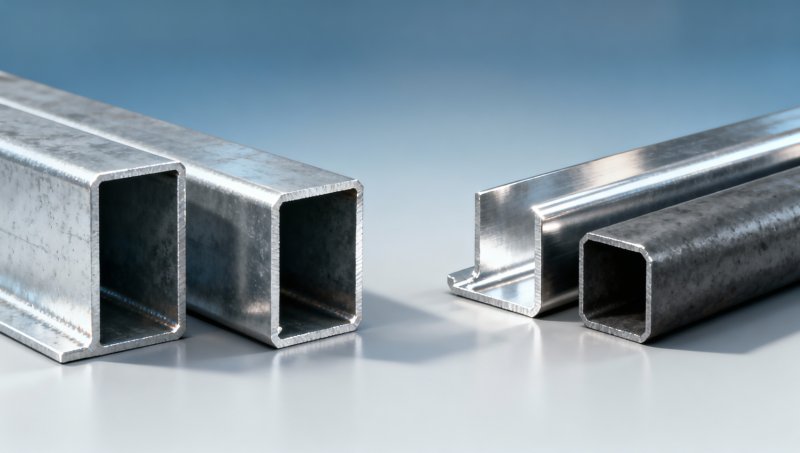
Geometric Comparison: How Shape Drives Performance
L-shaped sections distribute material away from the centroid more efficiently in one principal plane—but lack continuity in the other. Square tubes offer uniform torsional resistance and symmetric bending capacity around both axes. This difference becomes quantifiable when evaluating standard sizes commonly used in light-duty framing (e.g., 50×50×5 mm angle vs. 50×50×3 mm square tube, both in ASTM A36).
While the square tube shows superior Ix and J values, its weight penalty reduces stiffness-to-weight advantage—particularly in bending-dominant scenarios where angle sections can be oriented to maximize Ix. In practice, engineers at Hongteng Fengda observe that for spans ≤ 3 m and point loads ≤ 5 kN, properly braced Carbon Steel Angle achieves comparable deflection control at ~12% lower total system weight—including connection hardware and labor.
Key Fabrication Considerations
- Angle steel allows rapid field assembly using pre-punched holes and standard bolts—reducing on-site weld inspection requirements by up to 70%.
- Square tubes require precise cutting, squareness verification, and full-penetration welds for moment connections—adding 2–4 weeks to QA/QC cycles.
- For corrosion-prone environments (e.g., coastal industrial plants), galvanized angle offers equivalent protection to hot-dip galvanized square tubes—but at 15–20% lower coating cost due to simpler geometry.
How to Select Based on Your Project Profile
Selection isn’t binary—it’s contextual. Below are decision criteria mapped to real stakeholder priorities:
For mixed-load applications—such as gantry supports requiring both vertical compression and horizontal sway resistance—Hongteng Fengda recommends hybrid framing: primary beams in square tube (for torsional stability), with diagonal and corner bracing in Carbon Steel Angle. This approach delivers certified compliance with ASTM A6/A6M and EN 10025-2 while reducing total steel tonnage by 9–13% versus all-tube designs.
Why Partner with Hongteng Fengda for Your Structural Steel Needs
As a professional structural steel manufacturer and exporter based in China, Hongteng Fengda serves global buyers across North America, Europe, the Middle East, and Southeast Asia with stable production capacity, consistent quality, and dependable lead times. Our cold-formed and hot-rolled angle steel complies with ASTM, EN, JIS, GB, and DIN standards—and we support OEM specifications down to ±0.5 mm dimensional tolerance.
We help partners reduce sourcing risks through: 3-stage QC (raw material inspection → in-process dimensional checks → final load-test validation), ISO 9001-certified documentation, and flexible MOQs—from sample batches (≥ 500 kg) to container-scale orders (≥ 25 tons). All carbon steel angle products are traceable to mill test reports and available in galvanized, painted, or bare finishes.
Ready to optimize your light-duty framing? Contact us today for: free technical consultation on stiffness-to-weight trade-offs, custom size quotation (including 25×3 mm to 250×25 mm configurations), ASTM/EN certification verification, or lead-time confirmation for your next order. We respond to engineering inquiries within 4 business hours—and ship samples within 7 days.
Please give us a message


Please enter what you want to find