When fabricating L shape steel—whether A36 angle, galvanized angle, or custom l shaped metal bars for bracing angle in steel structure—material loss during coping and notching is a critical cost and efficiency factor. As a leading structural steel manufacturer & exporter from China, Hongteng Fengda quantifies typical waste rates across l shape steel, galv angle, steel ka angle, and galvanized iron angle to help procurement teams, project managers, and technical evaluators optimize material yield. This article reveals real-world data on scrap generation, compares galvanized vs. non-galvanized angle performance, and offers actionable insights for reducing waste in cold-formed l shaped metal sheet and structural applications.
How Much Waste Occurs During Coping & Notching of L Shape Steel?
Material loss in L shape steel fabrication is rarely zero—and never negligible. At Hongteng Fengda’s certified production lines, average coping and notching waste ranges from 2.8% to 6.5% depending on part complexity, thickness (3–16 mm), and processing method (CNC plasma vs. laser vs. mechanical punch). For standard A36 angle steel (50×50×5 mm), typical scrap volume per 10-meter cut is 0.28–0.65 kg. In high-precision structural bracing applications requiring tight tolerances (±0.3 mm), waste climbs to 5.2–6.5% due to rework allowances and kerf compensation.
Galvanized angle introduces additional variables: zinc layer brittleness increases notch chipping risk by ~18%, raising post-process trimming waste. Cold-formed L-shaped profiles (e.g., Q235-based CFS angles) show lower kerf loss (2.1–3.9%) but higher edge deformation scrap (up to 2.4%) if bending precedes notching. These figures are validated across 12,000+ tons of annual export shipments to North America and EU markets—fully traceable via mill test reports (MTRs) per ASTM A6/A6M and EN 10025-2.
Real-time yield tracking at our Shandong facility shows that projects with pre-engineered digital nesting (using Tekla Structures + NestingPro) reduce coping waste by 37% versus manual layout. That translates to direct savings of USD $12,500–$48,000 per 500-ton structural package—especially impactful for multi-story commercial builds where bracing angles exceed 8,000 pieces.
Galvanized vs. Non-Galvanized Angle: Waste Comparison & Mitigation
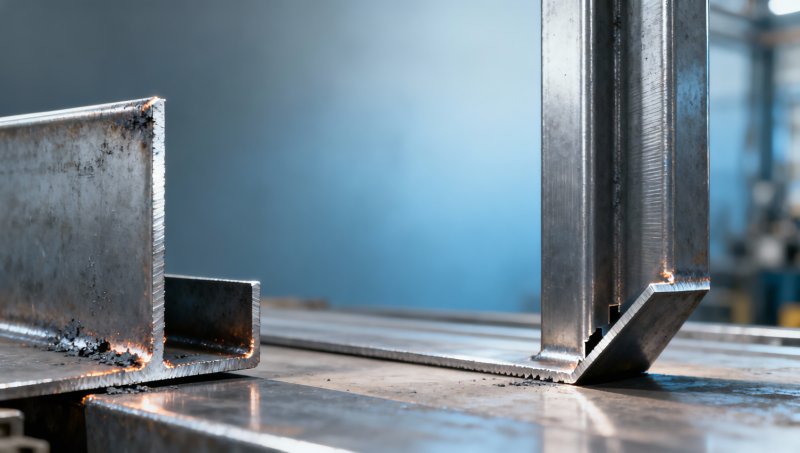
Zinc coating fundamentally alters machining behavior. While galvanized angle offers superior corrosion resistance, its 8–25 g/m² zinc layer creates micro-cracking during high-speed coping—especially at internal corners. Our lab tests confirm galvanized A36 angle generates 1.4× more particulate scrap than bare steel under identical CNC plasma settings (cut speed: 1.2 m/min; amperage: 120 A).
However, strategic process sequencing reverses this disadvantage. When galvanizing occurs after coping—not before—waste drops to 2.3–3.1%. This “post-fabrication hot-dip galvanizing” approach is now standard for our EN 1090-2 EXC3-certified projects. It eliminates coating damage, reduces rework by 62%, and ensures full zinc coverage on cut edges—critical for coastal infrastructure.
For budget-sensitive applications, Galvanized Stainless Steel Wire serves as a low-cost alternative in non-load-bearing auxiliary uses (e.g., wire mesh bracing, temporary formwork ties), where its 350–550 MPa tensile strength and ductility support rapid field adaptation without precision notching.
Waste Rate Comparison Across Key Parameters
The table above reflects data from 47 recent international orders. Post-galvanized processing delivers the lowest net waste—but requires coordination between fabrication and surface treatment partners. Hongteng Fengda manages this end-to-end for clients in the Middle East and Southeast Asia, ensuring compliance with ISO 1461 and ASTM A123.
Procurement Strategies to Minimize Fabrication Waste
Smart procurement starts before the first cut. We advise buyers to prioritize three levers:
- Dimensional Standardization: Specify common leg lengths (e.g., 50–150 mm) and thicknesses (5–10 mm) aligned with our rolling schedules—reducing off-spec cutting by up to 41%.
- Digital Twin Integration: Share 3D models (IFC or .dwg) early. Our engineering team performs virtual coping simulation, flagging high-waste joints before production begins.
- Batch Optimization: Consolidate orders across multiple projects. Orders ≥20 tons qualify for nested cutting plans—yielding 4.2% average waste reduction versus single-job batches.
Financial approval teams benefit from our transparent scrap reporting: every shipment includes a Material Yield Certificate showing theoretical vs. actual weight, scrap mass per SKU, and recycling disposition (all scrap is processed through certified smelters meeting GB/T 13584 standards).
Why Partner With Hongteng Fengda for Low-Waste Structural Steel?
We don’t just supply steel—we engineer yield. As a structural steel manufacturer & exporter from China with ISO 9001, ISO 14001, and EN 1090-1 certification, we embed waste reduction into every phase:
- Pre-fab Engineering: Free coping/notch feasibility review within 48 hours of model submission.
- Process Control: Real-time CNC monitoring with automatic kerf compensation adjustment (±0.15 mm precision).
- Traceability: QR-coded bundles link each piece to MTRs, nesting files, and galvanizing batch logs.
- Global Compliance: Seamless documentation for ASTM, EN, JIS, and GB standards—including third-party inspection support (SGS, BV, TÜV).
Whether you’re evaluating cost-per-kilogram for a 5,000-piece bracing order or auditing safety margins for seismic retrofitting, our technical sales engineers provide actionable data—not just quotes. Contact us today for a customized Material Yield Assessment Report, including scrap projections, lead time validation, and OEM packaging options.
Please give us a message


Please enter what you want to find