L Shaped Angle Iron vs Flat Bar: Which Fits Your Fabrication?
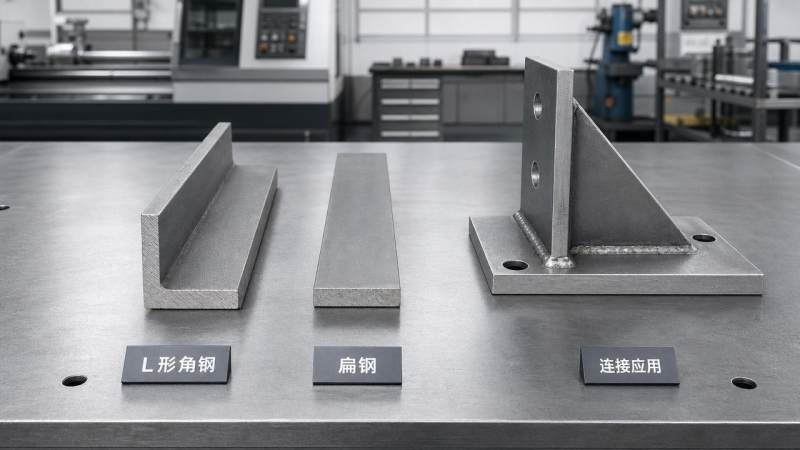
When comparing l shaped angle iron with flat bar, technical decisions rarely come down to shape alone.
Load path, weld access, stiffness, corrosion exposure, and fabrication speed all matter.
A part that looks simpler on paper can create extra cost in drilling, bracing, or reinforcement.
That is why choosing between l shaped angle iron and flat bar should start with application behavior, not just section price.
In practical fabrication, both products are versatile.
But they solve different structural and manufacturing problems.
This guide compares strength response, joining efficiency, material usage, and project suitability.
The goal is to support a cleaner selection with fewer downstream compromises.
Start with the Geometry Difference
The biggest advantage of l shaped angle iron is its two-leg profile.
That shape creates directional stiffness and a natural corner connection.
Flat bar, by contrast, is a single rectangular strip.
It is easier to cut, stack, strap, and plate, but it has less inherent resistance against twisting.
This difference becomes more obvious in unsupported spans, frame corners, and bracket assemblies.
If your component must hold shape under eccentric loading, l shaped angle iron usually brings better section efficiency.
If your part mainly works in tension, as a strap, clip, cover, or base plate extension, flat bar may be enough.
Quick visual comparison
- L shaped angle iron: two legs, corner support, stronger edge stability.
- Flat bar: one plane, simple profile, easier surface contact.
- Angle section: better for frames, supports, shelves, and guards.
- Flat bar: better for connectors, backing strips, clamps, and tabs.
Strength, Load Behavior, and Stability
For selection work, stiffness is often the turning point.
A flat bar can carry load well when aligned with its strong axis.
However, its weak-axis bending resistance is limited.
It also tends to deform more easily under torsion or off-center force.
L shaped angle iron performs better where loads do not stay perfectly centered.
Its perpendicular legs help distribute stress across two directions.
That can reduce the need for extra gussets in light and medium-duty assemblies.
In structural steel detailing, this often translates into fewer parts and faster fit-up.
Where l shaped angle iron usually wins
- Brackets with cantilever force.
- Frames needing corner rigidity.
- Equipment supports with vibration exposure.
- Secondary members needing better anti-twist behavior.
Where flat bar often makes more sense
- Tie strips and tension members.
- Base connections needing flush contact.
- Simple wear plates or packing pieces.
- Parts requiring repeated punching or stamping.
Fabrication Efficiency and Shop Practicality
From a fabrication viewpoint, flat bar looks easier at first glance.
It nests well, cuts quickly, and fits many standard punching lines.
That makes it efficient for high-volume simple parts.
Still, when the design needs a 90-degree function, flat bar may require bending, welding, or added stiffeners.
That is where l shaped angle iron can save real labor.
Its formed geometry already provides the corner shape.
In many support frames, handrails, edge trims, and equipment bases, that shortens the process chain.
Less welding also means lower distortion risk and simpler dimensional control.
In real procurement work, the best choice is not always the cheapest section per ton.
It is the one that lowers total fabrication cost per finished unit.
Connection Design, Welding, and Bolting
Connections often decide whether l shaped angle iron or flat bar performs better in practice.
Angle sections offer two surfaces for bolting or welding.
That flexibility helps when joining perpendicular members.
It can also simplify field installation where alignment tolerance is tight.
Flat bar provides a broad, flat face.
That is ideal for lap joints, cover plates, fish plates, and strap details.
But if the assembly must resist rotation, the designer may need additional detailing.
Questions worth checking before release
- Will the joint carry bending or only axial load?
- Is there risk of twist during transport or service?
- Do you need one-face contact or corner engagement?
- Will field crews prefer fewer weld passes or fewer loose parts?
Corrosion Exposure and Material Strategy
Section shape is only one part of long-term performance.
Coating choice matters, especially in outdoor, humid, or industrial environments.
For supporting panels, enclosures, or formed assemblies, corrosion-resistant sheet products can complement structural sections well.
One example is S220GD Galvalume Steel Coil .
Its 55% aluminium-zinc coating offers strong atmospheric durability and good heat resistance.
With yield strength at or above 220 MPa and compliance with GB, ASTM, EN, and JIS, it suits many formed accessory applications.
In mixed assemblies, using the right corrosion strategy around l shaped angle iron can extend service life and reduce maintenance frequency.
This matters even more near rooftops, equipment housings, and exposed industrial structures.
Cost Comparison Beyond Material Price
A direct price-per-kilogram comparison can be misleading.
The better question is how each option affects the full job cost.
L shaped angle iron may cost more than a flat bar of similar thickness in some markets.
Yet it can reduce welding hours, fixture needs, and reinforcing plates.
Flat bar may lower raw material cost, but secondary operations can quickly absorb that saving.
This is especially true in custom fabrication with many repeated corner parts.
Application Scenarios That Clarify the Choice
Selection becomes easier when tied to real use cases.
For rack frames, guards, machine stands, edging members, and support brackets, l shaped angle iron is often the more practical option.
For cleats, straps, joining plates, backing pieces, wear strips, and simple reinforcement, flat bar usually works well.
Where the design must balance structural support with sheet-based accessories, pairing angle sections with coated products can also be efficient.
That is where S220GD Galvalume Steel Coil can fit naturally in the broader material plan.
A simple decision rule
- Choose l shaped angle iron when shape must add stiffness.
- Choose flat bar when the job needs a flat, simple connector.
- Recheck both when corrosion, heat, or forming requirements are critical.
How to Make the Final Selection with Less Risk
A reliable decision should combine mechanical need, fabrication method, and supply consistency.
If the part sees multi-directional loading, corner stress, or twist risk, l shaped angle iron is usually the safer choice.
If the part mainly serves as a flat connector or reinforcement strip, flat bar keeps things simple.
Also check available standards, dimensional tolerances, coating options, and lead times before locking the bill of materials.
For global sourcing, stable production and clear compliance documents matter as much as section choice.
Hongteng Fengda, a structural steel manufacturer and exporter from China, supplies angle steel, channels, beams, cold formed profiles, and custom structural components for international projects.
With support across ASTM, EN, JIS, and GB standards, the company helps buyers reduce sourcing risk and keep fabrication schedules under control.
If your project is comparing l shaped angle iron against flat bar, start by mapping the real load case, joint layout, and production route.
That simple step usually reveals which option fits better, costs less overall, and performs longer in service.
Please give us a message


Please enter what you want to find