For procurement leaders weighing performance against budget, the real question is whether Hot dipped Galvanized Steel Wire Rope delivers enough long-term value to justify its higher initial price. In demanding construction and industrial environments, corrosion resistance, service life, maintenance savings, and supply reliability can all directly affect project costs and operational efficiency.
What should decision-makers really compare before paying more?
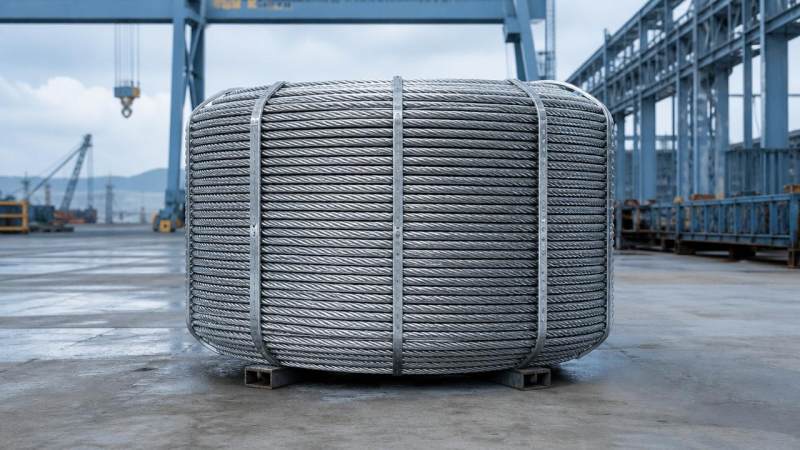
The upfront price gap between standard wire rope and Hot dipped Galvanized Steel Wire Rope often looks significant on a quotation sheet. However, experienced buyers rarely judge steel products by purchase price alone. They compare lifecycle cost, replacement frequency, downtime exposure, maintenance labor, safety risk, and supplier reliability.
In the steel industry, especially for construction, marine-adjacent, infrastructure, manufacturing, and heavy-duty handling applications, corrosion is not a cosmetic issue. It directly affects tensile retention, operational safety, inspection intervals, and service continuity. A lower-priced rope can become the more expensive option if it requires frequent replacement or causes unplanned shutdowns.
- Initial unit cost versus total ownership cost over the expected service period.
- Exposure conditions such as humidity, salt spray, chemical contamination, and outdoor storage.
- Operational criticality, including whether rope failure would stop a production line or delay a project milestone.
- Lead time consistency and the supplier’s ability to support repeat orders with stable quality.
For enterprise buyers, the better question is not “Is it more expensive?” but “In which conditions does that extra cost create measurable financial return?”
Why does Hot dipped Galvanized Steel Wire Rope cost more in the first place?
The higher price mainly comes from the galvanizing process, zinc consumption, process control, and the resulting improvement in corrosion resistance. Hot-dip galvanizing forms a more durable zinc coating than many lighter surface treatments. That coating acts as a barrier and also provides sacrificial protection when the surface is scratched or exposed.
For procurement teams, this premium should be interpreted as a performance investment. In steel-intensive projects, surface protection is often one of the most practical ways to extend service life without moving to a much more expensive stainless solution.
Key cost drivers behind the premium
- Additional zinc coating material and process energy input.
- More stringent process consistency requirements to achieve dependable coating coverage.
- Higher handling and quality control expectations for industrial-grade export supply.
- Extended durability that reduces replacement demand over time.
The table below helps procurement teams compare where Hot dipped Galvanized Steel Wire Rope usually creates value versus where a lower-cost alternative may still be acceptable.
This comparison shows why many industrial buyers accept a higher purchase price. If the operating environment is demanding, the premium often buys better cost stability rather than only better material appearance.
Which application scenarios justify the higher upfront cost?
Not every project needs the same protection level. Hot dipped Galvanized Steel Wire Rope is most valuable when the rope is exposed to moisture, weather, contamination, or difficult maintenance access. In such cases, the total cost impact of corrosion is much greater than the initial difference in material price.
High-value use cases
- Construction sites with long outdoor installation cycles and changing weather conditions.
- Port, shipbuilding, and coastal projects where salt-laden air accelerates corrosion.
- Industrial lifting and mechanical systems where downtime has a direct production cost.
- Infrastructure applications where replacement access is difficult, slow, or expensive.
The same principle applies across structural steel procurement. Buyers who prioritize lifecycle efficiency often align rope selection with other corrosion-conscious steel choices. For example, when a project combines protected wire rope systems with structurally efficient sections such as H Girder, planners can improve overall durability and cost control across mechanical manufacture, steel structures, bridging, shipbuilding, and automobile chassis applications.
That product category is commonly supplied in materials such as Q235, Q345B, Q460C, SS400, S275JR, S355JR, A572, A992, galvanized and stainless options, with dimensions including flange thickness from 8-64mm, web thickness from 5-36.5mm, flange width from 50-400mm, web width from 100-900mm, and length from 1m-12m or as required. For buyers managing mixed steel packages, combining durable rope and optimized beam sections can simplify sourcing and reduce coordination risk.
How should you evaluate lifecycle cost instead of unit price?
A sound procurement decision needs a cost model. The most common mistake is comparing only material prices per meter or per ton. Decision-makers should build a practical ownership view that includes installation intervals, inspection costs, production stoppage, replacement labor, and inventory planning.
The following table provides a useful framework for comparing total cost factors when reviewing Hot dipped Galvanized Steel Wire Rope for industrial and construction projects.
When this framework is used, the premium for Hot dipped Galvanized Steel Wire Rope often becomes easier to justify in outdoor or corrosive service. The decision is less compelling only in dry, low-risk, easily replaceable applications.
What technical and compliance points should procurement teams verify?
A good buying decision depends not only on the product type but also on verification discipline. Buyers should confirm the wire rope specification, coating expectations, mechanical requirements, application environment, and the standards relevant to their market or project documentation.
Practical verification checklist
- Confirm rope construction, diameter, load requirement, and intended operating conditions before comparing quotations.
- Ask whether the supplied material is intended for indoor, outdoor, coastal, or industrially contaminated environments.
- Check whether supporting documentation aligns with required ASTM, EN, JIS, or GB references where applicable.
- Review packaging, storage, and transport protection, especially for export shipments and long transit periods.
- Evaluate supplier production stability, not just one-time sample quality.
This is where working with a capable Chinese structural steel manufacturer and exporter can reduce risk. Hongteng Fengda supports global buyers with stable production capacity, customized steel solutions, and quality control aligned with major international standards such as ASTM, EN, JIS, and GB. For buyers sourcing multiple steel categories together, that consistency matters as much as product cost.
What procurement mistakes make the higher-cost option look less valuable?
Even a technically suitable material can fail to deliver value if the buying process is weak. Many companies pay for corrosion-resistant rope but undermine the benefit through incomplete specification, poor storage, or mismatched application.
- Choosing by price only, without estimating replacement labor and shutdown cost.
- Using Hot dipped Galvanized Steel Wire Rope in one part of the system while ignoring corrosion-prone adjacent steel components.
- Assuming all galvanized products offer the same coating durability and process quality.
- Failing to align order quantities and lead times with project milestones, which creates costly rush procurement later.
Procurement leaders should view this product as part of a broader steel reliability strategy. That means planning around environment, maintenance access, structural interfaces, and replacement logistics rather than evaluating it as an isolated line item.
FAQ: the questions buyers ask before switching to Hot dipped Galvanized Steel Wire Rope
Is Hot dipped Galvanized Steel Wire Rope always worth the extra cost?
No. It is usually most worthwhile in outdoor, humid, coastal, industrial, or maintenance-sensitive environments. If the rope is used indoors, in dry conditions, and can be replaced easily with minimal labor cost, the premium may be harder to justify.
How do I know whether lifecycle savings are real for my project?
Estimate expected service life, maintenance intervals, replacement labor, and the cost of equipment stoppage or schedule delay. If corrosion-related replacement would interrupt operations or create access costs, the higher upfront price often becomes financially reasonable.
What should I ask suppliers before placing an order?
Request confirmation of application conditions, relevant standards, production capability, packaging method, delivery schedule, and documentation support. If your project includes multiple steel items, ask whether the supplier can coordinate related structural steel products to reduce sourcing complexity.
Can Chinese suppliers meet international project requirements?
Yes, provided you work with manufacturers that operate modern facilities, maintain consistent quality control, and are familiar with international standards and export expectations. Hongteng Fengda supplies structural steel products for buyers across North America, Europe, the Middle East, and Southeast Asia, helping reduce sourcing risk and improve delivery confidence.
Why choose us for steel sourcing decisions that affect long-term cost?
For enterprise buyers, the right supplier should do more than issue a price list. Hongteng Fengda supports procurement teams that need dependable structural steel supply, customized solutions, and practical guidance on balancing cost, compliance, and performance. Our product scope covers angle steel, channel steel, steel beams, cold formed profiles, and customized structural steel components for global construction, industrial, and manufacturing projects.
If you are evaluating Hot dipped Galvanized Steel Wire Rope together with broader steel package requirements, you can contact us to discuss specification confirmation, material selection, lead time planning, OEM support, standards matching, sample arrangements, and quotation comparison. This helps your team make a faster and better-informed decision instead of managing separate suppliers with inconsistent quality and delivery expectations.
A higher upfront cost is worth paying only when it lowers total project risk. We can help you assess that tradeoff clearly, based on application conditions, steel product coordination, delivery needs, and long-term procurement value.
Please give us a message


Please enter what you want to find