Is DX53D Galvalume Steel Coil worth the extra cost for your project? In most cases, the answer is yes—if your application depends on longer service life, better corrosion resistance, and lower lifetime maintenance risk. But if the environment is mild and the project is highly price-sensitive, the extra upfront cost may not always deliver the best return. For buyers comparing DX53D Galvalume Steel Coil with AZ150 Galvalume Steel Coil, the right decision comes down to exposure conditions, forming needs, quality consistency, and total cost over time—not just the purchase price.
When is DX53D Galvalume Steel Coil actually worth paying more for?
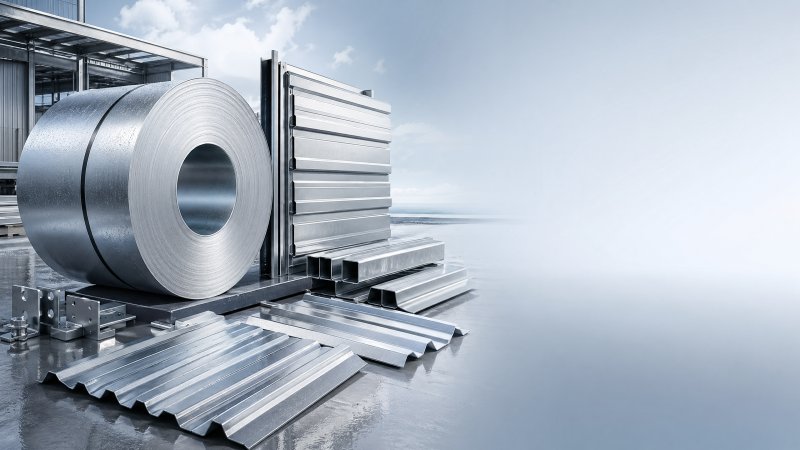
The core search intent behind this question is practical: buyers, engineers, and procurement teams want to know whether the added cost creates measurable value. They are not looking for a generic definition of Galvalume steel. They want a decision framework.
DX53D Galvalume Steel Coil is generally worth the extra cost when your project requires:
- Good formability for roll forming, bending, or profiling
- Reliable corrosion resistance in outdoor or semi-aggressive environments
- Lower repainting, repair, or replacement frequency
- More stable quality for large-volume or export projects
- Reduced lifecycle cost rather than the lowest initial purchase price
If your use case is roofing, wall cladding, light structural components, ducting, industrial panels, or fabricated sections exposed to humidity and weather, paying more for a better-grade and properly coated material can be justified quickly. In contrast, for temporary installations, low-exposure indoor parts, or very short service-life projects, a cheaper option may be commercially acceptable.
What do buyers really compare: DX53D vs AZ150 Galvalume Steel Coil?
One common source of confusion is that DX53D and AZ150 do not describe exactly the same thing.
- DX53D usually refers to the base steel grade under EN standards, with emphasis on forming performance.
- AZ150 usually refers to the coating mass of aluminum-zinc alloy, typically about 150 g/m² total coating.
So in real procurement, buyers are often comparing a forming grade plus coating specification against another offer that may differ in one or both dimensions. The correct question is not simply “DX53D or AZ150?” but rather:
- What is the substrate grade?
- What is the coating mass?
- Is the material intended for deep forming, standard profiling, or structural use?
- What standard does it follow—EN, ASTM, JIS, or GB?
A higher-performing offer may cost more because it combines a better formability grade, tighter thickness tolerance, and higher or more consistent coating weight. That is often where the real value comes from.
How much does better corrosion resistance matter in real projects?
For many commercial and industrial projects, corrosion resistance is the strongest argument for paying more. Galvalume steel typically performs better than conventional galvanized steel in many atmospheric environments because the aluminum-zinc coating provides both barrier protection and sacrificial protection.
The financial impact becomes clear when you calculate beyond the coil price:
- Fewer corrosion claims from end users
- Lower replacement frequency
- Reduced maintenance labor and downtime
- More stable appearance for visible building surfaces
- Less risk of early edge rust or coating failure from poor-quality supply
If your project is in coastal zones, high-humidity regions, industrial parks, or areas with temperature fluctuation and condensation, the difference between a low-price coil and a reliable Galvalume product can become obvious within a short service period.
What hidden factors can make a “cheap” steel coil more expensive?
This is where many purchasing mistakes happen. A low quoted price can look attractive, but hidden quality variation may create downstream costs that far exceed the initial savings.
Common hidden risks include:
- Actual coating mass lower than declared
- Inconsistent yield strength or elongation affecting forming
- Poor flatness, camber, or edge condition
- Surface defects that reduce paint adhesion or visual quality
- Unstable zinc-aluminum coating composition
- Packaging problems causing transit rust or edge damage
This is also why the question “is cheap steel from China reliable?” cannot be answered with a simple yes or no. China has both high-quality export manufacturers and low-control suppliers. Reliability depends on the producer’s process control, inspection system, export experience, and ability to deliver consistent compliance—not just country of origin.
For global buyers, the key is to verify:
- Mill test certificates and inspection records
- Coating mass test method
- Thickness tolerance standard
- Mechanical property consistency batch to batch
- Packaging standards for sea shipment
- Track record with international orders
How should engineers and procurement teams evaluate value, not just price?
A good evaluation process balances technical fit and commercial logic. Instead of asking which coil is cheapest per ton, ask which option delivers the lowest total risk-adjusted cost for the intended service life.
Use this decision checklist:
- Define the environment: indoor, outdoor, coastal, industrial, agricultural, or high-condensation.
- Confirm the forming requirement: simple roll forming, bending, stamping, or deep drawing.
- Set the service-life expectation: short-term, medium-term, or long-term asset use.
- Compare coating specification: not just nominal grade, but actual coating mass and uniformity.
- Review quality consistency: certificates, tolerances, and production control.
- Estimate maintenance and replacement cost: especially for installed systems where replacement is disruptive.
- Assess supplier reliability: communication, lead time, customization, and claim response.
For project managers and financial approvers, this lifecycle view is often the clearest way to justify paying more upfront. A small material premium is easier to approve when it reduces the probability of field failure, customer complaints, or premature replacement.
What other materials should buyers compare when reviewing corrosion-resistant coils?
In some sourcing discussions, buyers compare Galvalume products not only against galvanized steel, but also against stainless alternatives for more aggressive conditions or specialized fabrication needs.
For example, in applications involving chemical exposure, food-related environments, medical equipment, or decorative surfaces, a stainless option may be more suitable than coated carbon steel. A relevant reference product is 316 Stainless Steel Coil, which is widely used in chemical, food, medical, transportation, and outdoor decorative applications. It offers strong corrosion resistance, tensile strength of at least 520, yield strength of at least 275, elongation of about 55–60, and surface finish options such as BA, 2B, NO.1, NO.4, HL, and 8K. For buyers evaluating long-term durability, this kind of comparison helps clarify whether the project needs coated steel for cost efficiency or stainless steel for maximum corrosion performance.
The point is not that stainless is always better. It is that material selection should match exposure, fabrication, and budget priorities. For many building and industrial uses, DX53D Galvalume Steel Coil remains the more economical choice. But understanding adjacent options improves decision quality.
When is the extra cost not justified?
There are also situations where paying more may not produce enough return:
- Short-term or temporary structures
- Indoor dry environments with minimal corrosion risk
- Applications where appearance and long-term durability are not critical
- Projects where the component is easily replaceable at low labor cost
- Cases where the offer is overpriced without clear technical advantage
If the supplier cannot clearly explain what the premium includes—better substrate grade, better coating control, stricter tolerances, stronger QA, or more reliable delivery—then the higher price may simply be a commercial markup rather than added value.
Final verdict: should you choose DX53D Galvalume Steel Coil?
Yes, DX53D Galvalume Steel Coil is often worth the extra cost when your project needs dependable formability, corrosion resistance, and lower long-term ownership cost. It is especially valuable for export projects, outdoor applications, and production environments where quality inconsistency can create expensive downstream problems.
However, the decision should not be based on headline price alone or on incomplete comparisons like DX53D versus AZ150 without understanding grade and coating differences. The best buying decision comes from matching the steel specification to the environment, fabrication process, expected service life, and supplier reliability.
For procurement teams, engineers, and decision-makers, the practical conclusion is simple: if failure, maintenance, or replacement would be costly, the extra spend is usually justified. If the application is low-risk and short-term, a lower-cost option may be enough. The value of DX53D Galvalume Steel Coil is not in being cheaper today—it is in helping your project cost less over its full life.
Please give us a message


Please enter what you want to find