Choosing a roof is rarely just a material question. It shapes installation speed, structural loads, maintenance planning, and total project cost. That is why corrugated steel roofing remains a serious option for industrial, commercial, and infrastructure work. The key is not whether it is popular, but whether it matches the building’s span, environment, service life targets, and budget discipline.
Why corrugated steel roofing stays relevant
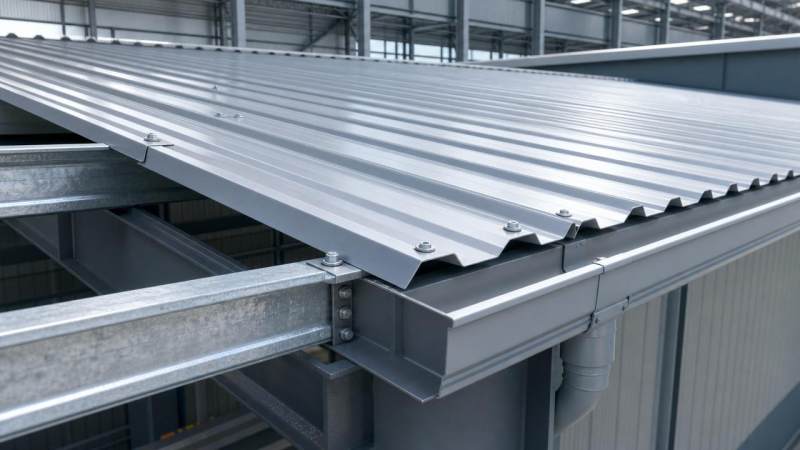
Corrugated steel roofing uses formed steel sheets with repeating ridges and grooves. That shape increases stiffness without requiring thick material, which helps balance weight, strength, and cost.
In steel-related construction, this matters because roofing is part of a wider system. The roof covering, purlins, beams, drainage layout, and fastening method all affect long-term performance.
For fast-moving projects, corrugated steel roofing often stands out for simple logistics, broad availability, and compatibility with prefabricated steel structures. That makes it common in warehouses, workshops, sheds, agricultural buildings, and utility facilities.
What it does well in real projects
The strongest case for corrugated steel roofing is usually practical rather than aesthetic. It solves several jobsite problems at once, especially when schedule and durability both matter.
Speed and installation efficiency
Large sheet sizes help crews cover roof areas quickly. Compared with many small roofing units, fewer pieces can mean fewer joints, faster alignment, and simpler handling on repetitive building layouts.
Good strength-to-weight balance
The corrugated profile improves rigidity. This allows roofing sheets to perform efficiently without excessive dead load, which can support lighter secondary framing in some designs.
Cost control over the project cycle
Initial purchase cost is often competitive. When corrosion protection, proper fixing, and drainage are handled well, corrugated steel roofing can also reduce repair frequency and avoid premature replacement.
Wide coating and specification options
Galvanized, galvalume, painted, and insulated variants allow the same roofing concept to fit different climates and operating conditions. This flexibility is useful when projects span multiple regions.
Where the limits usually appear
Corrugated steel roofing is not a universal answer. Its weak points become clear when design assumptions and operating conditions are not aligned with the material’s behavior.
Acoustic and thermal issues
Uninsulated metal roofing can amplify rain noise and transmit heat quickly. For occupied spaces, acoustic lining, insulation layers, or sandwich panels may be necessary.
Corrosion exposure
Coastal air, chemical fumes, fertilizer storage, and high humidity can shorten service life if the coating system is underspecified. Material selection should follow the actual exposure class, not just price.
Leak risk at details
Most failures happen at laps, penetrations, screws, flashing, and drainage transitions. Even good corrugated steel roofing can underperform if edge detailing and waterproofing are treated lightly.
Appearance expectations
For premium architectural work, the industrial look may not suit the design intent. In those cases, standing seam or concealed-fix systems may offer a cleaner visual result.
The roof should be judged with the structure beneath it
Roofing performance depends heavily on the supporting steel system. Purlin spacing, beam capacity, uplift resistance, and fabrication accuracy all influence how corrugated steel roofing performs in service.
In industrial structures, the roof often works best when procurement is coordinated with the main steel frame. That reduces mismatch between sheet spans, support points, and connection details.
For example, heavy-duty roof zones may require stronger beam support and tighter dimensional control. In such cases, Structural Steel I Beam solutions are often selected for industrial structure applications where load transfer and framing stability matter.
Available grades such as Q195-Q235, Q345, SS400, A36, and St52 support different project requirements. Hot rolled molding, dimensions from 10 cm to 60 cm, and tolerances around ±1% help maintain fit-up quality.
When fabrication includes bending, welding, punching, or cutting, coordination becomes even more valuable. International standards including JIS, ASTM, DIN, GB, and EN also simplify cross-border project execution.
That wider systems view is one reason global buyers often work with experienced Chinese steel suppliers. Hongteng Fengda, for example, supports structural steel, beams, channels, angles, and customized components with stable lead times and controlled quality.
Common use cases where corrugated steel roofing makes sense
The best applications are usually straightforward buildings that value durability, efficient erection, and easy replacement planning more than premium finishes.
- Warehouses and logistics sheds with repetitive roof geometry
- Factories and workshops requiring practical weather protection
- Agricultural buildings, barns, and storage structures
- Temporary or semi-permanent site facilities
- Utility buildings, substations, and service enclosures
- Infrastructure support buildings in remote locations
It can also work well in commercial developments when visual expectations are modest and insulation upgrades are included. The decision is often less about the roof sheet itself and more about the building’s operational priorities.
Questions worth settling before specification
A reliable decision on corrugated steel roofing usually comes from a few disciplined checks early in design and sourcing.
Check the environment, not just the span
Wind uplift, salt exposure, condensation, temperature cycling, and chemical contact should shape coating choice, fixing design, and maintenance intervals.
Clarify service life expectations
A low-cost roof for a short-term facility is judged differently from a long-life industrial plant. That affects thickness, finish, insulation, and accessory quality.
Review structural coordination
Confirm purlin spacing, support alignment, roof slope, drainage, and penetrations before procurement. Many site issues start with late coordination between roofing and steel framing teams.
Compare lifecycle cost, not only sheet price
A cheaper roof can become expensive through leaks, corrosion repair, thermal inefficiency, or shutdown-related maintenance. The right comparison includes accessories and future service needs.
A practical way to decide
Corrugated steel roofing is right for many projects, but mainly when the building brief is clear. It performs best where speed, structural compatibility, and cost discipline are more important than high-end architectural appearance.
It becomes less suitable when noise control, severe corrosion, complex waterproofing details, or premium visual standards dominate the brief. In those situations, a different metal roof system may be the better fit.
The next step is simple: map roof exposure, insulation needs, expected service life, and supporting steel requirements together. Once those four points are clear, the decision on corrugated steel roofing becomes far more objective.
Please give us a message


Please enter what you want to find