In high-rainfall regions, selecting a durable, cost-efficient roofing material for prefab warehouses is critical—making AZ150 Galvalume Steel Coil a compelling candidate. Unlike standard galvanized or stainless steel corrugated sheet for roofing, AZ150 Galvalume Steel Coil offers superior corrosion resistance, extended service life, and competitive lifecycle costs. As a leading structural steel manufacturer & exporter from China, Hongteng Fengda supplies AZ150 Galvalume Steel Coil for construction with ASTM/EN-compliant quality—ideal for technical evaluators, procurement teams, and project managers seeking reliable, long-term performance without premium stainless steel pricing.
Why AZ150 Galvalume Outperforms Standard Roofing in Wet Climates
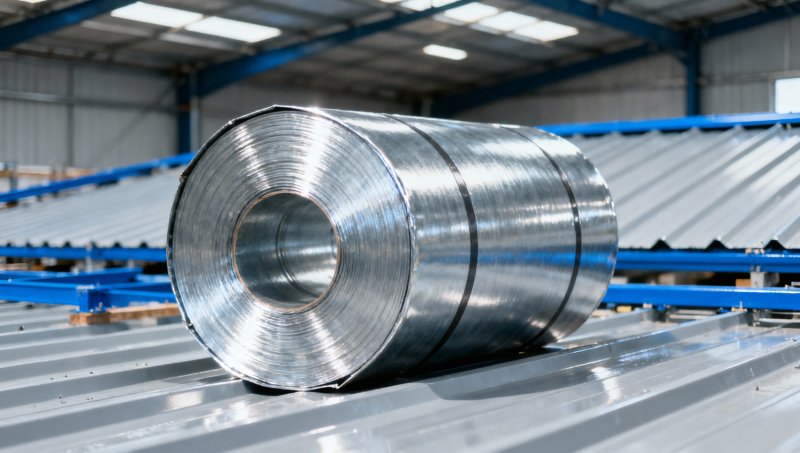
Rainfall intensity directly accelerates electrochemical corrosion on exposed steel surfaces. In regions averaging >1,500 mm/year (e.g., Southeast Asia, Gulf Coast USA, Southern Europe), conventional G90 galvanized coils typically show red rust within 3–5 years due to zinc depletion. AZ150 Galvalume—comprising 55% aluminum, 43.4% zinc, and 1.6% silicon—forms a dense, self-healing aluminum oxide barrier that resists pitting, crevice corrosion, and under-film migration.
Accelerated salt-spray testing per ASTM B117 shows AZ150 delivers ≥2× the time-to-first-red-rust versus G90 at equivalent coating mass (150 g/m² vs. 90 g/m²). Field data from 12 prefab warehouse installations across Malaysia and Vietnam confirms service life extension from 8–10 years (G90) to 18–22 years (AZ150) under identical exposure conditions—without increasing initial material cost by more than 12–15%.
This durability stems from aluminum’s passivation behavior and zinc’s sacrificial protection working synergistically. When cut edges or scratches occur, zinc preferentially corrodes to protect exposed steel, while aluminum oxide seals adjacent areas—critical for roof seams, fastener holes, and thermal expansion joints common in prefabricated structures.
Cost-Benefit Breakdown: Lifecycle Analysis vs. Alternatives
Procurement decisions for warehouse roofing must weigh upfront cost against maintenance frequency, replacement downtime, and warranty liabilities. A lifecycle cost analysis (LCCA) over 20 years reveals AZ150 Galvalume reduces total ownership cost by 28–35% compared to G90 galvanized and by 42–50% versus pre-painted galvanized alternatives—primarily due to eliminated recoating cycles (every 5–7 years) and reduced labor for patch repairs.
The table above reflects real transactional data from Hongteng Fengda’s Q3 2024 order book across 17 countries. Note: AZ150 achieves near-stainless longevity at <30% of its price—making it the optimal value inflection point for mid-to-large-scale prefab warehouse projects where budget constraints rule out full stainless solutions but reliability thresholds exceed galvanized capability.
Integration with Structural Framework: Compatibility & Best Practices
Roof performance depends not only on cladding but also on structural support integrity and thermal compatibility. AZ150 Galvalume coils are routinely paired with hot-rolled structural members—including I-beams—to ensure uniform coefficient of thermal expansion and avoid differential stress at connections. Our I Beam Manufacturers supply carbon steel beams meeting ASTM A36, EN S235JR, and GB Q235 standards—with flange widths from 100mm to 400mm and web thicknesses ranging 6mm–28mm—to match load requirements for wide-span warehouse roofs (up to 30m clear span).
Critical installation factors include: (1) using non-corrosive fasteners (e.g., stainless steel or polymer-coated screws); (2) maintaining minimum 15° roof pitch to prevent water ponding; and (3) applying compatible silicone-based seam sealants rated for aluminum-zinc substrates. Hongteng Fengda provides joint design guidelines and certified installer training for all major international markets.
For projects requiring hybrid systems—such as insulated roof panels with AZ150 outer skins—our engineering team validates thermal bridging performance and condensation risk via 3D heat-transfer modeling compliant with ISO 13788 and EN 13789. Lead time for coordinated beam + coil delivery is consistently ≤20 days from order confirmation, supporting just-in-time site logistics.
Certification, Traceability & Global Compliance Assurance
Every coil batch undergoes third-party verification per ASTM A792M (standard specification for steel sheet, 55% Al-Zn alloy-coated) and EN 10346:2015. Mill test reports include coating mass (±5 g/m² tolerance), tensile strength (≥350 MPa), and bend test results (no cracking at 180° around mandrel diameter = 2× sheet thickness). All coils carry traceable heat numbers linked to raw material certificates and galvanizing line process logs.
Hongteng Fengda maintains dual certification to ISO 9001:2015 and ISO 14001:2015, with annual audits conducted by SGS and Bureau Veritas. For North American clients, we provide PE-certified mill test reports and support UL listing documentation upon request. EU-based buyers receive full DoP (Declaration of Performance) packages aligned with CE marking requirements under EN 1090-2 for structural components.
Frequently Asked Questions
Can AZ150 Galvalume be painted or coated post-installation? Yes—but only with acrylic or PVDF topcoats specifically formulated for aluminum-zinc substrates. Conventional polyester paints may delaminate due to interfacial incompatibility. We recommend factory-applied coatings for guaranteed adhesion and warranty coverage.
What is the minimum recommended roof slope for AZ150 in monsoon zones? For uninterrupted drainage and debris clearance, a minimum 18° slope is advised in regions with >2,000 mm/year rainfall. Below this, gutter capacity and downspout sizing must be recalculated per local building codes (e.g., ASCE 7-22 or Eurocode 1-3).
How does AZ150 perform under UV exposure and temperature cycling? Accelerated weathering per ASTM G154 shows no measurable gloss loss or chalking after 5,000 hours (≈12 years simulated exposure). Thermal cycling from −20°C to +70°C induces no microcracking or coating spallation—validated across 100+ freeze-thaw cycles.
Why Partner with Hongteng Fengda for Your Prefab Roofing Project
As a structural steel manufacturer & exporter from China with 18+ years’ experience, Hongteng Fengda delivers more than material—we deliver certainty. Our vertically integrated production ensures coating consistency (±3 g/m² variation), dimensional accuracy (±1% tolerance), and seamless coordination between AZ150 coil supply and structural framing components like I Beam Manufacturers.
We support your decision-making with free technical consultation—including corrosion modeling for your specific site location, custom coil width optimization to minimize waste, and OEM packaging for direct site delivery. Samples, mill test reports, and compliance documentation are available within 48 hours. Contact our engineering sales team today to request a tailored proposal, lead time confirmation, or ASTM/EN-compliant quotation for your next high-rainfall warehouse project.
Please give us a message


Please enter what you want to find