Industrial Steel Pipe or Seamless Pipe: Which Should You Use?
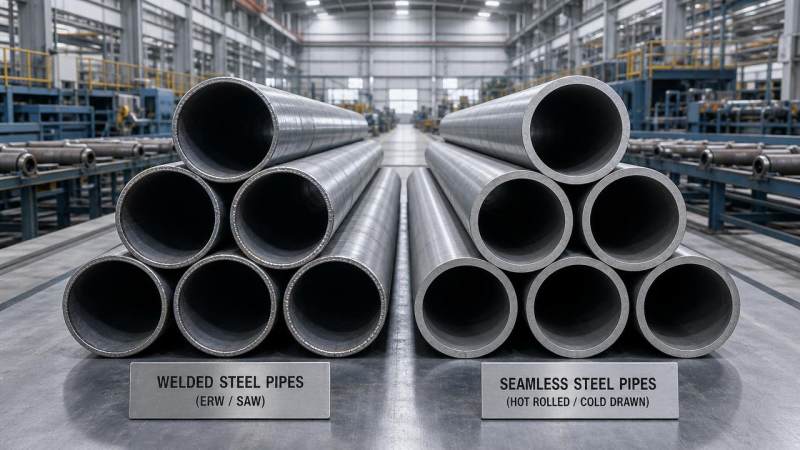
Choosing between industrial steel pipe and seamless pipe affects safety, budget, and maintenance planning.
The right choice depends on pressure, corrosion, fabrication needs, lead time, and total lifecycle cost.
Many teams assume seamless pipe is always better.
In practice, that is not always true.
An industrial steel pipe can be the smarter option when operating conditions are clear and sourcing discipline is strong.
This guide breaks the decision into practical factors that matter during specification, procurement, and project execution.
What Is the Difference Between Industrial Steel Pipe and Seamless Pipe?
The main difference starts with how the pipe is made.
An industrial steel pipe often refers to welded pipe used in industrial, structural, and utility systems.
Seamless pipe is produced without a welded seam.
It is formed by piercing solid steel billets and rolling them into pipe.
Because of this, seamless pipe is often selected for high pressure, high temperature, or critical process service.
However, modern welded industrial steel pipe can also meet demanding standards in many applications.
Quick comparison
- Welded industrial steel pipe usually offers better availability and lower cost.
- Seamless pipe usually offers stronger confidence for severe pressure cycles.
- Welded pipe can provide tighter cost control in large-volume procurement.
- Seamless pipe may reduce risk in highly regulated process environments.
How Manufacturing Process Affects Performance
Manufacturing method shapes consistency, wall tolerance, weld integrity, and downstream performance.
That is why pipe selection should never stop at price per ton.
Welded industrial steel pipe
Steel strip or plate is formed into a round section and joined by welding.
Quality depends on material grade, welding control, inspection, and dimensional accuracy.
For structural use, water systems, low to medium pressure lines, and fabrication projects, this option performs well.
Seamless pipe
The absence of a weld seam removes one traditional concern point.
This matters in systems facing high pressure, high heat, shock loading, or aggressive media.
Still, seamless pipe often costs more and may involve longer lead times for special sizes.
Where Industrial Steel Pipe Makes More Sense
An industrial steel pipe is often the practical winner in projects balancing performance and budget.
This is especially true when the service environment is well defined.
- Plant utility piping with moderate pressure requirements.
- Structural frameworks and support assemblies.
- Fire protection, water transfer, and drainage systems.
- Large-volume infrastructure with strict budget targets.
- Fabricated assemblies needing cutting, welding, and on-site modification.
In these cases, a qualified industrial steel pipe supplier can deliver strong value.
Good value means stable dimensions, test records, predictable delivery, and lower procurement risk.
When Seamless Pipe Is the Better Choice
Seamless pipe becomes the safer option when failure consequences are high.
That does not mean it belongs everywhere.
It means the operating profile justifies the extra cost.
- High-pressure steam, oil, gas, and chemical lines.
- Boiler tubes and heat exchange systems.
- Critical refinery and petrochemical service.
- Low-temperature or high-temperature duty with strict code requirements.
- Systems with repeated pressure fluctuation and fatigue concerns.
If inspection access is limited after installation, seamless pipe may offer better long-term confidence.
Cost Comparison: Purchase Price vs Total Project Cost
This is where many decisions become more nuanced.
Seamless pipe usually carries a higher unit price.
But the real question is total installed and operating cost.
If an industrial steel pipe meets the design code, over-specifying seamless pipe can waste budget.
That budget may be better used on coatings, inspection, or installation quality.
Key Questions Before You Finalize Pipe Selection
A smart pipe decision starts with a short list of non-negotiable requirements.
- What are the exact pressure and temperature ranges?
- Is the fluid corrosive, abrasive, or cyclic in load behavior?
- Which standard applies, such as ASTM, EN, JIS, or GB?
- Will the pipe be welded, bent, coated, or machined later?
- How costly is downtime if pipe failure occurs?
- What lead time risk can the project actually absorb?
These questions usually reveal whether industrial steel pipe is enough or whether seamless pipe is justified.
Supply Reliability Matters More Than Many Teams Expect
Even the right material choice can fail the project if supply performance is weak.
Late shipments, inconsistent dimensions, or unclear certificates create hidden costs very quickly.
This is why many buyers now evaluate manufacturers as carefully as they evaluate the pipe itself.
Hongteng Fengda, a structural steel manufacturer and exporter from China, supports global industrial and construction projects with stable capacity and controlled quality.
Its product range includes angle steel, channel steel, steel beams, cold formed profiles, and customized structural steel components.
Compliance with ASTM, EN, JIS, and GB helps reduce specification mismatch during cross-border sourcing.
For teams managing multi-material packages, this kind of supply coordination can simplify execution.
A Related Material Choice in Corrosive Work Environments
Pipe selection often connects with other corrosion-sensitive components across the same project.
For lifting, marine, mining, or equipment support systems, coated cable products may need similar attention.
One example is Galvanized Steel Wire Rope, used in cranes, elevators, drilling, railways, and marine industries.
Available in plain, electro galvanized, and hot dipped galvanized finishes, it supports different corrosion exposure levels.
With tensile strength from 1470Mpa to 1960Mpa and standards such as ISO 9001, DIN, and ABS, it fits demanding equipment environments.
The broader point is simple.
Material decisions work best when corrosion, strength, and supply planning are aligned across the full system.
Common Selection Mistakes to Avoid
- Choosing seamless pipe only because it sounds safer.
- Choosing industrial steel pipe only because the quotation is lower.
- Ignoring inspection level, testing records, and traceability.
- Missing the effect of coating, environment, and service life.
- Comparing suppliers by price while ignoring delivery reliability.
- Specifying material before confirming fabrication and installation needs.
Most costly errors come from incomplete evaluation, not from the pipe category alone.
Final Decision: Which Should You Use?
Use industrial steel pipe when the application is well defined, the code permits it, and cost efficiency matters.
Use seamless pipe when pressure, temperature, fatigue, or consequence of failure raises the risk profile.
The best decision is rarely about one material being universally better.
It is about matching service conditions, compliance needs, and sourcing reality.
If you compare industrial steel pipe and seamless pipe through performance, risk, availability, and lifecycle cost, the right answer becomes much clearer.
Start with operating data, confirm the standard, review supplier capability, and then lock the specification with confidence.
Please give us a message


Please enter what you want to find