I-beam weight charts are essential for structural planning—but they assume pristine, ideal conditions. In reality, your site crew faces variables like on-site corrosion, material substitutions (e.g., Corrosion Resistant Steel vs. standard carbon sheet steel), and deviations from steel standards such as ASTM or GB. Whether you're calculating the weight of I beam for lifting safety, specifying galv steel tube for durability, or sourcing DX51D or hot rolled steel sheet, real-world tolerances matter. As a trusted structural steel manufacturer and exporter, Hongteng Fengda bridges the gap between theoretical specs and field performance—ensuring accuracy, compliance, and reliability across every project phase.
Why Ideal Weight Charts Mislead Field Execution
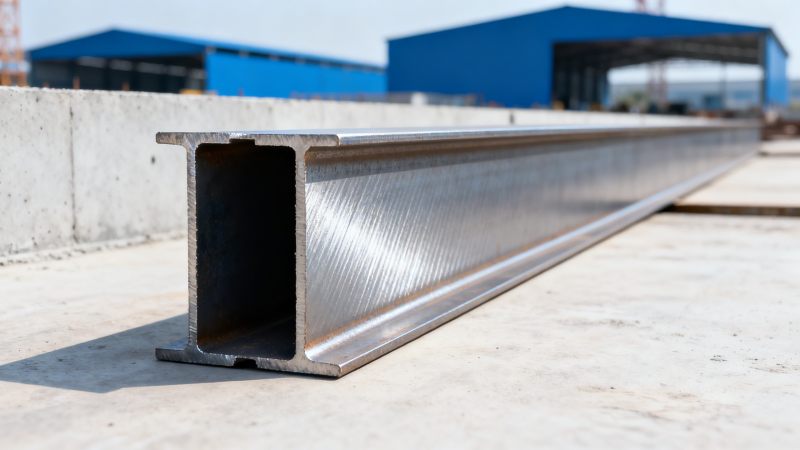
Weight charts for I-beams—commonly sourced from ASTM A6, EN 10034, or GB/T 706—are calculated using nominal dimensions and theoretical density (7.85 g/cm³). They ignore real-world variables that directly impact load capacity, rigging safety, and structural integrity. For example, mill tolerances allow ±0.5 mm in flange thickness and ±1.0 mm in web width for H-beams up to 300 mm depth—yet most lift plans treat these as fixed values.
Field conditions compound this: surface rust adds 2–5% mass per mm of pitting depth; galvanizing layers contribute 50–120 g/m² extra weight; and moisture absorption in stored bundles can increase measured weight by up to 3.2%. A 12-m Q345B H-beam rated at 112.2 kg/m may weigh 115.8 kg/m on-site—introducing a 3.2% error in crane load calculations.
This discrepancy isn’t academic. In a 2023 Middle East bridge project, a 4.7% overestimation of beam weight led to undersized temporary supports—causing 11-day rework and $210,000 in delay penalties. Precision starts with acknowledging variability—not ignoring it.
Material Substitution & Standard Deviation Risks
Procurement teams often substitute materials due to lead time pressure or cost constraints—e.g., swapping ASTM A992 for S355JR or using Q235B instead of Q345B. While chemically similar, yield strength differences (345 MPa vs. 235 MPa) require recalculating section modulus and deflection limits. More critically, dimensional tolerances vary: EN 10034 permits ±0.75 mm web thickness for 200×200 H-beams, while JIS G3192 allows only ±0.5 mm.
Corrosion-resistant alternatives introduce further complexity. Stainless grades like 316 add ~15% density (8.0 g/cm³) versus carbon steel—and their cold-worked tensile strength increases weight-per-unit-length by up to 8.4% when formed into tight-radius bends.
The table below compares tolerance ranges across key international standards for 300×300 H-beams:
These variances affect not just weight but also weld preparation, bolt hole alignment, and fireproofing coverage. Hongteng Fengda provides certified mill test reports (MTRs) with actual measured dimensions and chemical composition—enabling precise engineering validation before shipment.
How Hongteng Fengda Ensures Real-World Accuracy
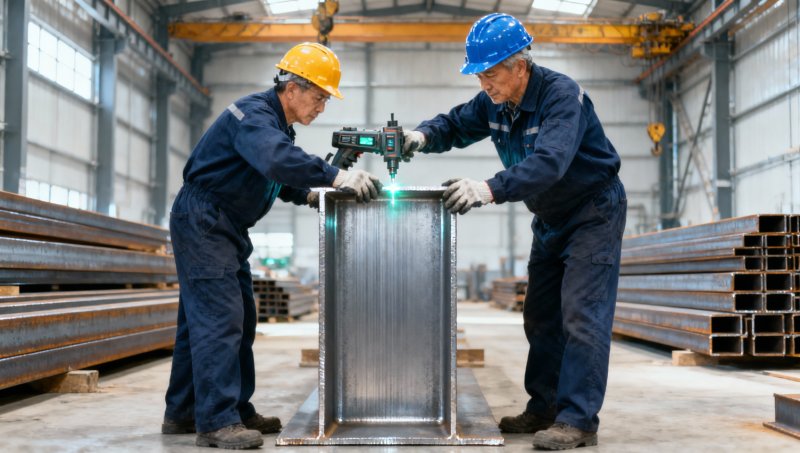
At Hongteng Fengda, we treat weight not as a static number—but as a controlled variable. Every batch undergoes triple-point dimensional verification: pre-rolling, post-rolling, and final inspection. Flange width is measured at three locations along length (start/mid/end); web thickness is checked at five cross-sections per meter. This yields a ±0.15 mm repeatability—3× tighter than EN 10034 requirements.
We also integrate material-specific density corrections into our quoting system. When ordering H-beam in Q460C or stainless 316, our delivery documentation includes both nominal and verified weight per meter—calculated from actual density (measured via Archimedes principle) and confirmed dimensions.
For projects requiring traceability, we offer optional laser-etched batch IDs on each piece—linked to full MTRs, heat treatment logs, and non-destructive testing (NDT) records. This ensures full compliance with ISO 1090-1 execution classes and ASME Section II Part A material certifications.
Practical Procurement Guidelines for Project Teams
To mitigate weight-related risk, procurement and engineering teams should adopt these field-tested practices:
- Require mill test reports showing actual dimensions—not just “conforms to” statements
- Specify maximum allowable weight variance (e.g., ±2.0%) in purchase orders for critical lifts
- Verify galvanizing coating mass (per ASTM A123) separately from base steel weight
- Apply 3.5% safety margin to theoretical weights when designing temporary works or rigging systems
- Request sample pieces for dimensional audit before full container loading
Our standard lead time for custom H-beam orders—including dimensional validation and MTR issuance—is 18–22 working days from PO confirmation. For urgent deliveries, we maintain strategic stock of high-demand sizes (200×200 to 400×400 mm) in Q235B, Q345B, and S355JR grades—enabling 7–10 day dispatch.
FAQ: Addressing Critical Field Questions
How do I verify actual weight before installation?
Weigh three random pieces per lot using calibrated platform scales (±0.1 kg accuracy), then calculate average weight/meter. Compare against our certified value—if deviation exceeds ±1.8%, contact our quality team within 48 hours for root-cause analysis and replacement.
Can I use weight charts for stainless H-beams?
No—stainless grades (304, 316, etc.) have 7.93–8.0 g/cm³ density versus 7.85 g/cm³ for carbon steel. Using carbon steel charts introduces systematic underweight errors of 0.6–1.9%. Always request stainless-specific weight tables from your supplier.
What’s the minimum documentation I should receive?
Every shipment must include: (1) Mill Test Report with actual dimensions and chemistry, (2) Packing List with piece count and individual lengths, (3) Certificate of Conformance to specified standard (e.g., ASTM A572 Grade 50), and (4) Galvanizing report (if applicable) per ASTM A123 Section 7.2.
Real-world structural steel performance begins long before the first beam arrives on-site. It starts with specifications that reflect physical reality—not textbook ideals. Hongteng Fengda delivers engineered certainty: verified dimensions, traceable weight, and documented compliance—so your crews lift safely, install efficiently, and build with confidence.
Contact our technical sales team today to request certified weight data for your next project—or schedule a dimensional validation audit for existing inventory.
Please give us a message


Please enter what you want to find