Why do mill certs matter so much when comparing i beam steel suppliers?
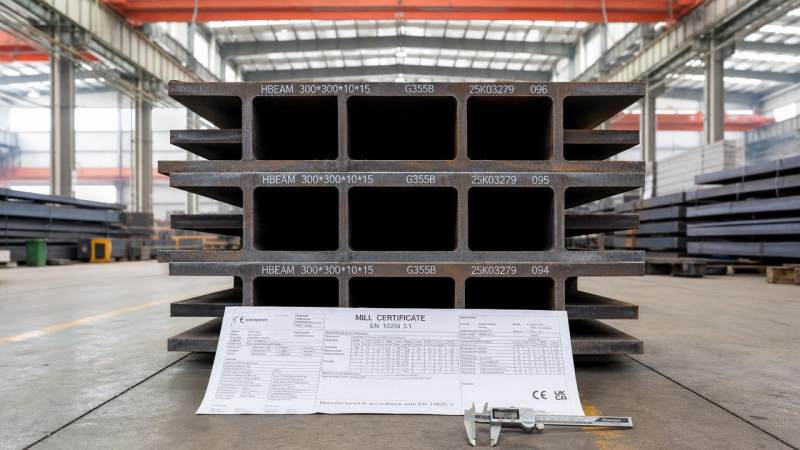
Price is easy to compare. Traceable quality is not.
That is why mill certificates often become the real dividing line between reliable and risky i beam steel suppliers.
A proper mill cert confirms heat number, grade, chemistry, mechanical properties, dimensions, and the standard used for production and testing.
In practical terms, it helps verify whether a beam marked as A36, Q345, SS400, or S355 actually matches the required specification.
Without that link, inspection becomes guesswork, and project risk increases before installation even begins.
The more dependable i beam steel suppliers do not treat certificates as paperwork only. They connect certs to production lots, markings, and shipment records.
This matters for structural steel used in industrial buildings, plant frames, equipment supports, and export projects crossing ASTM, EN, JIS, or GB requirements.
For example, China-based exporters with stable process control usually make traceability easier by aligning manufacturing, inspection, and shipping documents from the start.
That reduces confusion when a receiving team needs to check heat numbers or resolve a dimensional concern quickly.
What should you actually read on a mill certificate?
Many buyers receive mill certs, but fewer read them in a way that helps compare i beam steel suppliers objectively.
The useful approach is to read the document like a risk filter, not like a formality.
Start with the basic identifiers.
- Steel grade and standard, such as ASTM, EN, JIS, or GB
- Heat number and batch reference
- Section size, length, and ordered quantity
- Chemical composition values
- Yield strength, tensile strength, and elongation
- Test method, issuing mill, and inspection date
Then compare those values against the purchase specification, not just the label on the bundle.
A certificate can look complete while still missing the exact standard edition or the required mechanical test range.
A common issue appears when an exporter offers equivalent grades, but the project spec does not allow substitution.
That is not always a quality failure, but it can still create a compliance problem.
Where several grades are involved, including Q195-Q235, Q345, SS355JR, SS400, A36, ST37-2, S235J0, S235J2, or St52, line-by-line matching is safer than assuming broad equivalence.
A quick comparison table makes hidden gaps easier to spot
Are dimensional tolerances just a manufacturing detail?
Not really. Tolerances influence fit-up, welding quality, load path, and site rework.
When comparing i beam steel suppliers, tolerance control often reveals more than the quoted unit price.
A beam can pass chemistry and strength checks yet still cause trouble if flange width, web thickness, straightness, or length deviate too far.
More common problems include difficult connection alignment, uneven bearing, excessive shim use, and cutting adjustments on site.
That is why tolerance should be reviewed against the governing standard and the actual application.
For industrial structures, a nominally acceptable beam may still be operationally inconvenient if fabrication sequences are tight.
Some suppliers can support custom requirements better because their rolling and inspection systems are more stable.
One example in this category is Structural Steel I Beam, offered with hot rolled molding, non-alloy steel options, and stated tolerance control around ±1%.
Typical ranges may include thickness from 4.5mm to 15.8mm, lengths of 6-12m, and flange or web dimensions adjusted to order needs.
That kind of dimensional clarity helps when reviewing fabrication compatibility before shipment.
Which tolerances deserve the closest attention?
- Overall depth, because connection geometry depends on it
- Flange width and thickness, because bearing surfaces must stay consistent
- Web thickness, because it affects welding preparation and local stiffness
- Length tolerance, because site cutting creates delay and scrap
- Straightness and twist, because assembly alignment suffers quickly
How can you compare suppliers when all of them claim compliance?
This is where documentation quality and production discipline separate strong candidates from average ones.
Many i beam steel suppliers can mention ASTM, EN, JIS, or GB compliance in a quotation.
The better question is whether they can show repeatable evidence across orders, grades, and destinations.
A practical comparison usually includes four areas.
- Document consistency across quote, cert, packing list, and markings
- Inspection responsiveness when questions arise before loading
- Ability to handle mixed standards and OEM requirements
- Lead time reliability, especially for export shipments
In actual sourcing, stable capacity matters because rushed rolling schedules tend to increase avoidable variation.
Exporters with established process control often perform better when projects require custom lengths, secondary processing, or multiple destination standards.
That is one reason buyers often prefer suppliers that combine manufacturing and export experience rather than only trading documentation.
For instance, companies serving North America, Europe, the Middle East, and Southeast Asia usually become familiar with different acceptance expectations.
That familiarity can reduce delays caused by incomplete cert formats or mismatched standard references.
What are the most common warning signs before an order is approved?
The biggest warning sign is not always a failed test result.
Often, it is a pattern of vague answers, partial traceability, or tolerance language that stays too general.
If i beam steel suppliers cannot explain how dimensions are checked, how heat numbers are linked, or what standard edition is applied, caution is justified.
Another risk appears when the supplier offers “equivalent” material without confirming project approval rules.
That may work for stock trading, but not always for structural compliance.
It also helps to examine processing claims.
If bending, welding, punching, cutting, or decoiling will be involved, the original section accuracy becomes even more important.
A beam rolled on a four-roller universal mill may offer better section consistency for some applications, but that should still be verified by records and samples.
The checklist below is useful before final release.
How should the final decision be made without overcomplicating the process?
The cleanest method is to compare i beam steel suppliers using a short approval matrix.
Keep price in the discussion, but do not let it outweigh traceability, dimensional control, and schedule confidence.
A supplier with slightly higher cost may reduce much larger downstream exposure.
That exposure usually shows up as inspection holds, repair welding, rejected lots, delayed erection, or unresolved document gaps.
A sensible review often looks like this.
- Confirm the exact grade, standard, and acceptance criteria
- Review sample mill certs before placing the order
- Define critical dimensional tolerances in writing
- Request marking and traceability method details
- Align delivery timing with inspection checkpoints
When a supplier can support standard sections and custom structural requirements with clear documentation, the decision becomes easier.
That is especially true for export-oriented steel partners working across ASTM, EN, JIS, and GB systems with dependable lead times.
If the next step is evaluation, begin with the cert format, tolerance basis, and processing scope rather than the quote total alone.
That approach gives a more realistic view of which i beam steel suppliers can support safe, compliant, and efficient project delivery.
Please give us a message


Please enter what you want to find