Choosing between i beam h beam options can feel confusing when strength, cost, and project fit all matter. For homeowners, builders, and buyers, understanding the basic differences is the first step to making a smarter purchase. This simple guide explains how each beam type performs, where it is commonly used, and how a reliable structural steel supplier can help you select the right solution with confidence.
What most buyers really want to know first
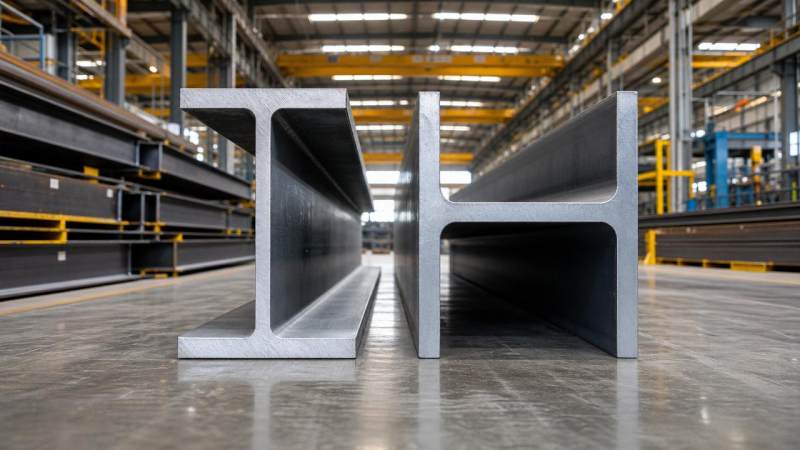
If you searched for i beam h beam, you probably do not need a textbook definition. You want to know which beam is better for your project, budget, and safety needs.
The short answer is simple. H beams usually offer stronger load performance, wider flanges, and better stability for heavy structures. I beams are often suitable for lighter spans and more conventional building work.
That said, there is no universal winner. The right choice depends on span length, load type, support conditions, installation method, and the standard required in your market.
For end consumers, the biggest mistake is choosing based only on appearance or price per ton. A cheaper beam can become more expensive if it causes redesign, waste, or safety concerns later.
I beam vs H beam: the simplest way to understand the difference
The names come from the cross section shape. An I beam looks more like the capital letter I, while an H beam has wider flange sections, forming a shape closer to H.
The main structural difference is flange width and web proportion. H beams usually have wider flanges and a thicker web, which helps distribute loads more effectively in many applications.
I beams typically have narrower flanges and may be lighter for certain sizes. That can make them practical for projects where load demands are lower and weight efficiency matters.
In everyday terms, if you imagine two people carrying weight, the H beam is often the stronger, more balanced lifter. The I beam can still work well, but usually in less demanding conditions.
Which beam is stronger for real-world use?
This is often the first practical question. In many structural applications, H beams are considered stronger because their geometry gives them better load-bearing capacity and bending resistance.
The wider flange of an H beam improves stability, especially in columns, heavy frames, large workshops, bridges, and industrial buildings where loads may be high or unevenly distributed.
I beams are not weak. They are widely used and reliable when correctly specified. In residential construction, smaller commercial structures, and support framing, they can perform very well.
Strength is never only about beam type. Steel grade, beam size, span, connection design, and installation quality all matter. A properly sized I beam can outperform an undersized H beam.
That is why buyers should avoid asking only, “Which is stronger?” A better question is, “Which beam is structurally suitable for my actual load and span requirements?”
When should you choose an H beam?
H beams are commonly preferred when a project needs higher strength, better stability, and stronger support in multiple directions. They are often selected for columns and long-span structural frames.
If your project includes factories, steel structure warehouses, large sheds, platforms, bridges, or multi-story buildings, H beams are often the safer and more efficient option to evaluate first.
They are also useful when future expansion is possible. If a building may later carry more equipment, heavier roofing, or additional floor loading, choosing a stronger beam profile can reduce future risk.
Another advantage is fabrication flexibility in larger steel structures. H beams are frequently easier to integrate into engineered systems designed under ASTM, EN, JIS, or GB standards.
When is an I beam the better choice?
I beams can be an excellent choice for lighter structural tasks, especially where weight control, simpler installation, and cost sensitivity are important decision factors.
In smaller buildings, house extensions, floor supports, mezzanine frames, and basic construction applications, an I beam may provide enough performance without the added material of a heavier H beam.
For buyers, this can mean lower material spending, easier handling, and reduced transport weight. But these savings only help if the beam still meets structural requirements with enough safety margin.
An I beam becomes a poor choice when it is selected only to cut cost, despite heavy loads or long spans. That decision can lead to deflection problems, reinforcement needs, or engineering changes.
Cost comparison: is H beam always more expensive?
Many consumers assume H beams always cost more because they are often larger and heavier. In unit price terms, that may be true in some sizes, but project cost is more complex.
A stronger beam may reduce the number of support points, simplify the frame, or lower fabrication changes. In that case, an H beam can improve total project efficiency despite a higher material price.
On the other hand, if your structure does not need that level of capacity, paying for a heavier section may add unnecessary cost. This is where correct selection creates real savings.
Ask suppliers for more than a quotation. Request size options, weight comparison, standard compliance, and loading guidance. The best buying decision comes from total value, not only from the cheapest line item.
Common buying mistakes that lead to wrong beam selection
One common mistake is choosing by shape name alone. Not every product called an I beam or H beam has the same dimensions, tolerances, or performance level across different standards.
Another mistake is ignoring actual use conditions. Indoor frames, coastal buildings, humid environments, and chemically exposed sites may require different material treatment or corrosion protection strategies.
Some buyers also overlook fabrication and logistics. Beam length, cutting, welding, drilling, bundling, and shipping all affect lead time and cost, especially for export and custom orders.
There is also confusion between primary load-bearing members and secondary steel components. In some projects, corrosion-resistant accessories such as Galv Steel Tube may complement the main beam system in support, piping, frames, or utility structures.
Finally, many end users rely on visual judgment instead of drawings or engineering advice. Steel structures should never be selected only by what “looks strong enough.”
How to choose the right beam for your project step by step
Start with the application. Is the beam supporting a roof, floor, platform, wall opening, machine load, or full structural frame? The job of the beam determines the selection path.
Next, identify the span and expected load. Longer spans and heavier loads generally push the decision toward stronger sections, often making H beam options more competitive.
Then check whether the beam acts as a horizontal member or column. H beams are often favored for columns because of their balanced geometry and improved compressive stability.
After that, review local standards and compliance needs. Projects in North America, Europe, the Middle East, and Asia may require different specifications, documentation, and inspection expectations.
Also think about the environment. If the project includes outdoor exposure, moisture, or fluid transport systems, associated materials may need extra corrosion resistance. In such support systems, products like Galv Steel Tube are often chosen for long service life and broad utility.
Last, confirm with a supplier that can support both standard and customized structural steel solutions. A good supplier should help you compare options instead of pushing one product blindly.
Why supplier capability matters as much as beam type
Even if you know the difference between i beam h beam products, your result still depends heavily on who manufactures and supplies the steel.
A reliable structural steel manufacturer should offer stable production, clear specifications, traceable quality control, and familiarity with international standards such as ASTM, EN, JIS, and GB.
This matters because end consumers often need more than raw material. They may need cutting, custom sizing, OEM support, consistent tolerance control, export packing, and dependable shipping schedules.
When a supplier understands global construction and industrial requirements, they can help reduce sourcing risk. That includes avoiding mismatched standards, dimension errors, coating issues, or late deliveries.
For buyers working on homes, workshops, farm buildings, bridges, machinery supports, or light industrial projects, experienced support can save both time and expensive corrections.
Questions you should ask before placing an order
Ask what standard the beam follows and whether mill test certificates are available. This helps verify chemical composition, mechanical properties, and compliance for your market.
Ask whether the supplier can recommend sizes based on your drawings, span, and application. A professional supplier should provide practical guidance, not only a price list.
Ask about length tolerance, customization options, surface treatment, and fabrication services. These details affect installation efficiency and reduce on-site modifications.
Ask about packing and export experience if you are importing. Structural steel is heavy, and poor packing can create handling damage, corrosion exposure, or unloading difficulties.
Finally, ask about related steel products if your project includes more than beams. Many structures also need channels, angle steel, cold formed profiles, tubes, and custom components from one coordinated source.
Final decision: how to think clearly about i beam h beam selection
If your structure is heavier, longer span, or more demanding, start by evaluating H beams. If your project is lighter, simpler, and cost-sensitive, I beams may be fully adequate.
The real goal is not to find the beam that is generally better. It is to find the beam that matches your project safely, economically, and with the least sourcing risk.
For end consumers, the smartest approach is to combine basic beam knowledge with supplier guidance and clear project information. That is how you avoid overbuying, underbuilding, or paying for avoidable mistakes.
In the i beam h beam comparison, understanding shape differences is only the beginning. The best choice comes from matching load, span, environment, compliance, and supplier reliability into one practical decision.
When those factors align, you do not just buy steel. You buy confidence that your project will move forward with stronger performance, better value, and fewer surprises.
Please give us a message


Please enter what you want to find