Tolerance directly affects fit-up, load transfer, and compliance in structural work. When reviewing cold formed angle steel specifications, dimensional variation is not a minor detail.
It influences welding quality, bolted alignment, assembly speed, and service performance. A section that meets strength targets can still create costly problems if tolerance control is poor.
In steel projects, selection should therefore balance nominal size, material grade, manufacturing route, and tolerance capability. This is especially important for cold formed angles used in frames, supports, bracing, and connection details.
Tolerance as a core part of cold formed angle steel specifications
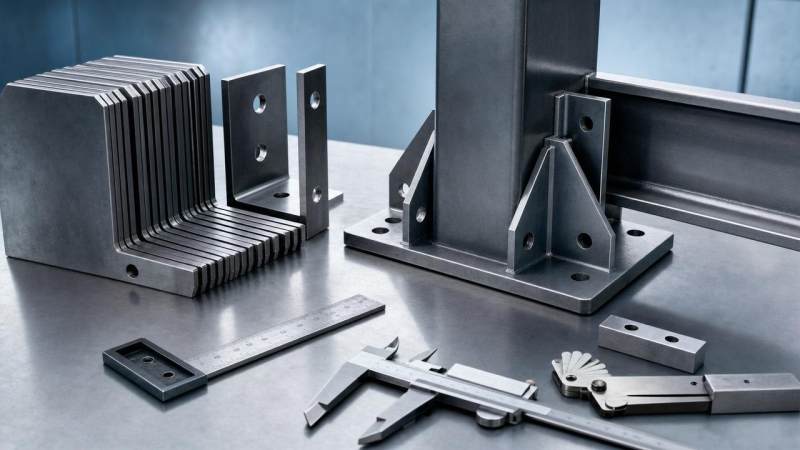
Cold formed angle steel is produced by bending steel strip or plate into an L-shaped profile. Its geometry depends on tooling, forming sequence, material springback, and finishing control.
Because of that process, cold formed angle steel specifications must include more than leg length and thickness. They should also address dimensional tolerance, straightness, squareness, twist, and edge condition.
Tolerance defines the acceptable deviation from nominal dimensions. That deviation affects how the angle mates with plates, channels, beams, and anchors during fabrication and installation.
Common tolerance items include:
- Leg length variation
- Thickness variation
- Inside and outside corner radius
- Out-of-square condition
- Bow, camber, and twist
- Cut length accuracy
When cold formed angle steel specifications are checked early, downstream rework can be reduced. That improves assembly consistency and supports better quality records during inspection.
Why the industry pays close attention to dimensional variation
Steel projects increasingly combine fast installation schedules with strict code compliance. Under those conditions, tolerance becomes a project control issue, not only a mill issue.
International supply chains also raise the importance of standard alignment. Buyers often compare ASTM, EN, JIS, and GB references when evaluating cold formed angle steel specifications.
Several current concerns explain this focus:
For this reason, cold formed angle steel specifications should be reviewed together with process capability, not only with catalogue dimensions.
How tolerance affects selection decisions in practice
Selection begins with structural demand, but final acceptance depends on usability. An angle with acceptable strength may still fail practical requirements if the tolerance window is unsuitable.
Connection fit-up
Leg length deviation can shift hole positions and reduce contact surfaces. That complicates bolting, increases slotting work, and may weaken intended connection behavior.
Load transfer reliability
Out-of-square angles can create uneven bearing and local stress concentration. In repeated or dynamic loading, that may accelerate fatigue-sensitive conditions.
Welding quality
Thickness variation and distorted corners affect root opening and weld access. Fabricators may need extra preparation to maintain consistent weld profiles.
Surface treatment compatibility
Galvanizing or coating performance can be influenced by edge shape and corner radius. Stable geometry supports more uniform coverage and appearance.
Inspection and acceptance
If cold formed angle steel specifications do not clearly state tolerance criteria, disputes can arise during receiving inspection. Clear limits reduce ambiguity and simplify approval.
Typical tolerance-sensitive applications for angle steel
Not every application needs the same control level. Selection should reflect assembly method, loading pattern, and interface complexity.
In mixed structural systems, angle steel often interfaces with heavier members. For example, support details may connect to H Girder sections.
Where such interfaces exist, dimensional consistency becomes more important. Heavier sections often offer strong bending resistance and stable geometry, so mismatch usually appears first in secondary angle parts.
Projects using H-beam sections in Q235, Q345B, S355JR, A572, or A992 grades also tend to expect similar clarity in angle steel tolerance documentation.
What to review in specifications, standards, and mill documents
A reliable selection process compares catalogue data with manufacturing and inspection documents. Cold formed angle steel specifications should be checked in a structured way.
- Confirm nominal dimensions and steel grade
- Verify the applicable standard and edition
- Review tolerance limits for each critical dimension
- Check test methods and measurement tools
- Clarify acceptance frequency and sampling plan
- Request mill certificates and inspection records
This step matters when components will be cut, punched, welded, or galvanized after forming. Every added process can magnify the effect of initial dimensional deviation.
It also helps to define which tolerances are critical-to-function. Not every deviation has equal consequence, so attention should follow actual service needs.
Practical selection guidance for reducing risk
A useful approach is to connect specification review with fabrication reality. The following practices improve decisions around cold formed angle steel specifications.
- Define interface points before ordering. Focus on holes, weld lines, bearing faces, and anchor locations.
- Match tolerance demands to application severity. Secondary trims may allow wider limits than structural connections.
- Use pre-production samples for critical assemblies. Trial fitting reveals hidden tolerance conflicts early.
- Agree on measuring positions. Different reference points can produce conflicting inspection results.
- Consider coating and thermal effects. Galvanizing or welding can alter final geometry.
- Document permitted corrective actions. Straightening or reworking should have limits and approval rules.
When supply involves broader structural packages, consistency across member types is useful. For example, projects using H sections with EN10025 or ASTM A572 references should keep angle tolerances equally clear.
That creates better communication from production to site installation and supports fewer surprises during final assembly.
Next-step considerations for project specification and sourcing
Cold formed angle steel specifications should be treated as a performance document, not only a size list. Tolerance determines whether design intent can be achieved in real construction conditions.
A sound review should combine standard compliance, measurable tolerance limits, inspection evidence, and application-specific fit-up needs. That approach reduces rework, protects safety margins, and improves installation efficiency.
For upcoming steel orders, prepare a checklist covering dimensional limits, test methods, certification standards, and interface details. Then compare suppliers by process stability as well as by price.
With careful attention to tolerance, cold formed angle steel specifications become a practical tool for selecting sections that are easier to fabricate, easier to install, and more dependable in service.
Please give us a message


Please enter what you want to find