Choosing the right carbon steel pipe supplier in Europe can directly affect project cost, quality, and delivery reliability. For procurement professionals, careful supplier evaluation is essential to reduce sourcing risks and ensure compliance with international standards. This guide explains the key criteria, verification steps, and practical considerations that help buyers identify dependable partners and make confident purchasing decisions.
In steel sourcing, a poor supplier decision can create delays of 2–6 weeks, unexpected rework, and compliance issues that affect an entire project schedule. Buyers responsible for industrial piping, structural fabrication, or equipment manufacturing need more than a competitive quotation. They need traceability, specification control, stable lead times, and a supplier that can communicate clearly across technical, commercial, and logistics stages.
When evaluating a carbon steel pipe supplier in Europe, procurement teams usually compare local stockholders, processors, importers, and direct manufacturers. Each model has advantages, but the best choice depends on order volume, technical requirements, project timing, and whether customization or OEM processing is required.
Key evaluation criteria for supplier selection
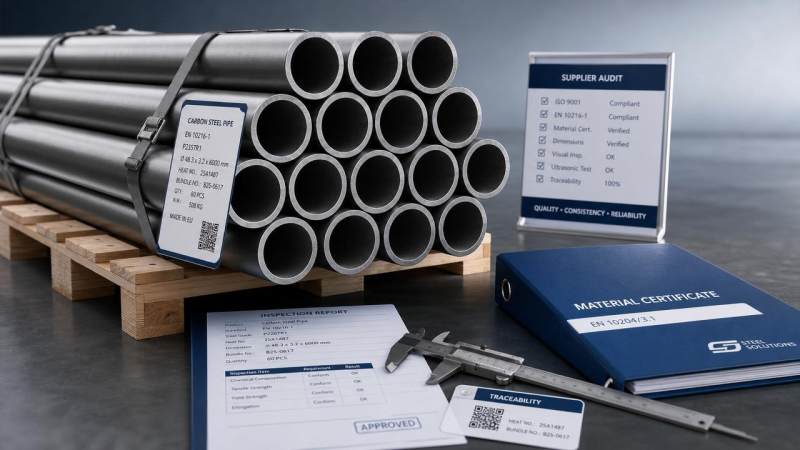
The first step in qualifying a carbon steel pipe supplier in Europe is to build a structured review framework. In most B2B purchasing processes, 5 areas matter most: product compliance, production capability, documentation, delivery performance, and commercial responsiveness.
1. Confirm standards, grades, and application fit
Not all carbon steel pipes are interchangeable. Buyers should verify whether the supplier can provide the exact standard and grade required for the project, such as ASTM A53, ASTM A106, API 5L, EN10210, or GB/T 8163. A mismatch in standard, wall thickness, or testing scope can lead to rejection at inspection or installation stage.
For example, pipes used in pressure service, structural support, heat transfer equipment, or general fabrication may require different tolerances, mechanical properties, and testing procedures. Procurement teams should request the technical data sheet, mill test certificate format, and dimensional range before comparing prices.
Questions to ask during technical review
- Which international standards can the supplier routinely produce or source?
- What outside diameter range, such as 10 mm to 914.4 mm, is available?
- What thickness range, for example 1 mm to 100 mm, can be supplied consistently?
- Are seamless, ERW, and cold-drawn options all available if the project scope changes?
- Can the supplier support fixed lengths like 6 m and 12 m, or custom cut lengths?
2. Check production capability and supply stability
A supplier may have strong sales ability but weak manufacturing control. That is a risk, especially for repeat orders or project-based deliveries over 3–12 months. Ask whether the company is a trader, stockholder, processor, or direct manufacturer, and whether subcontracting is used for key operations.
Stable supply matters when monthly demand exceeds 100 tons, when multiple sizes are bundled in one shipment, or when phased deliveries are tied to installation milestones. A reliable partner should explain production scheduling, raw material sourcing, inspection workflow, and average lead times with clarity.
The table below helps procurement teams compare the main supplier screening factors in a practical way.
This comparison shows that supplier qualification should go beyond price analysis. In practice, the lowest quote can become the highest landed cost if the supplier lacks testing discipline, dimensional consistency, or realistic delivery planning.
3. Review communication speed and document accuracy
Procurement performance often depends on execution discipline. If a supplier takes 4–5 days to answer simple technical questions, sends quotations with missing specifications, or cannot clarify coating, end finish, or packing details, the risk usually increases after the purchase order is issued.
A dependable carbon steel pipe supplier in Europe should respond within 24–48 hours for standard inquiries, provide a clean quotation structure, and confirm at least 6 core items: grade, standard, size, quantity, delivery term, and inspection requirement.
How to verify quality and reduce sourcing risk
After the initial shortlist is prepared, the next stage is verification. Procurement teams should use a 3-step approach: document review, production or stock assessment, and pre-shipment control. This is where many buyers separate capable suppliers from companies that only look strong on paper.
Document review before order confirmation
Before placing an order, request sample mill test certificates, inspection records, packing photos, and export document templates. Verify whether heat numbers, dimensions, chemical composition, mechanical properties, and testing results are clearly linked. Missing traceability is a common problem in mixed-batch supply.
For import projects, document consistency matters as much as the pipe itself. A mismatch between invoice description, packing list, MTC, and customs declaration can delay clearance by several days. This is especially important when sourcing from non-European mills for delivery into Europe.
Production and inspection checks
Where order value or risk level is high, buyers should consider a factory audit, third-party inspection, or remote production review. Even a 1-day audit can reveal whether the supplier actually controls incoming material, dimensional checks, hydrostatic testing, surface inspection, and final packing procedures.
Useful verification points include calibration frequency, marking method, non-conformance handling, and segregation of different grades. If the project involves mixed sizes from 1/8 inch to 3 inches or larger structural dimensions, identification discipline becomes especially important.
Typical pre-shipment checklist
- Confirm quantity by size, schedule, and length.
- Check marking against PO and heat numbers.
- Review MTC values against required standard.
- Inspect surface condition, end finish, and bundling.
- Verify packing suitability for sea, truck, or multimodal transport.
- Confirm final photo record before dispatch.
In many applications, buyers also need a supplier able to support adjacent product categories, not only pipes. For companies sourcing broader steel packages, a manufacturer with experience in structural steel, channels, beams, and custom fabricated components can simplify vendor management and reduce coordination time across 2–4 separate purchase streams.
As an example of specification-driven procurement, A36 Steel Pipe is often reviewed for projects requiring dependable carbon steel material with practical processing flexibility. Depending on the application, buyers may check diameter ranges from 10 mm to 914.4 mm, thickness from 1 mm to 100 mm, and unit lengths such as 3 m, 5.8 m, 6 m, 11.8 m, 12 m, or 13.5 m.
For equipment-related use, seamless cold-drawn low-carbon steel tubes may be required for tubular heat exchangers, condensers, and similar heat transfer equipment. In such cases, procurement teams should confirm applicable standards such as ASTM A179, ASTM A192, ASTM A106, API 5L, EN10210, JIS G3454, or GB/T 5310, depending on design and service conditions.
Commercial terms, logistics, and total cost assessment
A competitive ex-works or FOB price does not always mean a better procurement result. Buyers comparing a carbon steel pipe supplier in Europe should calculate total landed cost, which includes processing, testing, packaging, inland transport, customs handling, and the risk cost of late or partial delivery.
Compare more than unit price
A quotation that is 3% lower may become less attractive if the supplier requires split shipments, adds charges for testing, or cannot maintain the promised lead time. Procurement teams should assess at least 4 cost layers: material price, conversion or processing cost, logistics cost, and quality-risk cost.
The table below shows a practical framework for total cost comparison during supplier evaluation.
This structure helps buyers compare offers on a like-for-like basis. It also prevents hidden cost surprises after order placement, especially when the requirement includes multiple standards, mixed schedules, or custom lengths.
Lead time planning and delivery discipline
Lead time should be checked in detail, not only as a single number. Ask for the breakdown between production, inspection, packing, inland transport, and export booking. Standard stock supply may move in 7–15 days, while mill production or custom processing can require 3–8 weeks depending on size mix and testing scope.
For framework agreements or recurring demand, buyers should also ask about safety stock, monthly capacity allocation, and substitute size handling. These points matter when project consumption fluctuates or when urgent replacement material is needed.
Common mistakes buyers should avoid
Even experienced teams can make avoidable sourcing mistakes. The most common issue is treating all carbon steel pipes as commodity products without accounting for application differences, inspection requirements, or fabrication needs.
Mistake 1: Approving a quote without a full specification matrix
A complete RFQ should include grade, standard, OD, wall thickness or schedule, length, tolerance expectations, end treatment, testing, packing, and destination. Missing even 1 or 2 items often leads to price revisions or supply disputes later.
Mistake 2: Overlooking supplier breadth for multi-item projects
Many procurement departments prefer fewer qualified suppliers for easier control. If a partner can support pipes together with angle steel, channels, beams, cold formed steel profiles, or customized structural steel parts, the sourcing process becomes more efficient and coordination cost usually drops.
This is one reason global buyers often work with export-oriented manufacturers that understand ASTM, EN, JIS, and GB standards across several product groups. A company with stable production capacity and strict quality control can support both standard steel requirements and OEM-based procurement plans.
Mistake 3: Focusing only on Europe-based inventory
For urgent demand, local stock in Europe can be the right answer. But for larger volumes, scheduled imports, or custom structural requirements, direct cooperation with an experienced Chinese manufacturer or exporter may provide better control of cost, specification flexibility, and batch consistency.
Hongteng Fengda, for example, focuses on structural steel manufacturing and export for global construction, industrial, and manufacturing projects. With modern facilities, compliance with major international standards, and experience supporting buyers in Europe and other regions, this type of supplier can help reduce sourcing risk while keeping delivery planning practical.
A practical supplier vetting process for procurement teams
For buyers who want a repeatable method, a 6-step vetting process is usually effective. It creates a clear record, improves internal approval speed, and reduces dependence on assumptions during urgent sourcing cycles.
Recommended 6-step process
- Define technical scope and required standards.
- Shortlist 3–5 suppliers with relevant export or regional supply experience.
- Request quotation, MTC samples, and size availability list.
- Evaluate capacity, documentation, and communication quality.
- Run inspection or trial order for medium- to high-risk items.
- Approve supplier with clear KPI review every 6–12 months.
This process is particularly useful when the supplier will support recurring steel procurement instead of a single transaction. Performance should be measured through on-time delivery rate, documentation accuracy, claim response speed, and dimensional conformity across several orders.
What a dependable partner should demonstrate
A qualified supplier should not only offer material. The company should help buyers clarify specifications, propose workable size alternatives, explain standard differences, and support shipment planning. That combination of technical understanding and commercial discipline is often what separates a transactional vendor from a long-term sourcing partner.
If your purchasing scope includes both pipe and structural steel, working with a manufacturer-exporter that provides reliable production, quality control, and customized solutions can simplify supplier management. To evaluate the right carbon steel pipe supplier in Europe or to discuss broader structural steel sourcing, contact us now to get a tailored quotation, technical support, and practical delivery options for your next project.
Please give us a message


Please enter what you want to find