Choosing an ASTM certified carbon steel pipe supplier is critical for projects that require consistent quality, traceable records, and stable delivery. In steel sourcing, verification is not only about certificates. It also involves production control, testing discipline, export execution, and the ability to match real application requirements.
When evaluating an ASTM certified carbon steel pipe supplier, buyers should compare documents, plant capability, inspection systems, and shipment performance together. This reduces quality disputes, lowers rework risk, and supports long-term supply continuity for construction, industrial fabrication, and manufacturing use.
Why verification matters in different steel sourcing scenarios
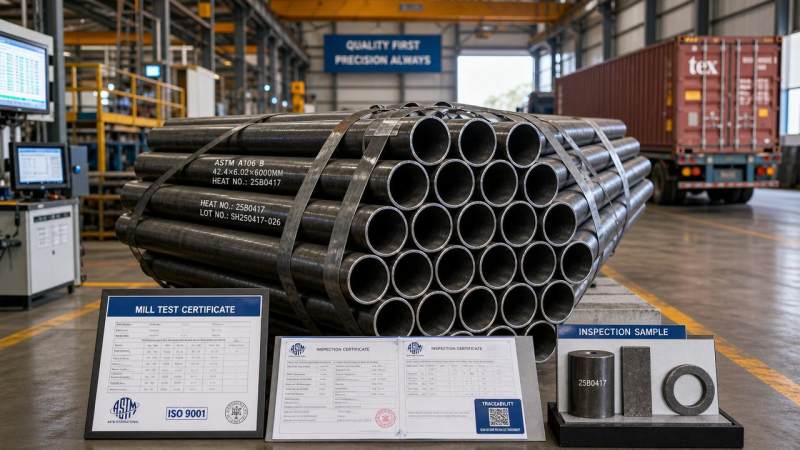
Not every project uses carbon steel pipe in the same way. A building structure, a machinery frame, and an industrial process line face different loads, coatings, tolerances, and compliance expectations.
That is why checking an ASTM certified carbon steel pipe supplier should begin with scenario matching. The supplier must prove it can meet the standard, the specification, and the service conditions together.
Scenario 1: Construction projects need compliance and repeatable quality
In construction, steel materials often move through multiple contractors and inspections. Documentation errors can delay acceptance even when the product itself looks acceptable.
A qualified ASTM certified carbon steel pipe supplier should provide mill test certificates, heat numbers, dimensional records, and clear standard references. Material traceability must link production batches to final shipment documents.
Key checks for construction use
- Verify ASTM grade, size range, wall thickness, and tolerance control.
- Check whether batch marking matches certificates and packing lists.
- Confirm coating, corrosion protection, and storage methods for site conditions.
- Review delivery consistency across repeat orders.
Scenario 2: Industrial fabrication requires process stability and testing depth
Fabrication projects usually demand better forming, welding, and machining consistency. Here, verifying an ASTM certified carbon steel pipe supplier goes beyond basic compliance.
Ask whether the supplier controls chemistry, mechanical properties, and surface quality through each production stage. Stable processing performance helps reduce cracking, distortion, and welding issues during fabrication.
Mid-project material matching also matters. Many export suppliers support broader steel packages, not only pipe. For corrosion-related applications, Steel Plate Galvanized can be used in connected structural sections, covers, guards, and formed components.
This product is available in grades such as DX51D, SGCC, S250GD, and S350GD. Thickness ranges from 0.12mm to 6.00mm, with widths from 600mm to 1500mm and custom lengths supported.
Its standards coverage includes ASTM, EN, JIS, DIN, and GB. That flexibility helps align pipe sourcing with surrounding galvanized structural or fabricated parts in one supply chain.
Key checks for fabrication use
- Review welding suitability and forming consistency.
- Ask for tensile, yield, and elongation data by batch.
- Confirm surface condition, edge quality, and packaging protection.
- Check whether inspection covers dimensional and mechanical performance.
Scenario 3: Export supply programs depend on documentation and delivery control
For cross-border orders, a capable ASTM certified carbon steel pipe supplier must manage more than manufacturing. Export documents, packing discipline, and schedule reliability become part of product quality.
A strong supplier should show shipment records to North America, Europe, the Middle East, or Southeast Asia. Experience with international standards reduces errors in marking, customs files, and inspection coordination.
Hongteng Fengda, as a structural steel manufacturer and exporter from China, supports global projects with angle steel, channel steel, steel beams, cold formed profiles, and customized steel components. Its production system follows ASTM, EN, JIS, and GB requirements.
This matters when buyers prefer fewer supply interfaces. A supplier with broader structural steel capability can simplify procurement, improve schedule control, and reduce communication gaps across related steel items.
How to verify an ASTM certified carbon steel pipe supplier step by step
1. Confirm the exact ASTM standard
Do not stop at the phrase ASTM certified. Ask which ASTM specification applies, such as ASTM A53, ASTM A106, or other relevant standards. The correct standard depends on use conditions.
2. Validate certificates and traceability
Check test certificates, heat numbers, inspection reports, and material marking. The data on certificates should match the actual goods, bundles, and shipping paperwork.
3. Review production capability
Ask about equipment, annual output, forming process, coating lines if relevant, and quality checkpoints. Real capacity is important for repeat supply, not only for sample orders.
4. Check quality control routines
A reliable ASTM certified carbon steel pipe supplier should use incoming material control, in-process inspection, finished testing, and nonconformance handling procedures.
5. Assess export execution
Confirm packing type, rust prevention, container loading method, lead time stability, and response speed when specifications change. Export reliability is essential for project continuity.
Different scenarios require different verification priorities
Practical supplier assessment questions before placing an order
- Can the supplier provide recent ASTM mill test certificates for similar grades?
- Are third-party inspections accepted before shipment?
- How are nonconforming materials isolated and reported?
- What is the normal lead time for repeat orders?
- Can related structural steel items be supplied under the same quality system?
- What export markets has the supplier served successfully?
Common mistakes when checking an ASTM certified carbon steel pipe supplier
One common mistake is treating a general certificate as proof of product compliance. A certificate without matching heat numbers or test details has limited value.
Another mistake is focusing only on price. A low quote may hide weaker coating control, unclear tolerances, poor packaging, or unstable delivery.
Some buyers also ignore production breadth. If a project needs pipe plus beams, channels, or cold formed profiles, fragmented sourcing can increase schedule risk.
Finally, many fail to test communication quality. Slow technical responses often lead to drawing errors, wrong specifications, or avoidable shipment delays later.
A practical next step for safer steel sourcing
The best way to verify an ASTM certified carbon steel pipe supplier is to combine document review, sample evaluation, factory capability checks, and export record assessment.
For projects requiring carbon steel pipe and related structural steel products, working with an experienced Chinese exporter can improve consistency across specifications, packaging, and lead times.
If you are comparing suppliers, prepare a technical checklist first. Include ASTM standard, grade, size, coating, inspection level, traceability, and delivery expectations. Then request matching proof for each point.
This approach helps identify a dependable ASTM certified carbon steel pipe supplier with the quality systems, steel processing experience, and global delivery support needed for stable long-term cooperation.
Please give us a message


Please enter what you want to find