For finance decision-makers, understanding a 304 stainless steel plate price quote is essential to controlling procurement budgets and avoiding hidden costs. Beyond the unit price, factors such as thickness, surface finish, standards, quantity, and freight can significantly affect the final offer. This guide explains how to evaluate a 304 stainless steel plate price clearly and compare suppliers with greater confidence.
In steel procurement, a quote that looks competitive at first glance may become expensive after processing tolerances, packaging, testing, tax terms, or logistics are added. For budget owners, the real task is not simply finding the lowest number, but understanding the full landed cost and the supply risk behind that number.
This matters even more when projects involve international sourcing. A Chinese structural steel manufacturer and exporter such as Hongteng Fengda may support buyers with stable production, standards compliance, and customized supply, but finance teams still need a practical method to read every line of a 304 stainless steel plate price quote before approval.
What a 304 Stainless Steel Plate Price Quote Should Include
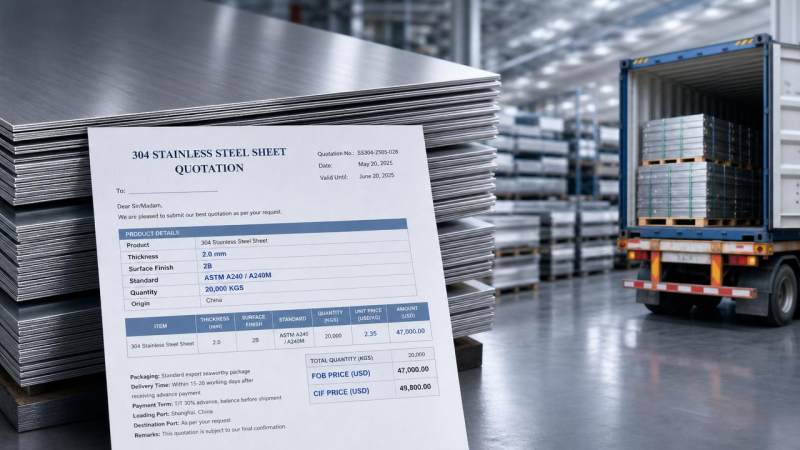
A complete 304 stainless steel plate price quote should cover at least 8 core elements: grade, size, thickness tolerance, surface finish, standard, quantity, trade term, and delivery schedule. If even 1 of these items is missing, comparing suppliers becomes difficult and budget leakage becomes more likely.
Core line items finance teams should verify
Start with the material description. “304 stainless steel plate” may sound clear, but quotes should define whether the offer follows ASTM, EN, JIS, or GB standards. Standard differences can affect chemical composition ranges, mechanical expectations, and acceptance criteria, which may later influence inspection cost or rejection risk.
Next, review dimensions. A quote should state thickness in millimeters, width, length, and tolerance. For example, 3 mm, 6 mm, and 10 mm plates do not only differ in ton price; they also influence yield rate, processing waste, and freight efficiency. A tolerance gap of even ±0.2 mm to ±0.5 mm can matter in downstream fabrication.
Surface finish is another major price variable. Common finishes such as 2B, No.1, BA, and No.4 carry different production steps and application value. If the end use does not require decorative appearance, a lower-cost industrial finish may improve budget efficiency without reducing functional suitability.
Commercial terms must also be visible. A 304 stainless steel plate price under EXW, FOB, CFR, or CIF can vary significantly, even when the ex-factory amount is unchanged. Finance approvers should never compare prices from different Incoterms as if they were on the same basis.
The table below shows the minimum fields that should appear in a usable quote review sheet.
The key takeaway is simple: the visible unit number is only one part of the 304 stainless steel plate price. A quote becomes financially meaningful only after specification, quantity, freight, and quality conditions are aligned.
How suppliers usually calculate plate pricing
Most suppliers build price from 4 layers: raw material base, rolling or processing cost, finishing cost, and commercial add-ons. Commercial add-ons may include export packing, documentation, third-party inspection, edge trimming, PVC film, and inland transport to port.
A practical cost-reading sequence
- Check whether the quote is per kg, per ton, or per sheet.
- Convert all offers into one unit, usually USD per metric ton.
- Confirm whether actual billable weight uses theoretical or measured weight.
- Ask if protective film, wooden pallet, or seaworthy packing is included.
- Verify payment term impact, such as T/T deposit versus L/C.
This 5-step review prevents a frequent approval mistake: accepting a lower nominal 304 stainless steel plate price that later rises after packaging upgrades, certification requests, or reduced production tolerance are added.
The Biggest Cost Drivers Behind a 304 Stainless Steel Plate Price
From a finance perspective, price movement usually comes from 6 variables more than from supplier margin alone. Understanding these variables helps procurement and finance teams discuss cost control with technical departments using the same framework.
Thickness, finish, and quantity
Thickness directly changes steel consumption per sheet and affects processing route. A 2 mm plate and a 12 mm plate may both be 304, but their manufacturing cost, flatness control, and freight density differ. In many purchasing situations, thickness is the first factor that explains a 10% to 30% quote gap.
Surface finish often creates the second largest cost spread. No.1 is commonly used for industrial applications, while 2B and BA involve more refined processing. Finance teams should ask whether the application truly needs decorative or hygienic finishing, because over-specification can raise total material spend without improving project performance.
Quantity affects price in two ways. First, larger tonnage improves mill efficiency. Second, fuller container loading can reduce freight per ton. For example, moving from a 1-ton trial order to a 20-ton order may reduce unit logistics cost meaningfully, even if the mill rate changes only slightly.
Standards, documentation, and testing
A supplier quoting to ASTM may price differently from one quoting to a looser internal description. Mill test certificates, PMI checks, third-party inspection, and special export packing all add cost. These items are not unnecessary, but they should be requested only when the end customer, regulator, or project specification requires them.
The following comparison helps finance approvers see where quote differences typically come from.
In many cases, quote differences are justified once service scope and technical scope are normalized. Finance teams should challenge price gaps, but only after checking whether both suppliers are offering the same commercial and quality package.
Freight, packaging, and destination costs
For imported steel, freight can shift a competitive quote into a weak one. Ocean freight volatility, inland trucking, port charges, and customs handling can materially affect total cost. On some routes, logistics and handling may represent 8% to 18% of landed value depending on volume, season, and destination port.
Packaging should also be checked line by line. Export-worthy wooden pallets, moisture protection, edge guards, and bundle reinforcement are useful for long transit, but they are not always included in the first offer. A finance approver should ask whether the quote covers standard export packing or only simple mill packing.
How to Compare Supplier Quotes Without Missing Hidden Costs
A disciplined comparison process is usually more valuable than aggressive price negotiation alone. Finance teams can reduce risk by using a 4-part review model: specification match, cost normalization, delivery reliability, and claim exposure.
Build a normalized comparison sheet
Every 304 stainless steel plate price should be converted into one comparison format. Use the same currency, same Incoterm, same quantity basis, and same quality requirement. If Supplier A quotes FOB Shanghai for 10 tons and Supplier B quotes CIF Dubai for 2 tons, the two prices are not directly comparable.
A useful internal sheet usually includes 10 fields: supplier name, standard, thickness, finish, quantity, unit price, freight, testing cost, lead time, and payment term. With this layout, finance can quickly identify whether a lower price is genuine or simply excludes key obligations.
Questions worth asking before approval
- Is the quoted weight based on actual plate dimensions or theoretical weight?
- Are MTCs included at no extra charge?
- What is the production lead time: 7 days, 15 days, or 30 days?
- Does the price include edge trimming, PVC film, or custom marking?
- What happens if dimensions fail incoming inspection?
These questions are especially important for project-driven purchases where schedule slippage can cost more than a modest unit price increase. A cheaper 304 stainless steel plate price loses its value if delayed material stops fabrication or installation.
Check supplier capability, not only quote value
Finance approvers should evaluate whether the supplier can repeatedly deliver the same specification. Consistent production matters when a project has 2, 3, or 4 delivery batches over several months. A reliable manufacturer with quality control and standard compliance may reduce total risk even if its first quotation is not the lowest.
For example, companies working across structural steel and customized steel supply often offer broader procurement coordination. In some sourcing programs, buyers who need multiple materials may also review related product lines such as 310 Stainless Square steel rod for manufacturing or construction support, especially when consolidating shipments or managing one export partner across several steel categories.
When reviewing such related products, check the same fundamentals: material grade, specification range, finish, standards, and application fit. For instance, square bar sizes such as 18 mm to 47 mm, lengths of 1 to 6 meters, and standards including ASTM, JIS, GB, DIN, and EN should be aligned with actual project use before they are included in a mixed procurement plan.
Common Mistakes Finance Decision-Makers Should Avoid
Even experienced approval teams can misread a steel quote when technical details are compressed into a short commercial email. Most budget overruns come from a few repeated mistakes rather than from dramatic market surprises.
Mistake 1: approving on unit price alone
The first mistake is focusing only on the face value of the 304 stainless steel plate price. Unit price matters, but finance should also estimate freight, wastage, inspection, and timing cost. A quote that is 3% cheaper can become 6% to 10% more expensive after extra services are added.
Mistake 2: overlooking standard and finish mismatch
The second mistake is comparing unlike-for-like material. If one quote is for 2B finish to ASTM and another is for a basic industrial finish under a different standard basis, the price gap may reflect specification mismatch rather than supplier competitiveness.
Mistake 3: underestimating lead time risk
The third mistake is ignoring delivery reliability. In international steel trade, a normal lead time may be 2 to 4 weeks for production plus shipping time, but this can extend during peak seasons. Delayed material can create penalty risk, idle labor cost, or site disruption far above any initial quote savings.
Mistake 4: failing to separate essential and optional costs
Not every extra line is a hidden cost; some are optional upgrades. Good practice is to ask suppliers to split the quote into 3 sections: base material, mandatory commercial costs, and optional services. This makes approvals faster and gives finance a clear basis for cost control.
A Practical Approval Framework for Better Steel Buying Decisions
A strong approval framework should connect technical reality with financial discipline. For stainless plate procurement, that framework can be reduced to 5 checks: exact specification, normalized cost, supplier capability, delivery timeline, and claim handling process.
The 5-check approval method
- Confirm grade, standard, thickness, size, and finish in writing.
- Convert every 304 stainless steel plate price to the same delivery basis.
- Review inclusions: MTC, packing, freight, and testing.
- Check realistic lead time and shipment plan.
- Clarify nonconformance and replacement responsibility before PO issue.
This method helps finance work more effectively with procurement and engineering. It also supports better supplier discussions, because pricing questions become specific: not “Why are you expensive?” but “Why is your 6 mm No.4 finish ASTM quote 8% above the FOB benchmark after normalization?”
For global buyers sourcing from China, working with a manufacturer and exporter that understands international standards, customized supply, and dependable lead times can reduce sourcing friction. That is especially useful when steel purchasing spans structural products, fabricated components, and project-based delivery schedules.
Reading a 304 stainless steel plate price quote well is ultimately a risk-control skill. The most useful quote is not the shortest one or the cheapest-looking one, but the one that clearly defines specification, cost structure, and delivery responsibility. If you want a clearer basis for stainless or structural steel sourcing, contact Hongteng Fengda to get a tailored quote review, discuss product details, or explore a customized supply solution for your next project.
Please give us a message


Please enter what you want to find