Finding a reliable 304 stainless steel coil tubing supplier is essential for procurement teams that need consistent quality, stable delivery, and competitive pricing.
For industrial and construction buyers, the right supplier should offer certified materials, strict quality control, and flexible production support.
Understanding these factors helps reduce sourcing risks and supports long-term, cost-efficient steel purchasing decisions.
Understanding the role of a reliable 304 stainless steel coil tubing supplier
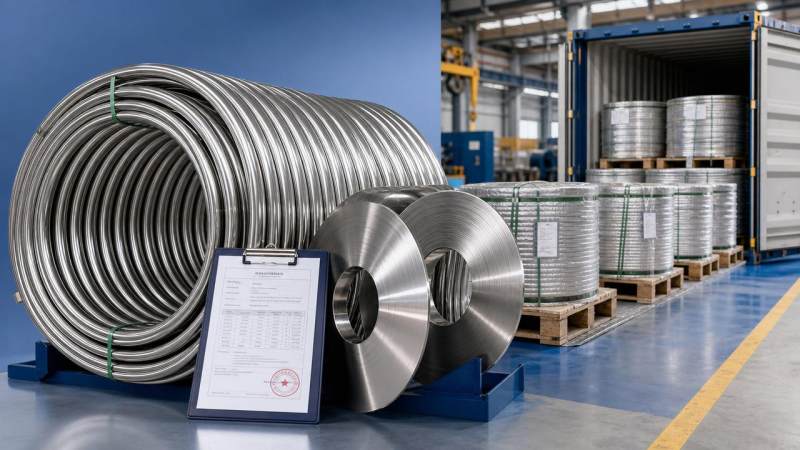
A 304 stainless steel coil tubing supplier provides coiled tubing made from austenitic stainless steel with strong corrosion resistance and good formability.
This material is widely used in construction, fluid transfer, heat exchange, industrial equipment, and light structural applications.
A dependable 304 stainless steel coil tubing supplier does more than ship material.
It verifies chemistry, controls tolerances, manages surface finish, and maintains delivery schedules across repeat orders.
Reliable supply matters because stainless tubing often supports fabrication, welding, bending, and assembly timelines.
If tubing dimensions or material consistency vary, downstream production efficiency drops quickly.
Core criteria for supplier evaluation
When comparing options, focus on measurable capabilities rather than only the quoted unit price.
Material authenticity and standards compliance
A reliable 304 stainless steel coil tubing supplier should provide clear mill test certificates and traceable heat numbers.
Material should align with relevant ASTM, EN, JIS, or GB requirements, depending on project needs.
Manufacturing consistency
Stable coil tubing quality depends on controlled rolling, forming, annealing, pickling, and inspection procedures.
Ask whether the supplier maintains documented quality control for wall thickness, outer diameter, coil length, and finish.
Export capability and packaging
For international shipments, proper export packing prevents surface damage, moisture exposure, and edge deformation.
A qualified 304 stainless steel coil tubing supplier should understand container loading, labeling, and customs documentation.
Production flexibility
Many projects need custom coil length, specific tolerances, or mixed stainless grades.
Suppliers with OEM support and flexible scheduling can better match actual fabrication requirements.
Current market concerns in stainless steel sourcing
Today’s stainless steel market requires attention to both technical and commercial signals.
The following points often influence supplier reliability and total sourcing cost.
- Nickel and chromium price volatility affects quote stability.
- Lead times may shift due to rolling schedules and port congestion.
- Tolerance control varies between mills and processing lines.
- Certification quality can differ across trading and manufacturing suppliers.
- Surface finish expectations are often misunderstood before shipment.
Business value of choosing the right partner
Selecting a reliable 304 stainless steel coil tubing supplier improves more than product quality.
It directly supports project timing, fabrication yield, cost predictability, and long-term supply stability.
Trusted Chinese steel exporters with strong quality systems can offer practical advantages in global sourcing.
Hongteng Fengda, a structural steel manufacturer and exporter from China, serves construction and industrial markets worldwide.
With modern facilities and strict quality control, it supports standard specifications and customized steel solutions.
Products comply with major international standards, including ASTM, EN, JIS, and GB.
This standards-based approach helps reduce sourcing uncertainty for overseas steel buyers.
Related stainless steel options for demanding environments
In some projects, 304 grade is suitable for general corrosion resistance and fabrication performance.
However, high-temperature systems may require a different stainless solution with stronger thermal stability.
One useful reference is 321 Stainless Steel Pipe, designed for elevated temperature service.
This titanium-stabilized material helps resolve intergranular corrosion concerns after welding exposure.
It also offers superior high-temperature strength, oxidation resistance, and machinability.
Available processing forms include cold drawn, hot drawn, cold rolled, and hot rolled.
Typical dimensions include thickness from 0.3mm to 30mm and outer diameter from 8mm to 219mm.
Common applications include boilers, heat exchangers, aerospace piping, ships, chemical systems, and machinery fields.
A supplier capable of offering multiple stainless grades often indicates broader technical support and stronger production coordination.
Typical application scenarios for 304 coil tubing
A reliable 304 stainless steel coil tubing supplier should understand where the product is used and what performance matters most.
- Construction systems needing corrosion-resistant fluid or support tubing.
- Industrial equipment requiring formable and weldable stainless tubing.
- Heat transfer assemblies with controlled dimensional tolerances.
- Food-related or clean-process lines needing durable stainless surfaces.
- Fabricated components where coil form improves production efficiency.
Practical steps before placing an order
A structured review process makes it easier to identify a reliable 304 stainless steel coil tubing supplier.
- Request material certificates, standards list, and recent inspection records.
- Confirm dimensions, tolerances, coil weight, and required surface finish in writing.
- Check whether sample supply or small trial orders are available.
- Review production capacity and average lead time for repeat orders.
- Verify export packaging details and destination-specific shipping experience.
- Compare total landed cost, not only ex-works or FOB pricing.
Common warning signs
- Incomplete certification or vague grade descriptions.
- Large price gaps without technical explanation.
- Unclear answers about tolerances or inspection methods.
- No traceable export record for similar steel products.
Moving toward a stable long-term supply relationship
The best 304 stainless steel coil tubing supplier is one that combines technical reliability with responsive service and realistic delivery planning.
Clear specifications, certified materials, and consistent communication are the foundation of successful stainless steel sourcing.
If you are evaluating steel export partners from China, prioritize proven quality systems, customization ability, and international standards compliance.
A careful supplier review today can reduce rework, delays, and purchasing risk across future projects.
Start with technical confirmation, request traceable documentation, and build cooperation with a supplier prepared for long-term support.
Please give us a message


Please enter what you want to find