How to Estimate Steel Structure Construction Cost Early
Estimating steel structure construction cost early is essential for project managers who need to control budgets, compare design options, and reduce procurement risks before construction begins.
From material selection and fabrication requirements to transportation, installation, and international standards, each factor can significantly affect the final investment.
This guide explains the key cost drivers and practical estimation methods to help engineering and construction teams make faster, more reliable decisions when planning structural steel projects.
Start with the decision you need to make, not only the tonnage
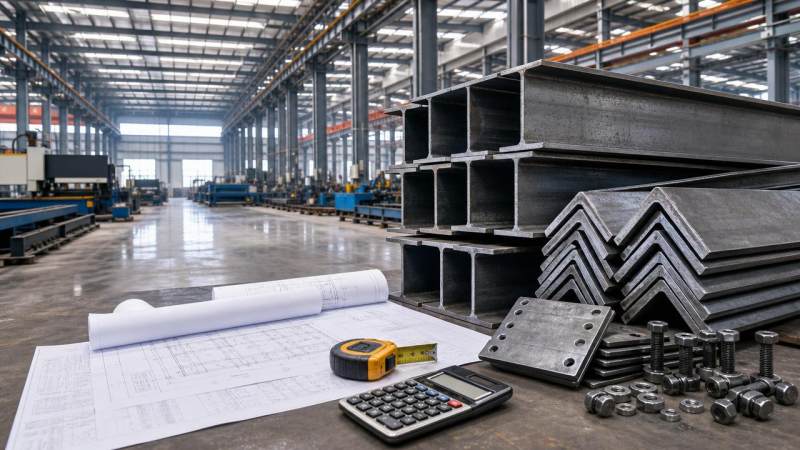
Early cost estimation is not meant to produce the final contract price. Its main value is guiding decisions before drawings are fully developed.
Project managers usually need to know whether the budget is realistic, which structural scheme is economical, and where procurement risks may appear.
For steel structure construction cost, the earliest estimate should combine quantity assumptions, steel grade, fabrication complexity, logistics, coating, and erection conditions.
A common mistake is multiplying estimated steel weight by a general price per ton. That approach can seriously understate total project cost.
Two buildings with the same steel tonnage may have very different costs if one requires heavy welding, complex connections, galvanizing, or remote delivery.
The best early estimate gives a cost range, explains assumptions, and identifies which variables could move the budget most significantly.
Define the project scope before calculating cost
Before estimating numbers, clarify what is included in the steel package. Scope gaps are one of the biggest causes of budget overruns.
A steel structure package may include main frames, secondary members, bracing, purlins, stair components, platforms, anchor bolts, fasteners, and surface protection.
Some estimates include design detailing, shop drawings, inspection documents, packing, inland transport, sea freight, insurance, and installation support.
Others only include fabricated steel supplied ex works. Comparing these two prices without scope alignment creates misleading conclusions.
Project managers should prepare a simple scope checklist before requesting budget quotations from manufacturers, fabricators, or export suppliers.
The checklist should state whether the estimate is for material only, fabricated steel, delivered steel, or installed steel structure.
Use steel weight as the first baseline, then adjust it carefully
Steel weight remains the foundation of early estimation because most material, fabrication, coating, and freight costs are influenced by tonnage.
At concept stage, weight may be estimated from reference projects, preliminary structural layouts, span length, building height, load requirements, and local codes.
Industrial buildings, warehouses, equipment platforms, and multi-story structures all have different steel consumption patterns per square meter.
However, square-meter benchmarks should only be used as a starting point. Crane loads, seismic requirements, wind loads, and mezzanines can change steel usage.
Once preliminary member sizes are available, estimate weight by profile type, including steel beams, columns, angle steel, channel steel, bracing, and cold formed sections.
Add an allowance for connection plates, stiffeners, base plates, bolts, and fabrication waste, especially when drawings are not fully detailed.
Separate material cost from fabrication cost
Material cost is usually easier to estimate than fabrication cost because steel sections can be priced according to grade, size, weight, and market conditions.
Fabrication cost depends more on labor hours, cutting, drilling, welding, assembly, dimensional tolerance, inspection, and production scheduling.
A project using standard beams and simple bolted connections is usually less expensive to fabricate than one with curved members or dense welded joints.
Custom structural steel components can improve constructability, but they often require more detailing, production control, and quality inspection.
When requesting early pricing, ask suppliers to separate raw steel, fabrication, coating, packing, and transportation wherever possible.
This structure helps your team see whether a higher price comes from steel market changes, complex workmanship, or export logistics.
Consider steel grade, standard, and specification requirements
Steel structure construction cost is strongly affected by the required standard, such as ASTM, EN, JIS, GB, or project-specific specifications.
Different grades have different yield strength, chemical composition, testing requirements, availability, and certification costs.
For international projects, equivalent grades should be reviewed carefully by engineers before substituting one standard for another.
Choosing a grade that is difficult to source locally may increase lead time, minimum order quantity, and mill pricing.
Project managers should confirm whether mill test certificates, third-party inspection, ultrasonic testing, or special traceability documents are required.
These requirements may look administrative, but they influence production planning, quality control cost, and delivery schedule.
Do not ignore surface treatment and corrosion protection
Surface protection can represent a meaningful share of total cost, especially for outdoor, coastal, industrial, or high-humidity environments.
Common options include primer painting, epoxy coating, fire-resistant coating, hot-dip galvanizing, or combined protection systems.
Hot-dip galvanizing usually provides strong corrosion resistance, but member size, drainage holes, handling, and coating thickness must be considered early.
Paint systems may appear cheaper at purchase, but maintenance cost and site repair requirements should be included in lifecycle evaluation.
Small supporting materials also matter in certain projects. For example, Galvanized Stainless Steel Wire can be used in wire mesh, packaging, barrier isolation, and construction-related applications.
Its corrosion resistance, ductility, and low-cost characteristics make it useful for auxiliary works where flexible steel wire products are required.
Estimate transportation and export logistics early
For international procurement, logistics can turn a competitive factory price into a less attractive delivered cost if not estimated early.
Steel structures are heavy, long, and sometimes irregular in shape, so packing design and container loading efficiency matter.
Oversized components may require special containers, breakbulk shipping, road permits, or additional handling equipment at destination.
Project managers should ask whether the supplier can optimize member length, bundle marking, packing method, and shipping sequence.
For export projects, compare prices using clear trade terms such as EXW, FOB, CFR, CIF, or DAP.
The earlier these terms are clarified, the easier it becomes to compare suppliers and avoid hidden freight or handling costs.
Include installation conditions in the early budget
Even when a manufacturer only supplies steel, installation conditions should influence the early cost estimate and structural planning.
Site access, crane availability, lifting height, connection method, weather, labor productivity, and safety requirements all affect erection cost.
A design that reduces fabrication cost may increase site labor if members are difficult to align or require extensive field welding.
Bolted connections often support faster installation, but they require accurate fabrication, clear marking, and complete bolt packages.
Project managers should involve construction teams early to check whether member weight, connection layout, and delivery sequence are practical.
This review can reduce rework, shorten erection time, and improve the reliability of the total steel structure construction cost estimate.
Use a layered estimating method for better accuracy
A practical early estimate should be built in layers, moving from rough assumptions toward supplier-validated numbers as information improves.
At feasibility stage, use reference weight per square meter and a broad cost range based on similar completed projects.
At concept design stage, classify steel by member type, estimate tonnage, and apply different rates for standard and complex components.
At preliminary drawing stage, request budget quotations from qualified manufacturers using clear scope, standards, coating, and delivery requirements.
At procurement stage, update the estimate with final drawings, bill of materials, inspection requirements, and confirmed logistics conditions.
This layered approach prevents false precision while still helping stakeholders make timely decisions with visible assumptions and risks.
Build a simple cost model that managers can actually use
A useful cost model does not need to be complicated. It must be transparent, easy to update, and aligned with project decisions.
Start with estimated steel tonnage, then apply separate unit rates for material, fabrication, surface treatment, packing, freight, documentation, and contingency.
Use different rates for main structural members, secondary members, customized parts, and small accessories when the scope is known.
Add percentage allowances for design development, connection materials, waste, inspection, and exchange rate fluctuation if purchasing internationally.
For management reporting, show low, expected, and high scenarios rather than a single number that may appear more accurate than it is.
This format helps decision-makers understand exposure and approve budgets with fewer surprises later in the project.
Check supplier capability, not only quoted price
Early supplier involvement can improve estimate quality, but only when the supplier has relevant production capacity and export experience.
A low quotation may not reduce project cost if it leads to delays, inconsistent quality, missing documents, or expensive corrective work.
Project managers should review manufacturing facilities, quality control procedures, international standard experience, lead times, and previous export performance.
For structural steel from China, stable production capacity and reliable documentation are especially important for global construction schedules.
Suppliers such as Hongteng Fengda support projects with angle steel, channel steel, steel beams, cold formed profiles, and customized components.
Working with an experienced structural steel manufacturer helps teams control sourcing risks while keeping cost, quality, and delivery visible.
Identify the cost risks that change estimates most often
The most common early estimate changes come from design revisions, steel market fluctuation, unclear standards, coating upgrades, and underestimated logistics.
Connection design is another frequent source of change because small plates, bolts, holes, and welding details accumulate significant labor.
International projects also face currency movement, freight volatility, customs documentation, port congestion, and changing delivery schedules.
To manage these risks, document assumptions clearly and update the estimate whenever drawings, standards, quantities, or delivery terms change.
Maintain a contingency that reflects project maturity. Early feasibility budgets need a higher contingency than procurement-ready estimates.
A disciplined update process is more useful than trying to make a very early estimate look exact.
How to compare quotations fairly
When several suppliers provide budget prices, compare them using a normalized quotation table rather than only reviewing the total amount.
Check whether each quote includes the same steel grade, standard, fabrication level, coating system, packing, spare parts, and documents.
Confirm whether prices are based on theoretical weight, actual weight, or finalized bill of materials after shop drawings.
Review payment terms, validity period, production lead time, inspection arrangement, and responsibility for design changes.
A higher quotation may offer better value if it includes clearer scope, stronger quality control, and more dependable delivery.
The goal is not to choose the cheapest steel, but to secure the lowest practical total project cost.
Conclusion: early cost estimation is a risk-control tool
Estimating steel structure construction cost early helps project managers make better design, procurement, and budget decisions before commitments become expensive.
The most reliable estimates do not rely on tonnage alone. They combine scope, standards, fabrication complexity, coating, logistics, and installation realities.
Use a layered estimating method, separate cost components, document assumptions, and update the model as drawings and supplier data improve.
For global projects, work with manufacturers who understand international standards, export documentation, quality control, and dependable production scheduling.
With the right approach, an early estimate becomes more than a budget number. It becomes a practical tool for reducing risk and protecting project value.


