Comparing stainless steel angle price by grade is essential for sourcing decisions that balance cost, corrosion resistance, strength, and project requirements. Grades such as 304, 316, and 201 differ in alloy content, performance, and market behavior. A reliable comparison should consider standards, tolerances, finish, order volume, delivery terms, and supplier capability, not only the unit quotation.
How does grade affect stainless steel angle price?
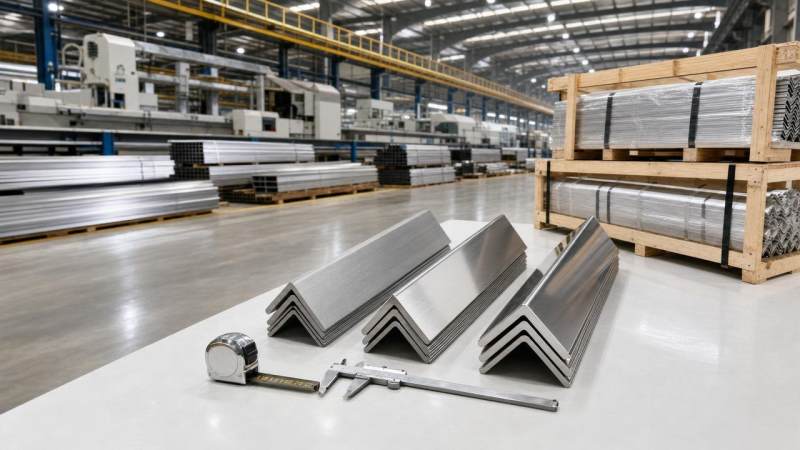
Grade is the main driver of stainless steel angle price because each grade uses different alloying elements and offers different performance levels.
Nickel, chromium, and molybdenum directly influence cost. When nickel or molybdenum markets rise, stainless steel angle price usually follows quickly.
304 stainless steel angle is often the benchmark grade. It offers good corrosion resistance, workability, and availability for general structural use.
316 stainless steel angle usually costs more. Its molybdenum content improves resistance to chloride, salt spray, chemicals, and marine environments.
201 stainless steel angle is usually cheaper. It contains lower nickel and more manganese, making it suitable for less demanding indoor applications.
A low stainless steel angle price may be attractive, but it can create risk if the grade does not match the service environment.
Why is stainless steel angle price not equal to material cost only?
Material cost is important, but stainless steel angle price also includes processing, inspection, packaging, logistics, and commercial terms.
Equal angle and unequal angle profiles may use similar grades, yet their rolling difficulty, tolerance control, and yield loss can differ.
Surface finish also changes stainless steel angle price. Pickled, polished, brushed, and mill finishes involve different processing steps.
Length tolerance affects final cost. Standard six-meter lengths are often easier to source than customized cut-to-length pieces.
Packing matters for export orders. Seaworthy bundles, waterproof wrapping, and reinforced protection reduce damage during long-distance transportation.
For global sourcing, Incoterms must be checked carefully. FOB, CFR, and CIF quotations can create very different total landed costs.
- Confirm whether the quotation is per ton, per meter, or per piece.
- Check if cutting, drilling, or marking is included.
- Ask whether packaging and loading fees are separate.
- Compare delivery terms before judging stainless steel angle price.
Which grade gives better value for different applications?
The best value depends on the operating environment. The cheapest stainless steel angle price is not always the lowest lifecycle cost.
For indoor frames, shelves, guards, and decorative supports, 201 may be acceptable when corrosion exposure is limited.
For building structures, machinery platforms, and general industrial supports, 304 often provides a strong value balance.
For coastal facilities, food processing areas, chemical plants, and marine equipment, 316 is usually more reliable.
In heavy-duty projects, stainless steel angle may be combined with other steel products to meet specific engineering needs.
For lifting, mining, marine, elevator, crane, and cableway applications, corrosion protection must also be considered in wire products.
A related solution is Hot dipped Galvanized Steel Wire Rope, available in steel or stainless steel materials.
It covers sizes from 1.0mm to 22mm, with tensile strength from 1470Mpa to 1960Mpa.
Options include plain, electro galvanized, and hot dipped galvanized surfaces for different corrosion conditions.
This comparison shows why grade, coating, environment, and standards should be evaluated together, not separately.
How should standards be used when comparing quotations?
Standards help make stainless steel angle price comparisons fair. Without a shared standard, two quotations may describe different products.
Common standards include ASTM, EN, JIS, and GB. Each may define chemical composition, mechanical properties, and dimensional tolerance differently.
A quotation should clearly state the grade, standard, size, thickness, length, tolerance, surface finish, and inspection document type.
If ASTM A276, EN 10088, JIS G4303, or GB standards are required, they should be written in the inquiry.
Mill test certificates should match the supplied batch. Chemical composition and mechanical values must be traceable.
When stainless steel angle price is unusually low, verify whether the material grade is equivalent or merely claimed as similar.
What supplier factors influence stainless steel angle price?
Supplier capability affects stainless steel angle price through production efficiency, inventory depth, quality control, and export experience.
A structural steel manufacturer with stable production can often offer better lead times and consistent quality.
Hongteng Fengda supplies structural steel products from China for construction, industrial, and manufacturing projects worldwide.
Product coverage includes angle steel, channel steel, steel beams, cold formed profiles, and customized structural components.
Modern facilities and strict quality control help align products with ASTM, EN, JIS, and GB requirements.
Export experience is important because packaging, documentation, booking, and loading affect the real delivery cost.
A dependable supplier can help reduce sourcing risk, especially when stainless steel angle price changes frequently.
- Check whether the supplier has experience with destination market requirements.
- Confirm production capacity before placing urgent or repeated orders.
- Review inspection, documentation, and after-sales support.
- Compare communication speed, not only stainless steel angle price.
What mistakes should be avoided during price comparison?
One common mistake is comparing different grades as if they provide the same performance.
Another mistake is ignoring weight calculation. Small differences in thickness tolerance can change total tonnage significantly.
Some quotations exclude cutting, polishing, testing, or special packaging. These additions can change stainless steel angle price after ordering.
Freight volatility also matters. Ocean freight, port charges, and insurance should be included in landed cost evaluation.
A short lead time may justify a slightly higher stainless steel angle price when project delay costs are high.
The safest approach is to compare quotations using the same specification sheet and the same commercial terms.
How to make a confident final decision?
Start by defining the environment, load requirement, design standard, and expected service life.
Then compare stainless steel angle price by grade, size, tolerance, finish, certificate, packaging, and delivery term.
For mild indoor use, 201 may reduce initial cost. For balanced structural use, 304 is often practical.
For marine, chemical, or coastal projects, 316 can lower long-term maintenance risk despite a higher purchase price.
A complete comparison should include total landed cost, inspection confidence, lead time, and supplier reliability.
To compare stainless steel angle price accurately, prepare a detailed inquiry and request itemized quotations from experienced suppliers.
Hongteng Fengda can support global projects with structural steel products, customized specifications, and export-ready documentation.
For a practical quotation, share grade, standard, size, quantity, destination port, and project requirements before confirming stainless steel angle price.
Please give us a message


Please enter what you want to find