For procurement teams, comparing hot rolled steel coil price fairly is not just about choosing the lowest quotation—it requires a clear review of material standards, coil specifications, origin, lead time, payment terms, and supplier reliability. In global sourcing, small differences in thickness tolerance, surface quality, or delivery conditions can significantly affect total cost and project risk. This guide explains how buyers can evaluate quotations more accurately, avoid hidden costs, and make confident purchasing decisions when sourcing hot rolled steel coils from reliable steel manufacturers and exporters.
Why the Same Hot Rolled Steel Coil Price Can Mean Different Costs
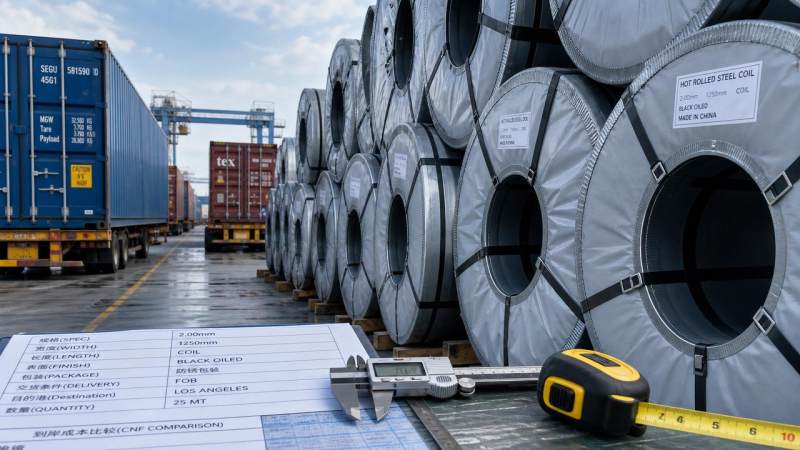
A hot rolled steel coil price is usually quoted per metric ton, but the quotation may include very different commercial conditions. Buyers should compare at least 6 factors before treating two offers as equal.
Common differences include steel grade, thickness range, coil weight, surface condition, packing method, delivery term, and payment schedule. A USD 10–20 per ton gap can disappear quickly after freight, unloading, or quality costs are added.
Quoted price versus landed cost
The first step is to separate the quoted steel price from the landed cost. A low EXW quotation may be less competitive than a FOB or CFR offer once inland trucking and port charges are included.
For international procurement, landed cost normally includes product value, packing, export handling, ocean freight, insurance, import duty, customs brokerage, and local transportation. Each item should be visible in the comparison sheet.
The table below shows how procurement teams can compare common quotation elements when reviewing hot rolled steel coil price from multiple suppliers.
A fair comparison starts only after the same pricing basis is used. If one supplier quotes FOB Tianjin and another quotes CIF destination port, the numbers are not directly comparable.
Material standard and specification must be aligned
Hot rolled coils may be ordered under ASTM, EN, JIS, GB, or project-specific technical conditions. Even similar grades can have different chemical limits, yield strength, and inspection requirements.
For example, a structural coil used for general fabrication is not the same as pressure vessel steel or weather-resistant steel. Mixing standards creates quality disputes and false savings.
Practical procurement rule
Before price comparison, lock 3 basic details: grade, thickness tolerance, and coil surface requirement. Then ask suppliers to quote against the same technical sheet.
Key Technical Factors Behind Hot Rolled Steel Coil Price
The hot rolled steel coil price is closely connected with raw material cost, rolling schedule, dimensional tolerance, grade composition, and order volume. Buyers should understand which factors are negotiable.
Thickness is one major driver. Coils in common ranges such as 1.5–12 mm are often easier to source, while special thickness, narrow width, or controlled tolerance may require longer planning.
Thickness, width, and tolerance
A quotation for 3.0 mm coil cannot be fairly compared with 3.2 mm material if the buyer calculates usage by area. The theoretical weight difference directly affects real project cost.
Tolerance also matters. A tighter thickness tolerance, for example ±0.15 mm instead of a broader mill tolerance, may require stricter process control and inspection.
Surface quality and downstream processing
Surface condition affects pickling, cutting, welding, painting, and forming. Rust, scale, edge cracks, or lamination can create losses beyond the original hot rolled steel coil price difference.
If the coil will be slit, leveled, or cut into sheets, confirm flatness, camber, edge condition, and inner diameter. Many processors prefer 508 mm or 610 mm coil ID.
For buyers who also purchase plate and sheet materials, Hongteng Fengda supplies Carbon Sheet Steel in grades such as Q245R, Q345R, Q370R, 16MnDR, 09MnNiDR, 15CrMoR, and 12Cr2Mo1R for demanding industrial applications.
Available thickness can range from 1 mm to 100 mm, with widths such as 1010, 1219, 1250, 1500, 1800, and 2500 mm. Lengths may follow 1000–6000 mm or project requirements.
Application requirements change the acceptable price
Steel used in construction, shipbuilding, petroleum, chemical industries, boilers, machinery, and hardware production may require different testing levels. The lowest price is not always the safest sourcing option.
If the final product involves welded structures, load-bearing frames, or pressure-related components, procurement should request mill test certificates and confirm inspection rules before order confirmation.
- For structural fabrication, confirm yield strength, elongation, weldability, and dimensional stability.
- For machinery parts, check flatness, cutting performance, and consistency across batches.
- For coated or painted products, review surface scale, rust prevention, and oiling condition.
- For export projects, align ASTM, EN, JIS, or GB standards before placing a deposit.
A 5-Step Method to Compare Quotations Fairly
Procurement teams can reduce sourcing risk by using a structured comparison method. A 5-step workflow helps separate real value from incomplete or overly simple quotations.
This method is especially useful when comparing 3–6 suppliers across different countries, ports, or payment models. It also supports internal approval and supplier audit records.
Step 1: Standardize the inquiry sheet
The inquiry should state grade, standard, thickness, width, coil ID, coil weight, quantity, destination port, packing, inspection requirements, and target shipment date.
For example, asking for “hot rolled coil, 500 tons” is too broad. A complete RFQ reduces quotation deviation and shortens clarification time by several rounds.
Step 2: Normalize quantity and tolerance
Many mills price by MOQ, rolling campaign, and coil combination. A 100-ton order may receive different pricing than a 1,000-ton monthly purchase.
Tolerance should also be normalized. If one supplier quotes commercial tolerance and another quotes stricter project tolerance, the hot rolled steel coil price comparison is incomplete.
The following table provides a practical quotation checklist for purchasing teams that need a transparent and repeatable evaluation process.
A supplier that responds with complete technical and commercial details often reduces hidden risk. A vague low quote may require extra confirmation before it becomes a reliable purchasing option.
Step 3: Check supplier consistency
A fair hot rolled steel coil price should be supported by stable production capacity, repeatable quality, and realistic lead time. Price without delivery reliability can damage project schedules.
Hongteng Fengda supports global buyers with structural steel products, customized components, and export services for North America, Europe, the Middle East, and Southeast Asia.
Step 4: Review inspection and claim terms
Inspection should be agreed before shipment. Buyers may request dimensional checks, surface inspection, chemical composition review, mechanical testing, or third-party inspection when necessary.
Claim terms should define reporting time, photo evidence, sample retention, and settlement method. A practical window may be 7–15 days after receiving goods.
Step 5: Match the offer with project risk
For urgent construction or manufacturing schedules, buyers may prioritize predictable delivery over a small price reduction. For stock replenishment, price and volume flexibility may matter more.
Common Mistakes When Judging Hot Rolled Steel Coil Price
Several purchasing mistakes repeat across steel sourcing projects. Avoiding these errors can protect budget, production continuity, and supplier relationships over 6-month or 12-month procurement cycles.
Mistake 1: Comparing different standards as equal
A coil under one standard may not satisfy another project specification. Differences in chemistry, strength, impact testing, or documentation can make a cheaper quote unusable.
Mistake 2: Ignoring theoretical weight differences
Steel is invoiced by weight, while many applications consume material by length or area. A 2–3% weight deviation can affect budget accuracy and fabrication yield.
Mistake 3: Underestimating packaging and storage
Export packing, anti-rust oil, seaworthy protection, and safe coil loading are important for ocean shipments. Poor packaging can cause corrosion before the material reaches the warehouse.
Risk control checklist
- Confirm the grade and standard in the purchase contract.
- Ask for mill test certificates matching heat numbers.
- Check coil labels, bundle marks, and packing photos before shipment.
- Clarify tolerance, quantity deviation, and over-shipment allowance.
- Reserve a realistic delivery buffer of 1–2 weeks for sea freight variability.
These checks do not make procurement slower. They create a clearer basis for negotiation and reduce the chance of disputes after material arrival.
How Hongteng Fengda Supports Global Steel Buyers
As a structural steel manufacturer and exporter from China, Hongteng Fengda focuses on reliable supply, customized specifications, and professional export coordination for industrial buyers.
The company supplies angle steel, channel steel, steel beams, cold formed steel profiles, and customized structural components. Products can follow major standards including ASTM, EN, JIS, and GB.
Support beyond unit price
A practical steel partner helps buyers control total sourcing risk, not only hot rolled steel coil price. Technical clarification, production follow-up, and export documentation all influence final value.
For procurement teams, this support is useful when coordinating multiple product categories, such as coils, sheets, plates, beams, and fabricated steel parts for the same project.
When to request a customized quotation
Request a tailored offer when your order includes special thickness, mixed grades, fixed shipment windows, third-party inspection, or OEM structural steel components.
A complete inquiry usually receives a more accurate response within fewer communication rounds. Include drawings, standards, estimated annual demand, destination, and preferred trade term.
Information to prepare before inquiry
- Steel grade, standard, and any supplementary technical requirements.
- Thickness, width, coil weight, or sheet and plate dimensions.
- Estimated quantity per order and annual purchasing plan.
- Destination port, delivery deadline, and preferred Incoterms.
- Inspection, packing, labeling, and documentation requirements.
A fair hot rolled steel coil price is the result of clear specifications, transparent commercial terms, reliable quality control, and realistic logistics planning.
For buyers comparing suppliers, the strongest decision is rarely based on price alone. It comes from matching cost, compliance, delivery, and supplier accountability.
If you are sourcing hot rolled coils, structural steel, or customized steel components for construction, industrial, or manufacturing projects, contact Hongteng Fengda to discuss your specifications and request a tailored quotation.
Please give us a message


Please enter what you want to find