For distributors and agents, choosing galvanized steel tube suppliers fairly means looking beyond price alone. Product consistency, compliance with ASTM, EN, JIS, or GB standards, stable lead times, and dependable OEM support all affect long-term margins and customer satisfaction.
A balanced review helps reduce sourcing risks, protect brand reputation, and improve project performance. This guide explains how to compare galvanized steel tube suppliers using practical criteria that support better decisions.
What does a fair comparison of galvanized steel tube suppliers really mean?
A fair comparison uses the same standards for every supplier. It checks quality, coating performance, delivery reliability, technical support, and commercial terms together.
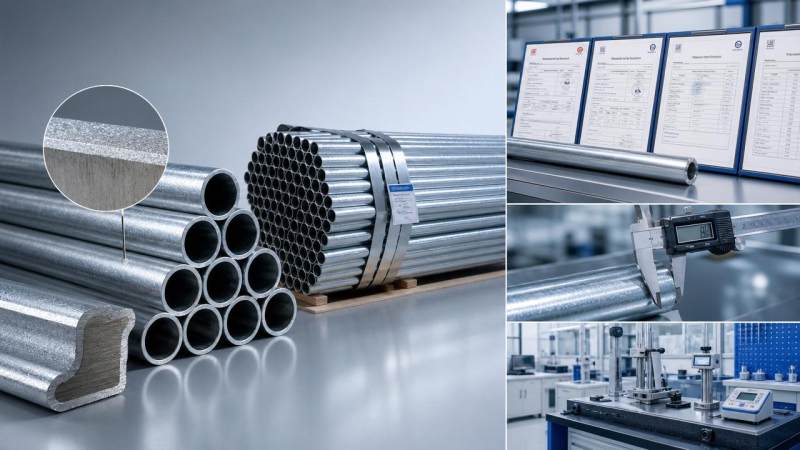
Many buyers compare offers only by ton price. That approach can hide major differences in zinc coating, dimensional tolerance, packaging, and after-sales response.
Reliable galvanized steel tube suppliers should be reviewed through measurable indicators. These include standard compliance, test documentation, claim handling, and production stability.
A low price may become expensive later. Delays, inconsistent wall thickness, poor galvanizing, or incorrect markings can create rework, penalties, and damaged customer trust.
Why price alone creates an unfair comparison
Not every quotation includes the same scope. One supplier may include testing, export packing, and stricter tolerance control, while another may exclude them.
When comparing galvanized steel tube suppliers, normalize the offer first. Match specification, coating type, zinc thickness, inspection method, Incoterms, and payment conditions.
Which technical criteria should you compare first?
Start with the technical baseline. This protects you from comparing products that look similar on paper but perform differently in real use.
- Steel grade and mechanical properties
- Tube size range and wall thickness tolerance
- Galvanizing method and zinc coating thickness
- Surface finish, edge condition, and straightness
- Compliance with ASTM, EN, JIS, or GB standards
- Mill test certificates and inspection records
Ask each supplier to quote against the same specification sheet. Include tolerances, coating expectations, application environment, and any fabrication requirements.
This is also the right stage to review related structural products. In many projects, tube supply must align with sections such as C-Shaped Steel.
For construction, machinery frameworks, storage racks, renewable energy supports, and prefabricated buildings, compatible profiles reduce assembly risk and simplify sourcing coordination.
A good structural steel partner should offer uniform dimensions, excellent mechanical strength, corrosion-resistant finishes, and accurate dimensional control across connected steel components.
How to verify quality claims
Do not rely only on brochures. Request recent test certificates, coating reports, sample photos, production records, and references from similar export destinations.
If possible, compare sample tubes from several galvanized steel tube suppliers. Check coating uniformity, weld seam appearance, marking accuracy, and packing quality.
How can you judge production capacity and delivery reliability?
Lead time matters as much as quality. A supplier that meets specifications but misses shipping windows can still disrupt your business.
Compare production capacity by monthly output, line configuration, galvanizing capability, and scheduling flexibility. Ask how they handle peak season congestion or urgent orders.
Delivery reliability should be measured using evidence. Request recent shipment records, average lead time, on-time performance, and export experience by region.
Experienced galvanized steel tube suppliers usually provide clearer answers because they already manage documentation, packaging, and shipping coordination for international orders.
What commercial factors should be compared besides unit price?
Commercial comparison should cover the total landed cost and the total transaction risk. This gives a more realistic view than ex-works price alone.
- Incoterms and freight responsibility
- Payment terms and credit flexibility
- Minimum order quantity and mixed-size options
- Tooling or OEM charges
- Inspection, certification, and testing costs
- Claim procedure and warranty response
If one supplier offers lower pricing but stricter payment terms, higher MOQ, and weak claim support, the real commercial value may be lower.
Fair evaluation of galvanized steel tube suppliers should also score communication speed. Slow replies often signal future delays in production updates or problem resolution.
How to compare OEM and customization support
Some projects require special lengths, punching, surface treatment, markings, or bundled kits. Not every supplier handles these requests with the same accuracy.
Ask for previous OEM cases, drawing review ability, sample approval workflow, and tolerance control methods. Practical customization support can reduce downstream labor significantly.
What common mistakes lead to poor supplier selection?
The first mistake is comparing different specifications as if they were equal. Small changes in thickness or coating can create major price differences.
The second mistake is ignoring consistency. A strong sample does not guarantee stable batch performance across multiple shipments.
The third mistake is skipping background checks. Review export records, factory capabilities, and response quality before placing large orders.
Another risk is underestimating compliance. In some markets, missing or inaccurate documentation can delay customs clearance or trigger customer disputes.
How should you build a practical scorecard for galvanized steel tube suppliers?
A scorecard keeps the process objective. It helps compare suppliers across multiple rounds, not just one urgent purchase.
Use weighted criteria based on your business priorities. Quality and delivery usually deserve higher weight than minor price differences.
- Product quality and standard compliance: 30%
- Delivery reliability and capacity: 25%
- Commercial terms and total cost: 20%
- Communication and service response: 15%
- OEM and technical support: 10%
Score each supplier using the same evidence. Include sample results, certificates, shipping records, and documented answers to technical questions.
This method makes conversations with galvanized steel tube suppliers more transparent. It also helps explain decisions internally or to downstream customers.
FAQ quick-reference table
To compare galvanized steel tube suppliers fairly, create one clear specification, request equal quotation terms, verify quality evidence, and score total supply performance.
Strong partners in structural steel offer more than material. They support compliance, stable production, dependable lead times, and coordinated solutions across related steel products.
If you are reviewing galvanized steel tube suppliers for construction, industrial, or manufacturing projects, the next step is simple. Build a scorecard, request matched samples, and compare facts instead of promises.
Please give us a message


Please enter what you want to find