Choosing a reliable galvanized pipe manufacturer is critical for business evaluators who need to balance quality, compliance, cost, and delivery stability. From production standards and export experience to customization capacity and quality control, the right supplier can significantly reduce sourcing risks and improve project efficiency. This guide explains the key factors to compare before making a confident purchasing decision.
What Business Evaluators Should Check First
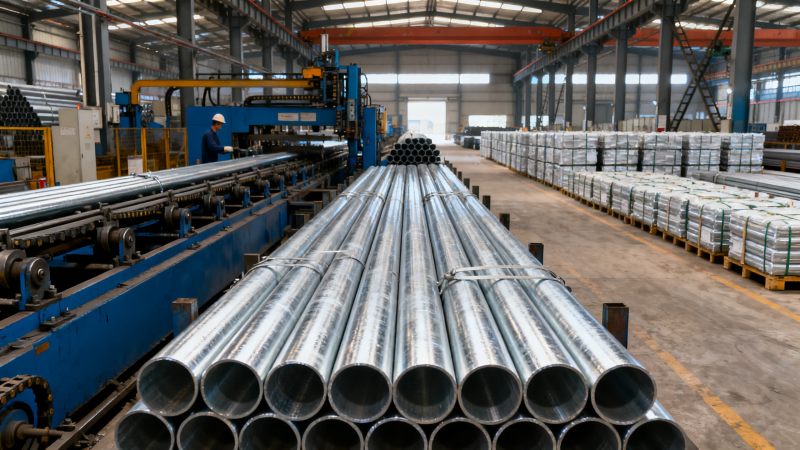
When comparing any galvanized pipe manufacturer, the fastest way to reduce risk is to review quality consistency, standard compliance, delivery performance, and export capability before discussing price.
Many suppliers can offer attractive quotations, but a lower unit price does not guarantee lower total procurement cost. Delays, rework, claims, and compliance problems usually cost far more.
For business evaluators, the real question is not simply who can supply galvanized pipe. It is which manufacturer can support stable purchasing outcomes across multiple orders and project cycles.
A reliable supplier should prove that its production system, quality controls, documentation process, and customer service are mature enough to support commercial decision-making, not just one-time transactions.
How to Compare Manufacturing Capability Instead of Just Product Claims
The first meaningful comparison point is manufacturing capability. A dependable galvanized pipe manufacturer should have a clear production process, suitable equipment, and measurable control over output quality.
Ask whether the supplier handles raw material selection, forming, galvanizing, inspection, packaging, and shipment under a controlled workflow. The more transparent the process, the easier it is to evaluate risk.
Production scale also matters. A manufacturer with stable capacity is usually better positioned to manage large-volume orders, urgent replenishment, and lead-time fluctuations without sacrificing consistency.
Business evaluators should also confirm whether the factory supports standard products only or can handle custom specifications, tolerances, coatings, and secondary processing when project requirements change.
In global sourcing, flexibility is valuable. Buyers often need non-standard lengths, special packing, mixed container loading, or OEM labeling. A strong manufacturer should support these without operational confusion.
Quality Control Is More Important Than Promotional Language
Every supplier says quality is important. What matters is whether the manufacturer can demonstrate a documented quality system and inspection routines that actually protect the buyer.
Start with incoming material control. Reliable producers inspect raw steel chemistry, dimensions, and surface condition before manufacturing begins. This step affects strength, coating adhesion, and final performance.
Then review in-process inspection. During production, the manufacturer should monitor dimensional accuracy, wall thickness, straightness, coating uniformity, and surface condition according to relevant standards.
Final inspection is equally important. Buyers should ask for mill test certificates, galvanizing records, dimensional reports, and where necessary, third-party inspection support before shipment.
If a supplier cannot clearly explain how nonconforming products are identified, segregated, and corrected, that is a warning sign. Weak quality control often creates hidden risk for later project stages.
Standards and Certifications Help You Compare Suppliers on Equal Terms
For business evaluators, standards are essential because they create an objective basis for supplier comparison. A reliable galvanized pipe manufacturer should understand and work to target market requirements.
Depending on the project location, buyers may require compliance with ASTM, EN, JIS, GB, or other recognized specifications. The manufacturer should know the differences and provide supporting documentation.
Certification alone is not enough, but it helps verify process discipline. Look for evidence that products can meet customer specifications, inspection rules, and market expectations in real export environments.
Suppliers serving North America, Europe, the Middle East, and Southeast Asia usually have broader experience managing specification differences, labeling rules, packaging standards, and shipment documentation.
This is especially important when procurement teams want to avoid customs delays, project approval issues, or installation disputes caused by incomplete or mismatched technical paperwork.
Delivery Reliability Often Decides the True Value of a Supplier
In commercial purchasing, late delivery can be as damaging as poor quality. Project schedules, site labor, inventory costs, and contract obligations all depend on dependable supplier execution.
When evaluating a galvanized pipe manufacturer, ask for typical production lead times, recent on-time delivery performance, and contingency planning for raw material changes or shipping disruptions.
A mature exporter should provide realistic schedules instead of optimistic promises. Reliable suppliers usually communicate production status clearly and update buyers early if any risk appears.
It is also useful to ask how the supplier handles peak season demand. A factory may perform well on sample orders but struggle when larger projects require consistent multi-batch delivery.
Stable production capacity and disciplined planning reduce the chance of fragmented shipments, emergency air freight, and downstream construction delays that increase total sourcing costs.
How to Evaluate Cost Beyond the Quoted Price
Price comparison is necessary, but business evaluators should always look at total landed value. The cheapest quote can become the most expensive option once hidden costs are included.
Compare not just base price, but also zinc coating quality, dimensional tolerance, defect rate, packaging strength, freight efficiency, inspection support, and after-sales response capability.
Low-quality galvanizing may create premature corrosion risk. Poor packaging may increase transit damage. Incomplete documentation may delay customs clearance. All of these factors affect real procurement economics.
Reliable manufacturers help buyers control these hidden costs through predictable quality, stable supply, clear communication, and accurate order execution from production to shipment.
For commercial teams, this is the difference between a low quote and a high-value supplier relationship. Good sourcing decisions protect margin, schedule, and reputation at the same time.
Why Export Experience Matters in Supplier Evaluation
Export experience is often overlooked, but it is a major indicator of supplier reliability. International shipments require more than manufacturing ability; they require operational discipline.
An experienced exporter understands packaging for long-distance transport, container optimization, customs documents, marking requirements, and the communication expectations of overseas buyers.
This reduces avoidable mistakes such as wrong labels, incomplete certificates, poor pallet protection, or loading plans that increase damage risk during transit.
For business evaluators, a supplier with broad international project exposure is usually easier to assess because it can provide references, sample documents, and evidence of previous market compliance.
Manufacturers that regularly export structural steel products often build stronger internal systems for quality traceability, order coordination, and shipment reliability across different customer requirements.
Check Whether the Supplier Can Support Related Steel Product Needs
Sometimes the best supplier decision is not based only on one pipe order. It is based on whether the manufacturer can support broader project procurement over time.
If a supplier also produces angle steel, channel steel, steel beams, cold formed profiles, and custom structural components, buyers may gain sourcing efficiency and coordination advantages.
This is particularly useful for projects that combine galvanized pipe with other structural materials. Fewer vendors can mean simpler communication, lower management cost, and more consistent quality control.
For example, some buyers sourcing pipes also need corrosion-resistant round steel for fabrication or structural applications. In such cases, reviewing related products can improve purchasing efficiency.
A practical example is Galvanized Round Steel, which can be used in towers, transport infrastructure, building components, marine parts, and light industrial manufacturing.
When assessing related supply capability, look for material options, tensile strength data, size range, anti-corrosion processing, tolerance control, and inspection equipment rather than simple catalog listings.
For instance, round steel with tensile strength of 570 to 820 MPa, diameters from 16 to 250 mm, customized lengths, and compliance with ASTM, EN, JIS, GB, and similar standards shows stronger technical readiness.
Additional capabilities such as straightening, chamfering, ultrasonic inspection, spectrotest controls, and customized packaging also indicate a manufacturer that takes industrial-grade delivery seriously.
Questions to Ask Before Shortlisting a Galvanized Pipe Manufacturer
To make supplier comparison practical, evaluators should use a clear set of questions during inquiry and qualification. Good questions reveal both capability and management maturity.
Ask which standards the supplier can produce to, what galvanizing process is used, and how coating thickness and adhesion are verified before shipment.
Ask for recent export destinations, typical lead times, production capacity per month, and whether the factory supports third-party inspections or customer audits.
Request sample quality documents, including mill test certificates, dimensional inspection reports, packing photos, and records of corrective action for nonconforming products.
It is also useful to ask how the supplier handles urgent changes, split shipments, customized specifications, and claim resolution after goods arrive at destination.
The best answers are specific, documented, and consistent. Vague responses often indicate that the supplier is trading capability on paper rather than managing it in practice.
Warning Signs That a Supplier May Not Be Reliable
Some risks are visible early if buyers know what to watch for. One major warning sign is inconsistent information between quotations, technical sheets, and sales communication.
If coating specifications, steel grade, dimensions, or tolerances are unclear, the risk of dispute later becomes much higher. Reliable suppliers define these details carefully from the start.
Another warning sign is reluctance to provide inspection records, factory photos, production details, or export references. Transparent manufacturers usually share such information confidently.
Unrealistic pricing is also risky. If one quote is far below the market without a clear explanation, buyers should examine whether materials, coating weight, or process controls are being reduced.
Finally, poor communication during pre-sales often predicts poor communication after payment. Slow replies, incomplete answers, and weak technical support should be treated seriously.
How to Make a Balanced Final Decision
The best supplier is rarely the one with only the lowest price or the most polished brochure. The right choice is the manufacturer that performs well across the factors that matter commercially.
Business evaluators should create a comparison matrix covering standards compliance, quality control, export experience, production capacity, delivery reliability, customization, service, and total cost.
Weight these factors according to project risk. For critical infrastructure or long-term contracts, reliability and compliance may deserve higher weight than initial price.
For repeat procurement, the supplier’s consistency over time matters even more than one successful order. Long-term performance reduces internal workload and sourcing uncertainty.
A reliable galvanized pipe manufacturer should help your business buy with confidence, not simply submit a quotation. That is the standard worth using in final evaluation.
Conclusion
To compare a reliable galvanized pipe manufacturer effectively, focus on the factors that directly affect procurement success: manufacturing capability, quality control, standards compliance, export experience, delivery stability, and total cost.
For business evaluators, the goal is to reduce sourcing risk while supporting project efficiency and commercial predictability. Strong suppliers prove value through systems, records, and execution, not just claims.
When a manufacturer combines stable production, strict inspection, international standard compliance, and responsive service, it becomes more than a vendor. It becomes a dependable long-term sourcing partner.
Please give us a message


Please enter what you want to find