When evaluating China Steel Suppliers, price should never be the only benchmark. For procurement professionals, factors like quality consistency, certification compliance, production capacity, customization ability, and delivery reliability directly affect project costs and long-term supply security. Understanding how to compare suppliers beyond quotations helps reduce sourcing risks and choose a partner that supports stable, efficient procurement.
What should procurement teams compare besides price?
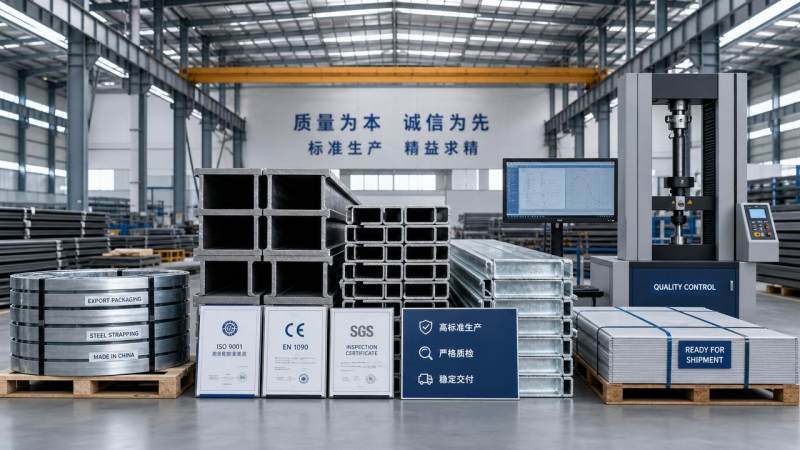
Many buyers start by collecting three or five quotations from China Steel Suppliers, then sorting offers from low to high. This is fast, but it often hides the real cost drivers. A low unit price can later turn into losses through inconsistent dimensions, coating problems, late shipment, or weak export coordination.
In steel sourcing, procurement decisions affect structural safety, fabrication efficiency, inventory planning, and project schedule. For construction, industrial manufacturing, and infrastructure projects, supplier comparison should therefore focus on total procurement performance rather than price alone.
- Product quality consistency across batches, not just the quality of one sample or one trial order.
- Compliance with required standards such as ASTM, EN, JIS, or GB based on destination market and project specification.
- Production capacity and lead-time stability, especially for staged deliveries and long-term contracts.
- Engineering support for customized structural steel components, OEM needs, and drawing-based production.
- Export responsiveness, packaging control, documentation accuracy, and after-sales communication.
A strong supplier does not simply sell steel. It helps procurement teams reduce uncertainty. That is why experienced buyers compare technical capability, process discipline, and service execution before they compare discount levels.
How to build a practical supplier evaluation framework
A structured comparison model makes it easier to evaluate China Steel Suppliers on measurable criteria. Instead of discussing “better” or “worse” in general terms, buyers can assign weight to the factors that matter most for the project.
The table below can be used as a first-round screening tool for structural steel sourcing, especially when comparing suppliers for angle steel, channel steel, steel beams, cold formed steel profiles, or custom-fabricated components.
This framework helps procurement teams move from price comparison to risk-based evaluation. It also makes supplier discussions more objective when internal teams from engineering, QA, and logistics need to align on a final sourcing decision.
Why weighting matters
Not every buyer values the same factor. A stockist may focus on turnover speed and packaging. An EPC contractor may prioritize certification records and phased delivery. A manufacturer may care more about tolerance control and repeatability. The right supplier is the one that fits your operating model, not the one with the cheapest headline quote.
How to judge quality consistency from China Steel Suppliers
Quality consistency is one of the biggest hidden differentiators among China Steel Suppliers. Two suppliers may both claim to meet a grade requirement, but the real difference appears in dimensional tolerance, straightness, surface condition, coating uniformity, and batch-to-batch repeatability.
For procurement professionals, the question is not only whether the steel passes inspection once. The question is whether the supplier can keep passing the same requirements across repeated shipments and varied order sizes.
Documents and checks worth requesting
- Material test reports tied to heat numbers or batch identification.
- Inspection records for dimensions, weight, coating, and mechanical properties where applicable.
- Photos or videos of production, loading, and packaging for export orders.
- Sample approval process for customized or non-standard steel components.
For example, if your procurement scope includes galvanized wire for packaging, wire mesh, or barrier applications, coating quality and ductility should be reviewed carefully. A product such as Hot Dipped Galvanized Steel Wire may be judged by wire diameter range, zinc coating thickness, tensile strength, surface appearance, and forming performance after bending or stamping.
This matters because a bright surface alone does not confirm reliable corrosion resistance. Buyers should compare whether the supplier can provide stable production within practical ranges such as 0.25 mm to 5.0 mm wire diameter, 8 to 25 g/m2 zinc coating, and 350 to 550 Mpa tensile strength when the application requires it.
Which standards and compliance details should buyers verify?
Procurement teams often face an internal challenge: the quotation looks acceptable, but engineering or the client later asks whether the material complies with ASTM, EN, JIS, or local project requirements. At that point, a low price is no longer useful if documentation cannot support approval.
When comparing China Steel Suppliers, check whether the supplier understands destination-market standards and whether it can align production and paperwork with the requested specification. This is particularly important for global buyers serving North America, Europe, the Middle East, and Southeast Asia, where standard references vary.
The table below summarizes practical compliance checkpoints that buyers can use before placing structural steel orders.
A supplier with solid compliance discipline reduces approval friction. This is especially valuable when you are managing multiple SKUs, mixed standards, or shipment plans that must match installation milestones.
Why production capacity and customization ability matter
In the steel industry, capacity is not just about the size of a factory. Buyers should ask whether the supplier can schedule production in line with actual order complexity. Standard angle steel and channel steel may be straightforward, but custom cut lengths, punched sections, welded assemblies, and cold formed profiles require a more controlled production process.
Hongteng Fengda focuses on structural steel manufacturing and export from China, supplying angle steel, channel steel, steel beams, cold formed steel profiles, and customized structural steel components. For procurement teams, this combination matters because it supports both standard specification orders and OEM-oriented sourcing strategies.
Questions that reveal real capability
- Can the supplier handle repeat orders with the same dimensional and mechanical requirements?
- Can it support drawing-based production for customized structural steel parts?
- Can it separate urgent orders from regular orders without damaging delivery discipline?
- Can it provide practical packaging solutions for long-distance sea freight?
A procurement team that ignores these questions may win a cheaper quote but lose time in engineering clarification, factory rescheduling, or container consolidation. In contrast, a supplier with modern manufacturing facilities and disciplined quality control can help buyers maintain project rhythm and reduce sourcing friction.
How to compare total landed value, not just ex-works price
For international procurement, the real comparison point is landed value. This includes base steel price, processing cost, packaging, inland transport, port handling, freight coordination, inspection cost, and the cost of failure. A supplier that looks more expensive at first may lower overall spend by reducing waste, shortage risk, and claim frequency.
This logic also applies to complementary steel products. If a buyer needs corrosion-resistant wire for construction, wire mesh, packaging, breeding, or barrier isolation, a low-cost option with unstable coating may fail in storage or end use. By contrast, Hot Dipped Galvanized Steel Wire is often selected when strong flexibility, good corrosion resistance, and excellent ductility are important to downstream use.
Procurement teams should look at packaging form as well. Coil supply from 50 to 1,000 kg with plastic film inside and woven bag outside, or bobbin packaging, can affect unloading efficiency, handling loss, and warehouse organization.
Signs a low quote may become expensive later
- Incomplete technical confirmation before production starts.
- Unclear tolerance control for fabricated or cold formed sections.
- Weak export packaging for long transit routes.
- Slow communication when nonconformity or document revision appears.
Common mistakes buyers make when screening China Steel Suppliers
Even experienced procurement teams can fall into predictable traps when the sourcing cycle is tight. Most of these mistakes happen when technical review, commercial review, and logistics review are handled separately without a unified supplier assessment.
Mistake 1: Treating samples as proof of mass consistency
A good sample only proves that a supplier can make one good piece or one good batch. It does not confirm stable process control. Ask how the supplier manages repeated production, inspection checkpoints, and traceability across shipments.
Mistake 2: Ignoring delivery coordination
Some China Steel Suppliers offer acceptable production lead time but weak shipment planning. If packing lists, marks, and loading sequence are not aligned with site needs, receiving efficiency drops and installation can be delayed.
Mistake 3: Comparing prices without specification alignment
Two offers cannot be compared fairly if one includes tighter tolerance, better packaging, or additional processing. Procurement should normalize technical and commercial terms before ranking quotes.
FAQ for procurement teams comparing China Steel Suppliers
How can I quickly shortlist reliable suppliers?
Start with four checks: product range fit, standards familiarity, manufacturing scope, and export responsiveness. If a supplier can clearly discuss material grades, tolerances, documentation, packaging, and delivery planning, it is usually a stronger candidate than one that only pushes price.
What is more important for structural steel procurement: capacity or service?
Both matter, but they matter in different phases. Capacity protects supply continuity. Service protects execution accuracy. A supplier with strong capacity but weak communication can still create delays. A balanced partner should support production, technical clarification, and export coordination together.
How do I reduce risk on custom steel orders?
Lock drawings, tolerances, surface requirements, marking rules, and packaging method before production. For custom components, sample confirmation or pre-shipment inspection can help avoid downstream fabrication problems.
When should I pay more instead of choosing the cheapest quote?
Pay more when the supplier offers stronger consistency, clearer documentation, better packaging, or more dependable lead time. In project procurement, these factors usually save more than the initial price gap, especially when replacement and delay costs are high.
Why work with a structural steel manufacturer and exporter from China?
For buyers who want more than a trading quotation, partnering with a manufacturer-exporter creates better visibility into production, quality control, and delivery planning. Hongteng Fengda serves global construction, industrial, and manufacturing projects with structural steel products and customized solutions designed to reduce sourcing risk.
Its supply scope covers standard structural steel and OEM-oriented components, backed by modern manufacturing facilities and quality control aligned with common international standards such as ASTM, EN, JIS, and GB. For procurement teams, this means one supplier can support multiple sourcing needs without sacrificing technical communication.
Why choose us
- We support comparison based on specifications, application, and delivery needs rather than pushing a one-size-fits-all quote.
- We help buyers confirm product parameters, standard references, and customization details before order release.
- We provide practical support for lead-time review, export packing, sample arrangements, and drawing-based inquiries.
- We work with customers across North America, Europe, the Middle East, and Southeast Asia, where stable quality and dependable delivery are essential.
If you are comparing China Steel Suppliers for structural steel, galvanized wire, or customized steel components, contact us to discuss parameter confirmation, product selection, delivery schedule, packaging method, certification expectations, sample support, and quotation details for your specific project.
Please give us a message


Please enter what you want to find