Choosing the right a106 gr b seamless pipe supplier in USA can directly affect project quality, delivery reliability, and total procurement cost. For buyers, comparing suppliers goes beyond price—it requires checking material standards, production capability, certifications, lead times, and service support. This guide will help you evaluate suppliers more efficiently and make a more confident sourcing decision.
What buyers really need to compare first
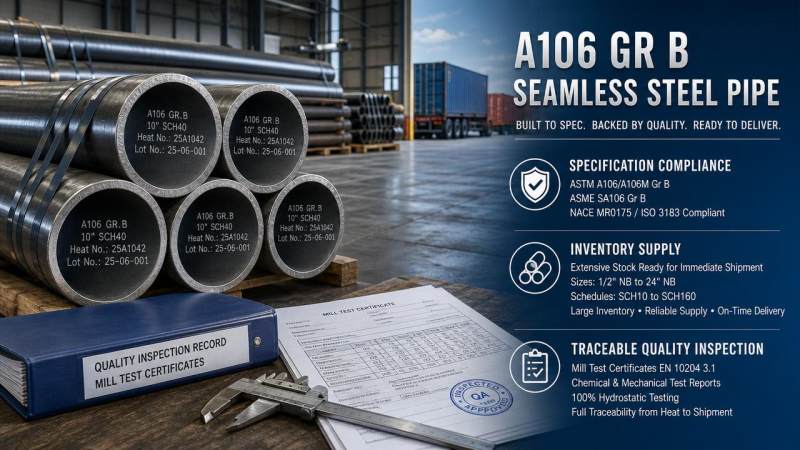
The core search intent behind finding an a106 gr b seamless pipe supplier in USA is practical supplier evaluation. Buyers are usually not looking for a basic definition of ASTM A106 Grade B.
They want to know which supplier can provide compliant material, stable deliveries, fair pricing, and lower procurement risk. In most cases, the real question is not who sells it, but who can supply it safely.
For procurement teams, the biggest concerns are usually mill traceability, stock availability, quality consistency, testing documents, response speed, and whether the supplier can meet project schedules without surprises.
That means a useful comparison method should prioritize risk control. Price matters, but material failure, late delivery, and incomplete documentation usually create much higher total cost than a small unit-price difference.
Start with specification compliance, not just product naming
Many suppliers list A106 Grade B seamless pipe, but the listing itself proves very little. Buyers should first confirm whether the supplier can provide material fully aligned with ASTM requirements for chemistry, mechanical properties, and testing.
Ask for the mill test certificate, heat number traceability, pipe size range, wall thickness range, and production route. A supplier that answers clearly and quickly is usually easier to work with later.
You should also verify whether the offered material is truly seamless and whether it is suitable for the intended temperature and pressure conditions. A vague product sheet is an early warning sign.
If your project also requires compliance with additional standards, such as ASME, API, or customer-specific inspection rules, include that in the comparison at the beginning rather than after quoting.
Check whether the supplier is a stockholder, trader, or direct mill source
Not every supplier in the USA plays the same role in the supply chain. Some are stocking distributors, some are project traders, and some work closely with mills or import channels.
This difference affects price, lead time, flexibility, and problem resolution. A stockholder may deliver quickly for common sizes, while a mill-linked supplier may offer better pricing or customization for larger orders.
For urgent maintenance or shutdown projects, local inventory may matter more than the lowest theoretical price. For long-cycle industrial projects, direct sourcing capability may create better cost control.
Ask each supplier what they physically stock, what they source externally, and what their normal replenishment cycle looks like. This helps you compare real capability instead of sales language.
Evaluate quality systems and documentation discipline
A reliable a106 gr b seamless pipe supplier in USA should be able to show a disciplined quality process. That includes incoming inspection, document control, marking control, and traceability management.
Request examples of mill test certificates, inspection reports, packing lists, and labeling practices. If the supplier cannot organize documents well during the quotation stage, future execution may become difficult.
Certifications such as ISO 9001 are helpful, but they should not be the only factor. What matters more is whether the supplier consistently links paperwork, heat numbers, and shipped material correctly.
For critical applications, ask whether third-party inspection can be arranged before shipment. A supplier that supports independent verification often reduces risk for engineering, QA, and procurement teams alike.
Compare lead times based on actual supply conditions
Lead time comparisons often become misleading because some suppliers quote based on stock while others quote based on future production. Buyers should separate immediate availability from planned availability.
Ask for a clear breakdown: in-stock quantity, warehouse location, estimated dispatch time, and transit time. For mill orders, ask for production slot timing and realistic shipment windows, not optimistic promises.
Delivery reliability is often more important than the shortest quote. A supplier that consistently delivers in three weeks may be more valuable than one promising one week but slipping repeatedly.
It is also wise to ask how they handle partial deliveries, back orders, and urgent changes. These operational details reveal whether the supplier can support real project pressure.
Look beyond base price and calculate total procurement cost
When comparing quotations, buyers should not focus only on price per ton or price per foot. Total procurement cost includes freight, cutting, testing, packaging, documentation, and the cost of delays.
Some suppliers appear competitive at first but add charges later for hydro testing, end finishing, marking, special packing, or certificate handling. Ask for a fully itemized quotation whenever possible.
Also compare payment terms, minimum order quantities, and claim-handling policies. A slightly higher initial price may still be the better commercial choice if the supplier reduces execution risk and hidden costs.
For repeat buyers, the true value often comes from fewer quality claims, fewer expediting hours, and smoother receiving processes. Those savings rarely appear in a simple unit-price comparison.
Assess service responsiveness before placing the order
Supplier service quality can often be judged before any purchase happens. Watch how quickly they respond, how technically accurate their answers are, and whether they ask useful project questions.
Strong suppliers do not just send a price list. They confirm sizes, schedules, standards, end use, quantity splits, delivery deadlines, and testing needs to reduce the chance of specification mistakes.
This matters especially when procurement teams manage several material categories at once. A responsive supplier reduces internal follow-up work and helps avoid purchasing errors that later affect construction schedules.
As an example, buyers working across broader steel packages may also need corrosion-resistant components for infrastructure or industrial fabrication. In those cases, products like Galvanized Round Steel can support applications such as power towers, highway protection, street light poles, marine components, and steel structure accessories.
Such materials are commonly supplied with galvanized surfaces, customizable diameters from 16 to 250 mm, and standards including ASTM, EN, JIS, and GB. For buyers, this highlights an important comparison principle.
A capable supplier or sourcing partner should not only quote one item, but also understand adjacent steel product requirements, tolerances, anti-corrosion needs, and documentation expectations across the full package.
Review technical capability for processing and customization
Some projects need more than plain-length pipe. If you require cutting, beveling, threading, bundling by area, special marking, or project-specific packaging, compare these services in advance.
Suppliers with processing capability can save time at the jobsite and reduce handling costs. However, value-added processing only helps if dimensional control and identification remain accurate after processing.
Ask whether the supplier has standard procedures for special requests and whether they inspect processed material before shipment. A good answer shows operational maturity, not just commercial flexibility.
This point is especially important for EPC contractors and industrial buyers managing multiple installation sequences. Proper pre-processing can improve site efficiency, but errors can also create expensive delays.
Check past project experience and market reputation
Experience in similar industries often matters more than broad marketing claims. A supplier serving power, oil and gas, mechanical contracting, or industrial maintenance may better understand documentation and urgency.
Ask for references, case examples, or customer sectors served. You do not always need confidential project names, but you should understand whether they regularly support requirements similar to yours.
Online reviews alone are not enough, yet they can still reveal patterns. Repeated comments about poor communication, wrong material, or delayed deliveries should be taken seriously during supplier screening.
You can also evaluate reputation through consistency. Suppliers that maintain organized catalogs, technical data, and clear sales communication usually perform better than those relying on vague descriptions and inconsistent follow-up.
Build a practical comparison scorecard for decision-making
To compare suppliers fairly, use a simple scorecard instead of relying on memory or the lowest quote. This makes internal approvals easier and improves procurement discipline.
Typical scoring categories include specification compliance, documentation quality, stock depth, lead time reliability, commercial terms, service responsiveness, processing capability, and claim resolution support.
Weight each category according to project risk. For a shutdown project, delivery speed may carry the highest weight. For a high-spec industrial package, traceability and testing may matter more.
Using a scorecard also helps justify decisions to engineering, finance, and management teams. It turns supplier selection into a structured commercial decision rather than a price-only discussion.
Common mistakes buyers should avoid
One common mistake is approving a supplier based only on a low quote without checking whether the material is actually available. Another is assuming all ASTM-labeled pipe has the same documentation quality.
Buyers also often underestimate the importance of communication speed. Delays in quotation updates, document submission, or discrepancy handling usually become bigger problems after the purchase order is issued.
Another avoidable issue is failing to confirm shipment details early. Packaging, marking, bundle size, and receiving requirements should be aligned before dispatch, especially for multi-site projects.
Finally, do not compare suppliers using different assumptions. If one quote includes testing and freight while another does not, the comparison is not meaningful until those variables are normalized.
Final thoughts on choosing the right supplier
The best a106 gr b seamless pipe supplier in USA is not simply the cheapest or the closest. It is the supplier that can deliver compliant material, complete documents, dependable lead times, and responsive support.
For procurement professionals, the most effective approach is to compare suppliers across five practical areas: specification compliance, supply capability, quality control, total cost, and service reliability.
When these factors are reviewed together, sourcing decisions become clearer and procurement risk drops significantly. That is the real goal behind supplier comparison in industrial steel purchasing.
If you use a structured checklist and verify claims early, you will be in a much stronger position to choose a supplier that supports project success rather than creating hidden downstream problems.
Please give us a message


Please enter what you want to find