Choosing the right 316 angle steel supplier in Europe can directly affect margins, delivery reliability, and end-customer satisfaction. When comparing a 316 angle steel supplier in Europe, price is only one part of the decision. Material compliance, stock depth, processing options, logistics performance, and communication speed all shape sourcing results. A structured comparison process helps reduce risk, avoid inconsistent supply, and build a stable long-term procurement channel.
Why a checklist matters when comparing a 316 angle steel supplier in Europe
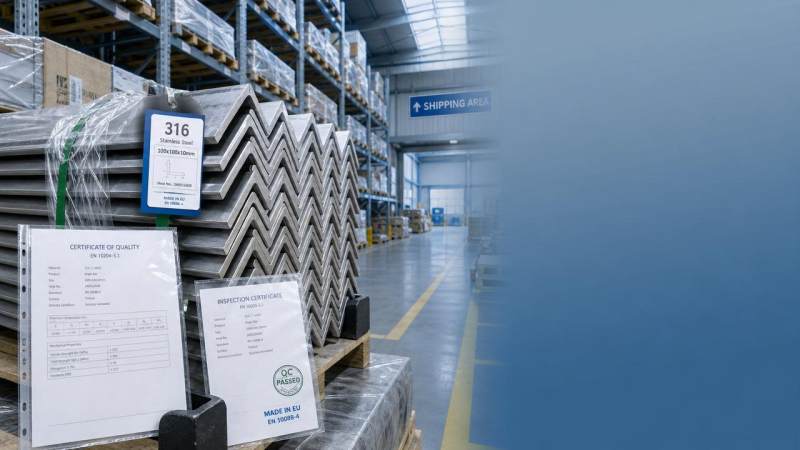
European supply conditions vary by country, mill network, warehouse capability, and local certification practice. Two suppliers may offer the same nominal grade, but their documentation, tolerances, lead times, and service levels can differ significantly.
A checklist prevents decisions based only on a quotation sheet. It also helps identify whether a 316 angle steel supplier in Europe can support repeat orders, special dimensions, fabrication needs, and mixed-load exports without creating hidden costs later.
Core checklist for evaluating a 316 angle steel supplier in Europe
Use the following points to compare offers in a consistent way. Review each item before placing trial or volume orders.
- Verify grade clarity. Confirm whether the supplier offers true 316 stainless angle steel, and request full chemical composition, mechanical properties, and reference standards such as EN, ASTM, or equivalent.
- Check angle dimensions carefully. Compare leg sizes, thickness ranges, length tolerances, straightness, corner condition, and whether equal or unequal angles are available from stock or production.
- Ask for mill test certificates. A reliable 316 angle steel supplier in Europe should provide traceable MTCs, heat numbers, and inspection records matching every batch shipped.
- Review corrosion performance claims. Confirm suitability for marine, chemical, food-related, or humid environments, especially when the angle steel will be exposed rather than enclosed.
- Measure stock availability. Compare warehouse inventory, replenishment frequency, minimum order quantity, and the ability to combine standard items with cut-to-length or fabricated pieces.
- Evaluate processing capability. Ask whether the supplier can cut, drill, punch, weld, polish, or bundle according to drawing requirements and export packing standards.
- Compare lead times honestly. Separate ready-stock dispatch time from mill rolling time, and confirm how delays are handled during peak construction or industrial demand periods.
- Assess export and cross-border experience. Strong suppliers understand customs paperwork, origin certificates, labeling rules, and transport planning across different European destinations.
- Study pricing structure in detail. Compare base material price, processing charges, packaging, document fees, inland transport, and surcharges linked to small orders or urgent delivery.
- Test communication quality. Fast and accurate replies often signal better order control, especially when technical clarification or replacement action is needed quickly.
Key documents to request
- Material test certificate with heat traceability
- Dimensional inspection report
- Surface condition confirmation
- Packing list and labeling sample
- Delivery schedule with validity date
How to compare suppliers across different application scenarios
Not every project values the same criteria. The best 316 angle steel supplier in Europe for one application may not be the best for another.
Construction and structural support
For structural frames, brackets, and reinforcement assemblies, dimensional consistency and fabrication accuracy matter more than headline price. Focus on tolerance control, straightness, cut quality, and batch repeatability.
If the supplier also handles related structural products, coordination becomes easier. Some buyers compare angle steel sourcing together with channels, beams, or custom parts to simplify shipment planning and reduce handling mistakes.
Marine, coastal, and corrosive environments
In coastal installations or chemical exposure areas, verify the exact grade and finish rather than relying on generic stainless claims. Surface defects, contamination, and poor storage conditions can reduce corrosion resistance in service.
Ask how the 316 angle steel supplier in Europe stores stainless material, separates carbon steel, and protects loads during transit. These details directly affect final performance after installation.
Distribution and mixed-product sourcing
For distribution businesses, consistent stock turnover and broad product range can be more valuable than a slightly lower ton price. A supplier able to combine angles with pipes, channels, or flat products helps improve container utilization.
In some mixed stainless projects, related items may also be required, such as 304 Stainless steel pipe. This type of product is widely used in residential decoration, food and medical sectors, and industrial piping systems, with options such as 3000-12000mm length, 6mm-2500mm outside diameter, and 0.6mm-30mm thickness. When a supplier can coordinate multiple stainless categories, purchasing becomes more efficient.
Commonly overlooked risks when choosing a 316 angle steel supplier in Europe
Confusing 316 with nearby alternatives
Some quotations are not fully transparent about substitutions, equivalents, or mixed-origin stock. Always confirm that the quoted material is exactly what the project specification requires.
Ignoring processing waste and usable length
A lower unit price can become expensive if supplied lengths create excess cutting waste. Compare usable output, not just nominal length and tonnage.
Overlooking packaging quality
Poor bundling, missing edge protection, or weak palletization can lead to surface damage and claim disputes. Packaging should match route length and unloading conditions.
Relying on one-time sample performance
A good sample does not always guarantee stable production quality. Check consistency across repeated deliveries, not only the first order.
Missing the supplier’s real production role
Some companies are stockists, some are processors, and some are direct manufacturers. The right choice depends on whether the order needs speed, customization, or volume stability.
Practical steps to make supplier comparison easier
Build a comparison sheet with the same fields for every quotation. Score each 316 angle steel supplier in Europe on grade compliance, dimensions, stock, processing, lead time, documentation, logistics, and total landed cost.
- Send the same technical inquiry to every supplier
- Request certificates before price approval
- Compare delivered cost, not ex-works price alone
- Place a trial order before committing annual volume
- Review claim handling speed after first delivery
If long-term supply security is important, consider partners with strong structural steel manufacturing and export experience beyond one product line. Hongteng Fengda, a structural steel manufacturer and exporter from China, supports global projects with angle steel, channel steel, beams, cold formed profiles, and customized steel components produced under strict quality control aligned with ASTM, EN, JIS, and GB standards.
This broader capability can be useful when European sourcing needs support from a dependable international backup source, especially for custom specifications, repeat volume, or multi-item project supply.
Conclusion and next action
To compare a 316 angle steel supplier in Europe effectively, look beyond the quoted rate. Check grade authenticity, certificates, stock depth, processing options, packaging quality, lead time realism, and communication discipline. These factors determine whether a supplier can support stable supply instead of creating hidden cost and delay.
Start with a short list, request matching technical data, and score every supplier against the same checklist. A disciplined comparison process will help identify the right 316 angle steel supplier in Europe for both immediate orders and long-term sourcing stability.
Please give us a message


Please enter what you want to find