Selecting the right API 5L steel pipe grade for sour service is critical to safety, compliance, and long-term performance in oil & gas, petrochemical, and offshore applications. With hydrogen sulfide (H₂S) exposure, standard grades like ASTM A106 Gr B or mild steel plate are insufficient—only properly specified, corrosion-resistant pipe with stringent HIC/SWC resistance qualifies. At Hongteng Fengda, a trusted structural steel manufacturer and exporter from China, we supply API 5L seamless/welded pipes (e.g., X52, X60, X65, X70 PSL2 with TMCP + heat treatment), hot galvanizing options, and certified carbon sheet steel—all compliant with NACE MR0175/ISO 15156. Whether you’re a technical evaluator, procurement specialist, or project manager, this guide helps you match material specs to sour service requirements—reducing risk, cost, and downtime.
Understanding Sour Service and Its Material Demands
Sour service refers to environments where steel piping systems are exposed to wet hydrogen sulfide (H₂S) under pressure—common in upstream oil & gas production, acid gas injection, and refinery desulfurization units. In such conditions, standard carbon steels suffer from hydrogen-induced cracking (HIC), sulfide stress cracking (SSC), and stepwise cracking (SWC). These failures can occur without visible deformation and often lead to catastrophic leaks or ruptures within 72 hours of exposure if material specifications are misapplied.
The severity of sour service is classified by partial pressure of H₂S (measured in kPa or psi), pH level, chloride content, temperature range (typically 0–150°C), and total tensile stress. According to ISO 15156-2, environments exceeding 0.05 kPa H₂S partial pressure require materials qualified for SSC resistance—making selection far more rigorous than general corrosion resistance.
Unlike non-sour applications, sour service demands full traceability of chemical composition, strict control of hardness (≤22 HRC per NACE MR0175), and mandatory post-weld heat treatment (PWHT) for welded joints. Microstructural uniformity—especially avoidance of banded ferrite-pearlite structures—is equally critical to prevent preferential crack propagation.
Key API 5L Grades Qualified for Sour Service
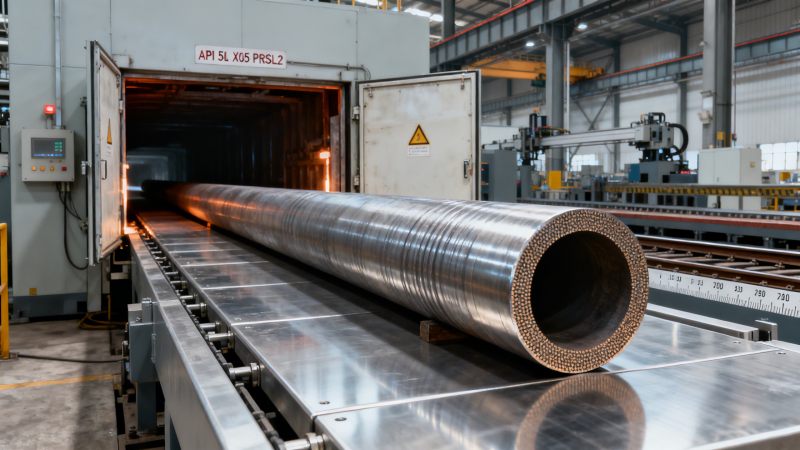
Not all API 5L grades meet sour service requirements—even high-strength variants like X80 may fail qualification if not produced under PSL2 with specific metallurgical controls. Only PSL2 pipes manufactured using thermomechanical controlled processing (TMCP) followed by quenching & tempering (Q&T) or normalizing achieve consistent SSC resistance. Common qualified grades include X52, X60, X65, and X70—but their suitability depends on final heat treatment, hardness verification, and HIC testing per NACE TM0284.
For example, X65 PSL2 supplied by Hongteng Fengda undergoes double-normalizing + tempering, achieving yield strength of 450–530 MPa while maintaining hardness ≤200 HV10 across both base metal and weld zones. This ensures compliance with ISO 15156 Annex A tables for service up to 100°C and 1.0 MPa H₂S partial pressure.
This table highlights how qualification goes beyond nominal grade designation—it hinges on process control, hardness limits, and certification rigor. For instance, our X65 PSL2 pipes are routinely tested at three locations per joint (weld center, HAZ, base metal), with each reading required to stay below 190 HV10. Such precision enables safe deployment in Class III sour environments defined by ISO 15156.
Critical Selection Criteria Beyond Grade Name
Choosing the correct pipe involves evaluating six interdependent parameters: H₂S partial pressure, operating temperature, chloride concentration, pH value, mechanical stress state (including residual welding stresses), and service lifetime expectation (typically 20–30 years). A mismatch in any one parameter invalidates the entire specification.
For example, even an X70 PSL2 pipe fails if delivered with hardness spikes above 205 HV10 near the weld fusion line—a common issue when PWHT is omitted or improperly timed. Likewise, pipes intended for subsea flowlines must pass additional hydrostatic testing at 1.5× design pressure and demonstrate zero leakage after 100-hour exposure to simulated sour brine per ASTM G39.
Hongteng Fengda applies real-time ultrasonic thickness mapping during finishing to detect micro-segregation zones prone to HIC initiation. All sour-service pipes undergo 100% non-destructive examination (NDE): automated ultrasonic testing (AUT) for longitudinal and transverse flaws, plus eddy current inspection for surface-breaking defects.
Integration with Structural Steel Systems
In integrated facilities—such as modular refineries or FPSO topsides—sour-service piping interfaces directly with structural supports, skid frames, and load-bearing platforms. That’s why material compatibility extends beyond pipe alone. Our Structural Steel I Beam series, available in grades Q345, SS355JR, and S235J2, is engineered for seamless integration with API 5L sour-service systems. With flange widths spanning 100–400 mm and web thicknesses from 6–28 mm, these beams support anchoring, bracing, and vibration damping—all while meeting EN 10025-2 and ASTM A6/A6M dimensional tolerances of ±1%.
Hot-rolled on universal four-roller mills, our I-beams deliver uniform grain structure and predictable weldability—critical when attaching pipe hangers or clamping assemblies subject to cyclic thermal loading. Delivery time remains stable at within 20 days, supporting just-in-time installation schedules without compromising sour-service integrity.
Procurement Best Practices and Risk Mitigation
Procurement teams must verify five documentation layers before release: mill test reports (MTRs) showing full chemistry and hardness profiles, NACE-compliant HIC/SSC test reports, third-party inspection certificates (e.g., DNV, TÜV, SGS), traceable heat numbers linked to physical markings, and EN 10204 3.2 compliance statements. Skipping any layer introduces unquantifiable field failure risk.
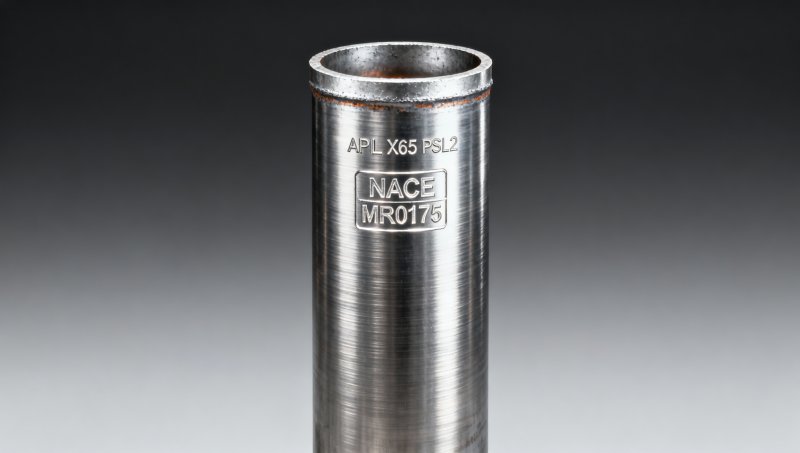
We recommend ordering sour-service pipes with extended marking: laser-etched heat number, grade, size, PSL level, NACE symbol (e.g., “NACE MR0175”), and manufacturing date—visible even after hot-dip galvanizing. Hongteng Fengda provides digital MTR access via secure portal, enabling real-time audit readiness for EPC contractors and end-user QA departments.
For projects requiring rapid turnaround, our dual-track production system allows simultaneous rolling of structural sections and API 5L pipes under shared quality protocols—reducing interface coordination delays by up to 30%. This ensures synchronized delivery of Structural Steel I Beam and sour-service piping for turnkey installations.
Conclusion: Partnering for Sour-Service Integrity
Selecting the right API 5L grade for sour service isn’t about choosing the highest strength—it’s about matching metallurgical control, hardness consistency, and certification depth to your exact process envelope. From X52 for low-pressure gas gathering to X70 for high-pressure acid gas transport, every decision must be grounded in verified test data—not catalog claims.
As a structural steel manufacturer and exporter from China, Hongteng Fengda bridges the gap between piping integrity and structural reliability—supplying both API 5L sour-service pipes and compatible structural components like Structural Steel I Beam under unified quality governance. With facilities certified to ISO 9001, ISO 14001, and OHSAS 18001, we ensure every tonne meets international safety and sustainability benchmarks.
Whether you’re validating material specs for a new FEED package or expediting replacement pipes for an aging facility, contact Hongteng Fengda today for a technical review, customized sour-service qualification report, or OEM co-engineering support.
Please give us a message


Please enter what you want to find